EU parliament leader under fire for praising Mussolini

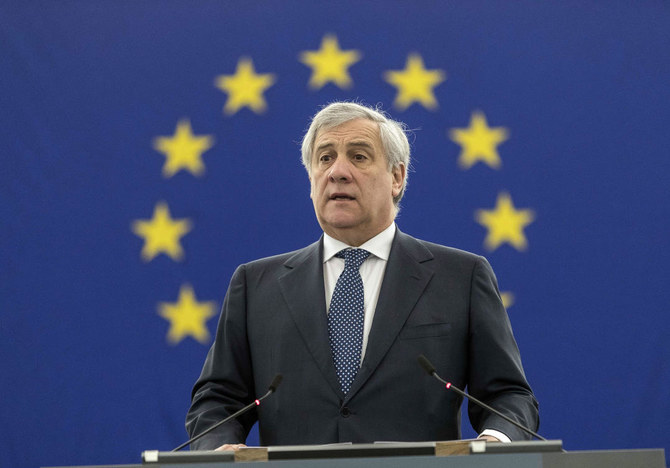
In this Wednesday, Jan.16, 2019 file photo, European Parliament President Antonio Tajani speaks at the European Parliament during a debate on Brexit, in Strasbourg, eastern France. (AP)
Updated 14 March 2019
Follow

EU parliament leader under fire for praising Mussolini

  • Tajani was criticized from across the political spectrum, inside and outside of Italy

MILAN: European Parliament President Antonio Tajani has come under fire for comments praising Italian dictator Benito Mussolini.
Tajani told Radio 24 Wednesday evening that Mussolini did some “positive things,” including improving Italy’s infrastructure, until “he declared war on the entire world, following Hitler, until he promoted the racial laws” that restricted the rights of Jews.
Tajani, who is a member of Silvio Berlusconi’s Forza Italia party, was criticized from across the political spectrum, inside and outside of Italy.
Italy has struggled to come to terms with its fascist past and the rise of populism has brought reminders of Mussolini’s two-decades in power until his execution in 1945.


Junta leader Gen. Mamdi Doumbouya is declared winner of Guinea’s election, provisional results show

Updated 31 December 2025
Follow

Junta leader Gen. Mamdi Doumbouya is declared winner of Guinea’s election, provisional results show

  • Mamady Doumbouya took power in 2021 coup

CONAKRY, Guinea: Guinea coup leader ​Mamady Doumbouya has been elected president, according to provisional results announced on Tuesday, completing the return to civilian rule in the bauxite- and iron ore-rich West African nation.
The former special forces commander, thought to be in his early 40s, seized power in 2021, toppling then-President Alpha Conde, who had been in office since 2010. It was one in a series of nine coups that have reshaped politics in West and Central Africa since 2020.
The provisional results announced ‌on Tuesday showed Doumbouya ‌winning 86.72 percent of the December 28 vote, ‌an ⁠absolute majority ​that allows ‌him to avoid a runoff.
The Supreme Court has eight days to validate the results in the event of any challenge.
Doumbouya’s victory, which gives him a seven-year mandate, was widely expected. Conde and Cellou Dalein Diallo, Guinea’s longtime opposition leader, are in exile, which left Doumbouya to face a fragmented field of eight challengers.
Doumbouya reversed pledge not to run
The original post-coup charter in Guinea barred junta members from running ⁠in elections, but a constitution dropping those restrictions was passed in a September referendum.
Djenabou Toure, the ‌country’s top election official who announced the results on ‍Tuesday night, said turnout was 80,95 percent. However ‍voter participation appeared tepid in the capital Conakry, and opposition politicians rejected ‍a similarly high turnout figure for the September referendum.
Guinea holds the world’s largest bauxite reserves and the richest untapped iron ore deposit at Simandou, officially launched last month after years of delay.
Doumbouya has claimed credit for pushing the project forward and ensuring Guinea benefits ​from its output.
His government this year also revoked the license of Emirates Global Aluminium’s subsidiary Guinea Alumina Corporation following a refinery dispute, ⁠transferring the unit’s assets to a state-owned firm.
The turn toward resource nationalism — echoed in Mali, Burkina Faso and Niger — has boosted his popularity, as has his relative youth in a country where the median age is about 19.
Political space restricted, UN says
Political debate has been muted under Doumbouya. Civil society groups accuse his government of banning protests, curbing press freedom and restricting opposition activity.
The campaign period was “severely restricted, marked by intimidation of opposition actors, apparently politically motivated enforced disappearances, and constraints on media freedom,” UN rights chief Volker Turk said last week.
On Monday, opposition candidate Faya Lansana Millimono told a press conference the election was marred by “systematic fraudulent practices” and ‌that observers were prevented from monitoring the voting and counting processes.
The government did not respond to a request for comment.