

Film Review: ‘Badla’ sinks in a quagmire of plot imperfections

A still from Bollywood flick ‘Badla.’ YouTube
Updated 13 March 2019
Follow

Film Review: ‘Badla’ sinks in a quagmire of plot imperfections

CHENNAI: After a few flops, Sujoy Ghosh directed two engaging pieces of work — “Kahaani” in 2012 and “Kahaani 2” in 2016. His genre has been thrillers, and he sticks to it in his latest outing in Scotland, set mostly in Glasgow.

Titled “Badla” or “Revenge,” this is a near-faithful adaptation of the 2016-17 Spanish murder-mystery, “Contratiempo,” or “The Invisible Guest,” by Oriol Paulo, now streaming on Netflix.

Badla is a typical whodunnit with a couple of murders and a pretty suspect, Naina Sethi, played by Taapsee Pannu, who pairs with Amitabh Bachchan once again (as they did in “Pink”). 
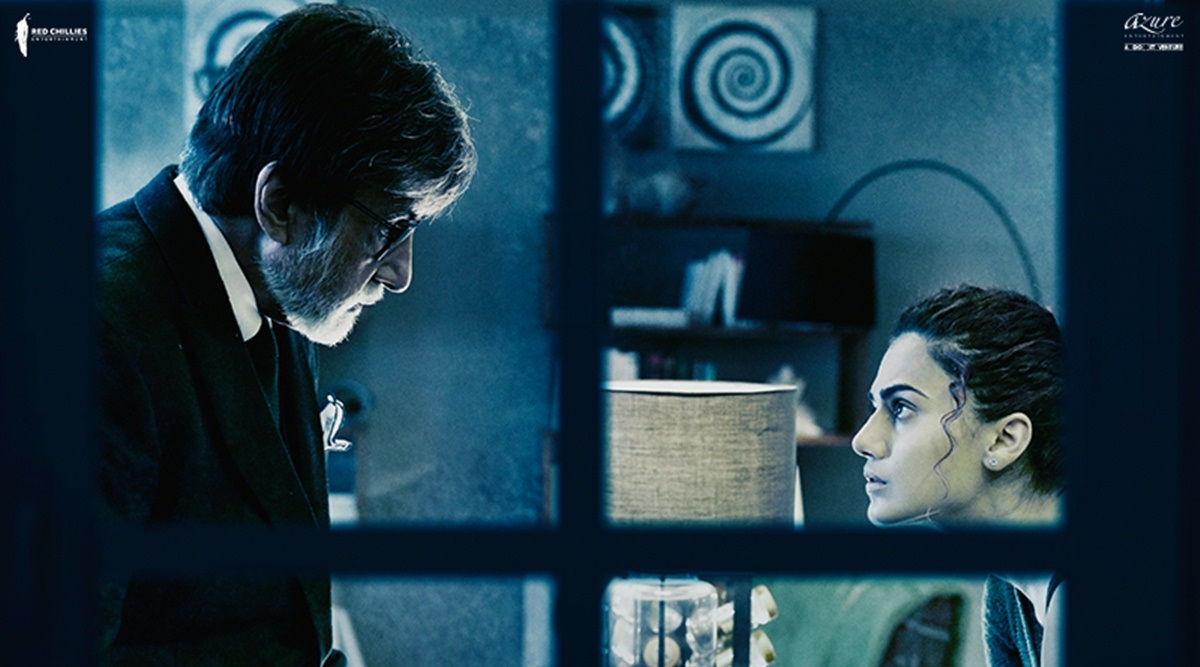
Like in “Pink,” Bachchan is a lawyer in “Badla.” As Badal Gupta, he is tasked with defending Naina, whose  fling outside her happy marriage has gone horribly wrong. She finds herself in a hotel room with her lover, Arjun (Tony Luke), killed. She is arrested for murder, but gets out on bail with the help of her close lawyer friend, Jimmy Punjabi (Manav Kaul). Woven into this sticky situation are two more characters, an elderly couple — Nirmal (Tanveer Ghani) and Rani (Amrita Singh) — whose son goes missing, and there appears to be a link between this disappearance and Arjun’s death.

“Badla” looks ethereal, with cinematographer Avik Mukhopadhyay capturing Scotland in all its splendour — its misty mornings adding to the air of mystery. But unfortunately, these picture-postcard images serve as mere embellishments to a plot and performance that are disappointing. Bachchan brings little novelty to his role. As for Pannu, she fails to get her act together as a crime suspect whose position as a celebrated businesswoman and as a mother as well as a wife is in peril. Not much of an effort appears to have gone into developing these characters.

And the plot itself has far too many holes and convenient coincidences. Of course, Ghosh would say that he merely followed the Spanish original. But what stopped him from reworking the story and the script to give us a believable narrative?

Riyadh to install 25 new public artworks after conclusion of Tuwaiq Sculpture symposium

Updated 09 March 2026
Follow

Riyadh to install 25 new public artworks after conclusion of Tuwaiq Sculpture symposium

  • Move will extend the impact of the annual art event beyond its conclusion, bringing large-scale contemporary artworks into the city’s streets and parks
  • Artworks produced during the symposium will now become part of Riyadh Art’s permanent collection

RIYADH: Some 25 sculptures created during the seventh edition of the Tuwaiq Sculpture symposium and exhibition will soon be installed across public spaces in Riyadh.

The move will extend the impact of the annual art event beyond its conclusion, organizers said, bringing large-scale contemporary artworks into the city’s streets and parks.

Organized by the Royal Commission for Riyadh City through the Riyadh Art Program, the 2026 edition has ended after nearly two months of live sculpting, exhibitions and public programming.

The artworks produced during the symposium will now become part of Riyadh Art’s permanent collection and will appear across the capital as part of a broader effort to integrate art into everyday urban life.

This year’s symposium began in January and took place along Prince Mohammed bin Abdulaziz Road, widely known as Tahlia Street.

The site was transformed into an open-air studio in which visitors could observe artists carving, welding and assembling sculptures.

The live sculpting phase, which was held between Jan. 10 and Feb. 5, brought together leading Saudi and international artists to produce 25 large-scale works.

The sculptures were created using locally sourced granite and reclaimed metal, highlighting both the region’s natural materials and the creative reuse of industrial elements.

Visitors were able to follow the process of each artwork’s development, from raw materials to finished sculptures, while also interacting with the artists and learning about their techniques and concepts.

The event also featured a wide-ranging community engagement program designed to deepen public understanding of contemporary art.

The program included 10 panel discussions, 105 training workshops and 15 masterclasses exploring sculptural techniques, materials and the role of public art in cities.

Educational outreach formed another key component of the symposium. Organizers hosted 25 educational visits for more than 600 students, while daily guided tours enabled visitors to explore the artworks and gain insight into the creative processes behind them.

After the live sculpting phase, the completed sculptures remained on-site until March 8, giving visitors the opportunity to experience the works in their original setting before their distribution across Riyadh.

The symposium was curated by Lulwah Al-Homoud, Sarah Staton, and Rut Blees Luxemburg, who guided the artistic direction around the theme “Traces of What Will Be,” exploring how sculpture can reflect future possibilities while responding to the city’s evolving identity.