

This small-town Pakistani restaurant owner was inspired by tea-drinking Indian pilot

Abdul Haq Khan, the owner of a new tea stall inspired by Indian pilot Abhinandan Varthaman, poses at his restaurant in Pakistan’s Rahim Yar Khan city on March 12, 2019. (AN photo)
Updated 13 March 2019
Follow

This small-town Pakistani restaurant owner was inspired by tea-drinking Indian pilot

  • Indian airman captured by Pakistan and shown in videos drinking tea with Pakistani soldiers became a social media sensation last month
  • Abdul Haq Khan set up a hit new tea stall at his Rahim Yar Khan restaurant with the slogan: “The kind of tea that turns an enemy into a friend”

LAHORE: Abdul Haq Khan had been running a restaurant selling richly seasoned lamb curry for years when he got a new idea while watching the news last month in Rahim Yar Khan, the main Pakistani city in a district of sugarcane plantations and mango orchards along the Indus river.

The news bulletin showed a video released by the Pakistan army of an Indian pilot captured after an enemy jet was shot down.

“The officers of the Pakistani Army have looked after me well, they are thorough gentlemen,” the pilot said into the camera as he sipped tea from a white cup.

Tension between nuclear-armed neighbours and arch-rivals India and Pakistan escalated late last month as both countries engaged in aerial dogfights and carried out airstrikes against each other. The Pakistan army also captured Wing Commander Abhinandan Varthaman, and after it released videos of the airman, he quickly became a social media sensation and was released two days later.
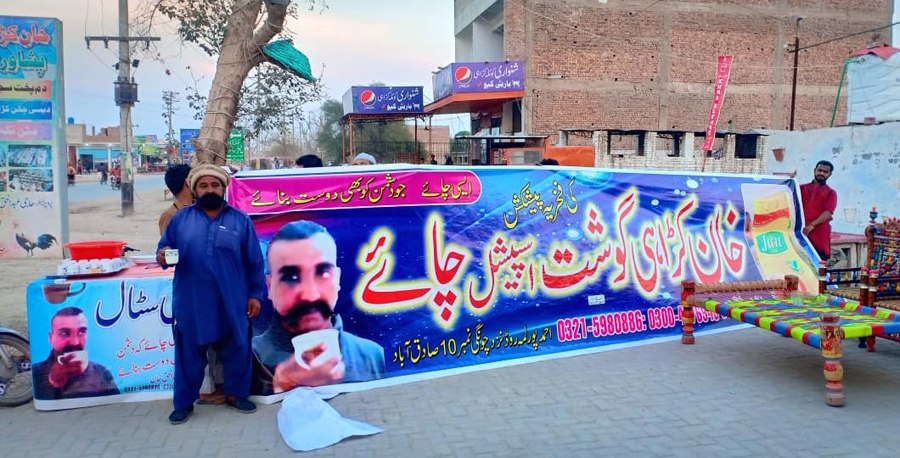


A customer poses next to a new tea stall in Pakistan's Rahim Yar Khan city on March 12, 2019. The stall is inspired by a tea-drinking Indian pilot captured and released by the Pakistan army last month. (AN photo)

As Khan watched the story unfold on his TV screen, he decided to set up a tea stall at his restaurant and had a banner printed with the face of Indian Wing Commander Abhinandan Varthaman splashed across it, his signature horseshoe moustache on full display.

“I never knew the power of tea until I saw a cup in the hands of Indian pilot Abhinandan Vardhaman, singing praises of the Pakistan Army,” Khan told Arab News via phone from Sadiqabad district in southern Punjab. “It was the cup of tea offered to him by our military officers with love that changed his ideas completely. He came here as an enemy but left as a friend."
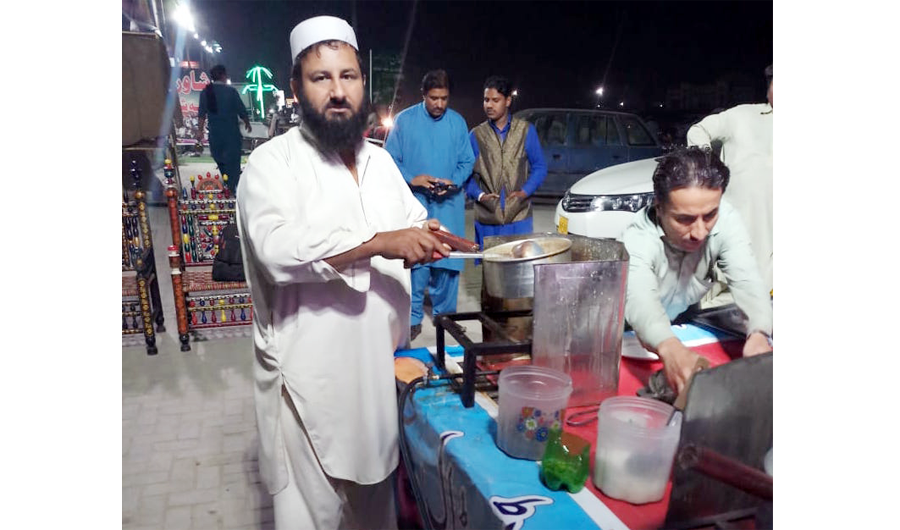


Abdul Haq Khan, the owner of a new tea stall inspired by Indian pilot Abhinandan Varthaman, poses at his restaurant in Pakistan’s Rahim Yar Khan city on March 12, 2019. (AN photo)

Khan said this gave him the idea for a slogan for his tea stall: “The kind of tea that turns an enemy into a friend.”

People first arrived at the stall just to look at the banner and laugh but soon, many began to place orders for tea.
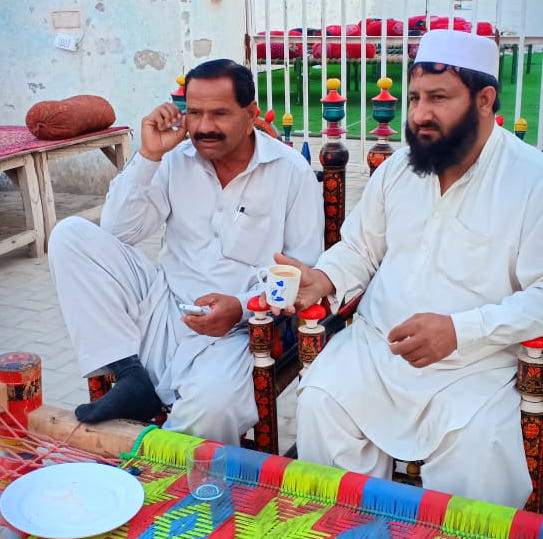


Abdul Haq Khan ( to the right), the owner of a new tea stall inspired by Indian pilot Abhinandan Varthaman, sits with a customer at his restaurant in Pakistan’s Rahim Yar Khan city on March 12, 2019. (AN photo)

“In the beginning the people looked at the banner and laughed but then they also ordered a cup of tea,” Khan said. “I had to explain to them that if tea can make an enemy pilot your friend it can also end all the bitterness in your life.”

Barbers in several cities in India reported receiving requests to copy Abhinandan’s distinctive facial hair, but in Pakistan, it is the videos of him sipping tea that have caught the public imagination.
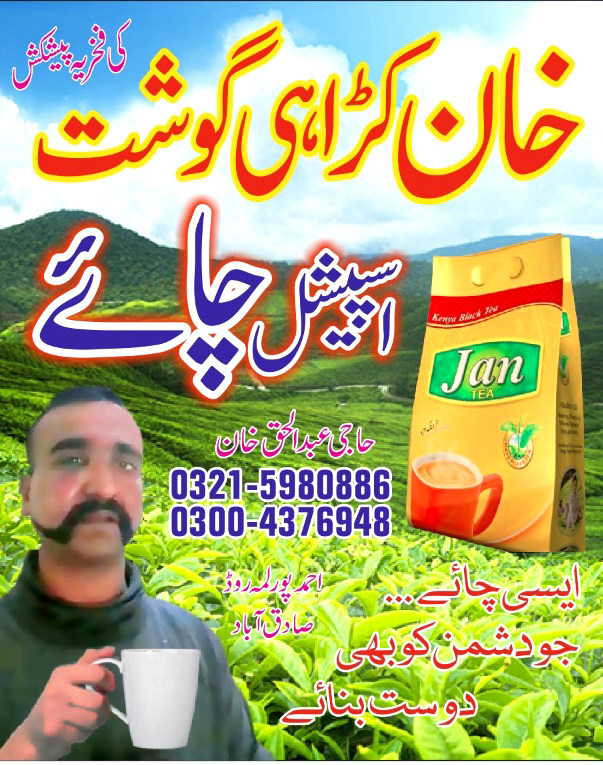


An advertisement for Abdul Haq Khan’s new tea stall inspired by Indian pilot Abhinandan Varthaman who was captured and released by the Pakistan army last month. (Supplied)

“Offering a cup of tea to someone with love can change his thoughts and I learnt that from Abhinandan,” Khan said.

Muhammed Latif, a customer at Khan’s tea stall, said: “I am not fond of tea but this idea of Abhinandan, this picture, attracted me and now here I am, sitting with my friends and enjoying tea.”


Pakistan launches final nationwide polio drive for 2025 amid rise in global cases

Updated 11 sec ago
Follow

Pakistan launches final nationwide polio drive for 2025 amid rise in global cases

  • Global polio tracking data shows Pakistan accounted for 30 of the world’s 39 cases in 2025, with remainder in Afghanistan
  • Health authorities urge parents to cooperate with vaccination teams and ensure all children under five receive polio drops

ISLAMABAD: Pakistan will launch its final nationwide polio vaccination campaign for 2025 from tomorrow, aiming to immunize more than 45 million children under the age of five, health authorities said on Sunday, as the country remains at the center of global efforts to eradicate the disease.

Global polio tracking data shows that 30 of the 39 confirmed wild poliovirus type 1 (WPV1) cases worldwide 2025 were reported in Pakistan, with the remainder in neighboring Afghanistan.

Pakistan recorded 74 polio cases in 2024, a sharp increase from six cases in 2023 and just one case in 2021, highlighting the volatility of eradication efforts in a country where misinformation, vaccine hesitancy and security issues have repeatedly disrupted progress.

“The final national polio campaign of 2025 will formally begin across the country from tomorrow,” Pakistan’s National Emergency Operations Center (NEOC) said in a statement.

“During the campaign, polio drops will be administered to more than 45 million children nationwide,” it said, adding that the seven-day drive would run from Dec. 15 to Dec. 21.

The NEOC said more than 400,000 male and female polio workers would take part in the campaign, with vaccination targets including over 23 million children in Punjab, 10.6 million in Sindh, 7.2 million in Khyber Pakhtunkhwa, 2.6 million in Balochistan and smaller numbers in Islamabad, Gilgit-Baltistan and Azad Jammu and Kashmir.

“Protecting children from polio is a shared national responsibility,” the NEOC said. “Parents must fully cooperate with polio workers to secure the future of the nation.”

It urged families to ensure that all children under five years of age receive the required two drops of the vaccine during the campaign.

Pakistan has drastically reduced polio prevalence since the 1990s, when annual cases exceeded 20,000.

By 2018, the number had fallen to eight. But health authorities warn that without consistent access to children — particularly in high-risk and underserved regions — eradication will remain out of reach.

Violence has also hampered the program. Polio teams and their security escorts have frequently come under attack from militants in parts of northwestern Khyber Pakhtunkhwa and southwestern Balochistan.

Officials say continued security threats, along with natural disasters such as recent flooding, remain major obstacles to reaching every child.