

YouTuber’s quest to visit Taiwan’s dwindling allies

1 / 3
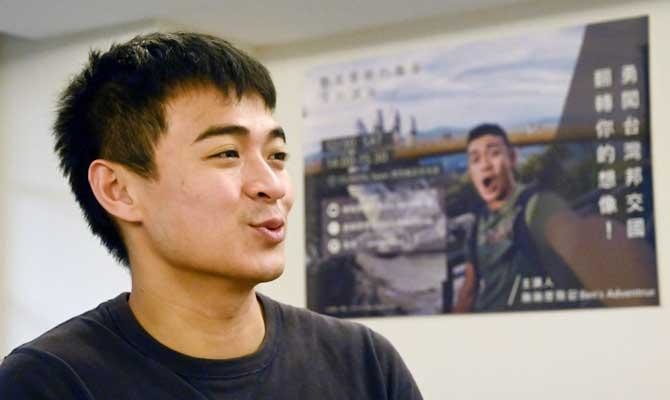
This photo taken on February 13, 2019 shows Taiwanese YouTuber Ben Wu talking about his travels while displaying a video during an interview in Taipei. (AFP)
2 / 3
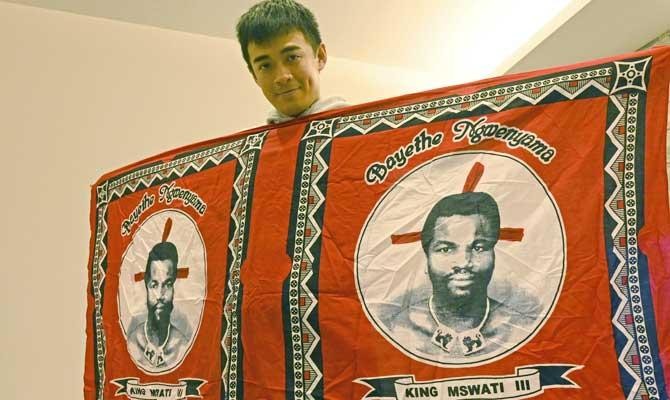
This picture taken on February 13, 2019 shows Taiwanese YouTuber Ben Wu displaying a cloth showing the portrait of King Mstwati III of eSwatini during an interview in Taipei. (AFP)
3 / 3
This picture taken on February 13, 2019 shows Taiwanese YouTuber Ben Wu speaking in front of a poster of himself during his travels during an interview in Taipei. (AFP)
Updated 12 March 2019
Follow

YouTuber’s quest to visit Taiwan’s dwindling allies

  • Wu’s YouTube videos on his channel “Ben’s Adventures” have racked up tens of thousands of views and turned into a career

TAIPEI: From battling a storm in the Solomon Islands to consulting a witch doctor in eSwatini, Ben Wu has trekked some of the world’s less-trodden paths as he embarks on a quest to visit all of Taiwan’s dwindling diplomatic allies.
The list of countries he must visit is short — just 17 nations still recognize Taiwan over mainland China, a vivid illustration of the democratic island’s international isolation as Beijing uses its clout to woo Taipei’s few remaining friends.
In all practical ways Taiwan is a de facto independent country but both Taipei and Beijing insist they are the one true China and that other nations can recognize only one of them. Most have sided with China as its political and economic might has grown.
Last summer Wu, 25, was having a meeting in Taiwan’s foreign ministry on the day El Salvador just happened to become the latest country to switch its recognition to Beijing.
He watched as the country’s flag was removed from the ministry’s entrance.
“I think most young people only know about our allies when there is a termination of diplomatic relations and this is not good,” Wu told AFP at his home in Taipei. “They should know about the allies in other ways.”
Using YouTube, Wu is trying to change that.
He came up with the idea to visit the remaining allies while riding the Trans-Siberian Railway. Flicking through a news article about Taiwan’s allies he realized he only recognized three — Haiti, Tuvalu and the Vatican.
“I love travel and some of Taiwan’s diplomatic allies are less known and more difficult to reach. I hope to explore these countries that fewer people have traveled to and be a part of ‘people diplomacy’,” he said.
So far Wu has ticked off five allies in the Pacific — Tuvalu, Nauru, Kiribati, the Marshall Islands and the Solomon Islands — as well the only ally in Africa, eSwatini.
This month, he sets out for Latin America and the Caribbean to visit Guatemala, Honduras, Nicaragua, Paraguay, Haiti, Belize, Saint Lucia, St. Vincent and the Grenadines as well as St. Kitts and Nevis. He will wrap up his quest with the Vatican and Palau in the summer.

Taiwan’s diplomatic isolation was not always the case.
After its split from the mainland in 1949 when the communists defeated Chiang Kai-shek’s nationalists, it was the Republic of China that was recognized by the majority, not the People’s Republic of China.
The global reversal began in earnest in 1971 when Taiwan — then in the grip of Chiang’s military dictatorship — was kicked out of the international club by the UN General Assembly, which recognized the PRC as “the only legitimate representative of China.”
Allies began falling like dominoes with Washington switching recognition in 1979 — although it remains a key military backer and supplies Taiwan with most of its weaponry.
Those nations that remained tended to be impoverished, smaller countries in the Pacific, Africa and Latin America who have since become easy pickings as China morphed from dysfunction and poverty into the world’s second largest economy.
After the 2016 election of Taiwanese President Tsai Ing-wen — who hails from an independence leaning party — Beijing has launched a campaign to further undermine the island’s sovereignty.
Five allies have been poached, it blocked Taipei from attending major global gatherings and pressured a string of international companies, including airlines and hotels, to list Taiwan as part of China.

J Michael Cole, a Taipei-based expert at the University of Nottingham’s Taiwan Studies Programme, said the remaining allies most at risk of switching are those in the Pacific.
“Beijing is hard at work trying to sway those,” he told AFP, adding China may try to lure further defections as Tsai seeks reelection in 2020.
But he added that Taiwan under Tsai had made “substantial progress strengthening ties with unofficial allies that, in the end, are far more influential, both in terms of their diplomatic weight and size of their economies, than the small states with which it has official diplomatic relations.”
Wu said he wanted greater awareness of the those who have stayed loyal to Taiwan, even if somewhere like Tuvalu only boasts some 12,000 people.
“These countries have a voice in international organizations. They can speak up for Taiwan and let more people know about Taiwan’s difficult diplomatic situation,” he said.
Wu’s YouTube videos on his channel “Ben’s Adventures” have racked up tens of thousands of views and turned into a career.
One shows him bashed by a storm in a rickety boat after seeing human skulls left by headhunters in the Solomon Islands.
Others show him consulting a witch doctor in a dark room filled with bags of herbs in eSwatini, eating betel nuts in Kiribati and finding Taiwanese food in a Marshall Islands supermarket.
Wu says he hopes other young Taiwanese might follow in his footsteps.
“I hope to introduce the culture, tradition, custom and sightseeing of our allies in a relaxing way so people can get to know these countries. I am opening a window, a door and people can explore the rest.”


Filipinos master disaster readiness, one roll of the dice at a time

Updated 29 December 2025
Follow

Filipinos master disaster readiness, one roll of the dice at a time

  • In a library in the Philippines, a dice rattles on the surface of a board before coming to a stop, putting one of its players straight into the path of a powerful typhoon

MANILA: In a library in the Philippines, a dice rattles on the surface of a board before coming to a stop, putting one of its players straight into the path of a powerful typhoon.
The teenagers huddled around the table leap into action, shouting instructions and acting out the correct strategies for just one of the potential catastrophes laid out in the board game called Master of Disaster.
With fewer than half of Filipinos estimated to have undertaken disaster drills or to own a first-aid kit, the game aims to boost lagging preparedness in a country ranked the most disaster-prone on earth for four years running.
“(It) features disasters we’ve been experiencing in real life for the past few months and years,” 17-year-old Ansherina Agasen told AFP, noting that flooding routinely upends life in her hometown of Valenzuela, north of Manila.
Sitting in the arc of intense seismic activity called the “Pacific Ring of Fire,” the Philippines endures daily earthquakes and is hit by an average of 20 typhoons each year.
In November, back-to-back typhoons drove flooding that killed nearly 300 people in the archipelago nation, while a 6.9-magnitude quake in late September toppled buildings and killed 79 people around the city of Cebu.
“We realized that a lot of loss of lives and destruction of property could have been avoided if people knew about basic concepts related to disaster preparedness,” Francis Macatulad, one of the game’s developers, told AFP of its inception.
The Asia Society for Social Improvement and Sustainable Transformation (ASSIST), where Macatulad heads business development, first dreamt up the game in 2013, after Super Typhoon Haiyan ravaged the central Philippines and left thousands dead.
Launched six years later, Master of Disaster has been updated this year to address more events exacerbated by human-driven climate change, such as landslides, drought and heatwaves.
More than 10,000 editions of the game, aimed at players as young as nine years old, have been distributed across the archipelago nation.
“The youth are very essential in creating this disaster resiliency mindset,” Macatulad said.
‘Keeps on getting worse’ 
While the Philippines has introduced disaster readiness training into its K-12 curriculum, Master of Disaster is providing a jolt of innovation, Bianca Canlas of the Department of Science and Technology (DOST) told AFP.
“It’s important that it’s tactile, something that can be touched and can be seen by the eyes of the youth so they can have engagement with each other,” she said of the game.
Players roll a dice to move their pawns across the board, with each landing spot corresponding to cards containing questions or instructions to act out disaster-specific responses.
When a player is unable to fulfil a task, another can “save” them and receive a “hero token” — tallied at the end to determine a winner.
At least 27,500 deaths and economic losses of $35 billion have been attributed to extreme weather events in the past two decades, according to the 2026 Climate Risk Index.
“It just keeps on getting worse,” Canlas said, noting the lives lost in recent months.
The government is now determining if it will throw its weight behind the distribution of the game, with the sessions in Valenzuela City serving as a pilot to assess whether players find it engaging and informative.
While conceding the evidence was so far anecdotal, ASSIST’s Macatulad said he believed the game was bringing a “significant” improvement in its players’ disaster preparedness knowledge.
“Disaster is not picky. It affects from north to south. So we would like to expand this further,” Macatulad said, adding that poor communities “most vulnerable to the effects of climate change” were the priority.
“Disasters can happen to anyone,” Agasen, the teen, told AFP as the game broke up.
“As a young person, I can share the knowledge I’ve gained... with my classmates at school, with people at home, and those I’ll meet in the future.”