

US plan for military deployment costs worries Turkey

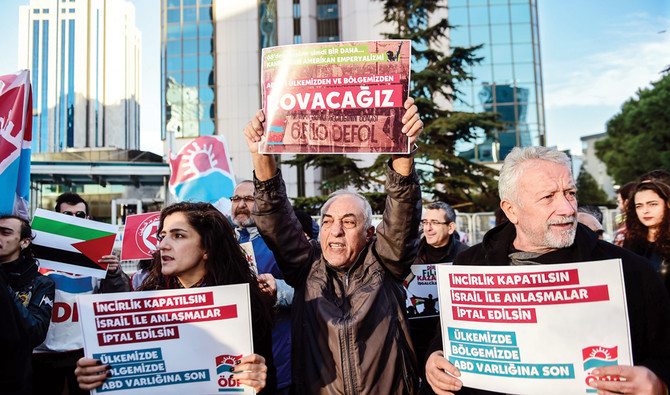
Protesters hold placards reading ‘US air base in Incirlik should close’ during a demonstration in Istanbul. (AFP)
Updated 11 March 2019
Follow

US plan for military deployment costs worries Turkey

  • The move may trigger a debate in Ankara whether the presence of American troops at Incirlik air base is desirable

ANKARA: The US plans to demand that allies hosting American troops cover the full cost of their deployment and pay an additional amount, Bloomberg reported on Friday.

The idea, which US President Donald Trump has floated for months, has raised concerns in fellow NATO member Turkey, where American troops are stationed in the Incirlik air base, 250 miles southeast of Ankara. 

Analysts say the plan may cause a further deterioration in US-Turkish relations, and may trigger a debate in Turkey about whether the presence of American troops is desirable. 

In a separate move, the Pentagon recently warned Turkey that it could be banned from buying the US F-35 and Patriot defense systems if it goes through with plans to buy Russia’s S-400 air defense system.

Ziya Meral, senior resident fellow at the British Army’s Center for Historical Analysis and Conflict Research, said Turkey’s Incirlik is used by the US for its own purposes, not to defend Turkey. 

If Washington implements its plan regarding deployment costs, “it would add fuel to the fire of voices in Turkey asking Ankara to put an end to the US presence in Incirlik,” Meral told Arab News. 

Combined with the crisis over the S-400s, and strained US-Turkish relations, he said it may trigger a strategic rift that would be the final nail in the coffin of bilateral ties. 

“This would not only harm US military operations and reach in the region … but would also be a major win for Russia and a blow to NATO’s integrity,” he added. 

Incirlik has been in use since December 1954, when Turkey and the US signed a joint-use agreement. It was also used by coalition forces during the first Gulf War for combat missions over Iraq. 

The base is currently home to the 39th Air Base Wing of the US Air Force, and holds B61-type hydrogen bombs. 

In 2015, Turkey authorized the use of the strategically important base as a launching pad for aerial operations by the US-led anti-Daesh coalition in Syria. The base is believed to host about 2,000 American service members. 

Calls to close it, especially by Turkish nationalists, have increased recently as relations between Ankara and Washington have deteriorated. 

Ankara has warned several times that it would consider denying the US access to the base, which has also been used as leverage against Germany. 

After Turkey refused to permit German MPs to visit the base, Berlin decided to relocate its military planes from Incirlik to Jordan in 2017. 

Prof. Serhat Guvenc, from Istanbul’s Kadir Has University, said Jordan’s Al-Asrak air base has always been seen by the US as an alternative to Incirlik. 

“It wouldn’t provide similar advantages like the Incirlik air base, but the US may renounce its presence in Turkey considering the increased political burdens,” he told Arab News. 

Asking Turkey for a premium for the presence of US troops on its soil is a non-starter, he said. 

“In that case, Ankara may either request that the US leave its soil completely, or decrease its military presence to a minimum,” he added. 

But Oubai Shahbandar, a defense analyst and fellow at the New America think tank’s International Security Program, said US military cooperation with Turkey in Syria will be as crucial ever with Daesh’s defeat. 

“Iran-backed militias in Iraq want to close down the US Al-Asad air base in the Iraqi desert, which could make Incirlik as important as ever to support kinetic strikes against Daesh terror remnants,” he told Arab News. A satisfactory deal will eventually be reached between Washington and Ankara, he said.


Palestinians attempt to use Gaza’s Rafah Border crossing amidst delays

Updated 08 February 2026
Follow

Palestinians attempt to use Gaza’s Rafah Border crossing amidst delays

  • The Rafah Crossing opened to a few Palestinians in each direction last week, after Israel retrieved the body of the last hostage held in Gaza and several American officials visited Israel to press for the opening

CAIRO: Palestinians on both sides of the crossing between Gaza and Egypt, which opened last week for the first time since 2024, were making their way to the border on Sunday in hopes of crossing, one of the main requirements for the US-backed ceasefire. The opening comes as Prime Minister Benjamin Netanyahu is expected to travel to Washington this week, though the major subject of discussion will be Iran, his office said.
The Rafah Crossing opened to a few Palestinians in each direction last week, after Israel retrieved the body of the last hostage held in Gaza and several American officials visited Israel to press for the opening. Over the first four days of the crossing’s opening, just 36 Palestinians requiring medical care were allowed to leave for Egypt, plus 62 companions, according to United Nations data.
Palestinian officials say nearly 20,000 people in Gaza are seeking to leave for medical care that they say is not available in the war-shattered territory. The few who have succeeded in crossing described delays and allegations of mistreatment by Israeli forces and other groups involved in the crossing, including and an Israeli-backed Palestinian armed group, Abu Shabab.
A group of Palestinian patients and wounded gathered Sunday morning in the courtyard of a Red Crescent hospital in Gaza’s southern city of Khan Younis, before making their way to the Rafah crossing with Egypt for treatment abroad, family members told The Associated Press.
Amjad Abu Jedian, who was injured in the war, was scheduled to leave Gaza for medical treatment on the first day of the crossing’s reopening, but only five patients were allowed to travel that day, his mother, Raja Abu Jedian, said. Abu Jedian was shot by an Israeli sniper while he was building traditional bathrooms in the central Bureij refugee camp in July 2024, she said.
On Saturday, his family received a call from the World Health Organization notifying them that he is included in the group that will travel on Sunday, she said.
“We want them to take care of the patients (during their evacuation),” she said. “We want the Israeli military not to burden them.”
The Israeli defense branch that oversees the operation of the crossing did not immediately confirm the opening.
A group of Palestinians also arrived Sunday morning at the Egyptian side of the Rafah crossing border to return to the Gaza Strip, Egypt’s state-run Al-Qahera News satellite television reported.
Palestinians who returned to Gaza in the first few days of the crossing’s operation described hours of delays and invasive searches by Israeli authorities and an Israeli-backed Palestinian armed group, Abu Shabab. A European Union mission and Palestinian officials run the border crossing, and Israel has its screening facility some distance away.
The crossing was reopened on Feb. 2 as part of a fragile ceasefire deal that stopped the war between Israel and Hamas. Amid confusion around the reopening, the Rafah crossing was closed Friday and Saturday.
The Rafah crossing, an essential lifeline for Palestinians in Gaza, was the only crossing not controlled by Israel prior to the war. Israel seized the Palestinian side of Rafah in May 2024, though traffic through the crossing was heavily restricted even before that.
Restrictions negotiated by Israeli, Egyptian, Palestinian and international officials meant that only 50 people would be allowed to return to Gaza each day and 50 medical patients — along with two companions for each — would be allowed to leave, but far fewer people than expected have crossed in both directions.