

Women march “as one” to mark International Women’s Day in Pakistan

1 / 9
Participants seen at Aurat March, a series of protests held around the country to mark International Women's Day in which rights campaigners, activists, politicians and thousands of women from all walks of life came together to draw attention to women’s issues and gender inequality on Match 8, 2018. (AN Photo)
2 / 9
Participants seen at Aurat March, a series of protests held around the country to mark International Women's Day in which rights campaigners, activists, politicians and thousands of women from all walks of life came together to draw attention to women’s issues and gender inequality on Match 8, 2018. (AN Photo)
3 / 9
Participants seen at Aurat March, a series of protests held around the country to mark International Women's Day in which rights campaigners, activists, politicians and thousands of women from all walks of life came together to draw attention to women’s issues and gender inequality on Match 8, 2018. (AN Photo)
4 / 9
Participants seen at Aurat March, a series of protests held around the country to mark International Women's Day in which rights campaigners, activists, politicians and thousands of women from all walks of life came together to draw attention to women’s issues and gender inequality on Match 8, 2018. (AN Photo)
5 / 9
Participants seen at Aurat March, a series of protests held around the country to mark International Women's Day in which rights campaigners, activists, politicians and thousands of women from all walks of life came together to draw attention to women’s issues and gender inequality on Match 8, 2018. (AN Photo)
6 / 9
Participants seen at Aurat March, a series of protests held around the country to mark International Women's Day in which rights campaigners, activists, politicians and thousands of women from all walks of life came together to draw attention to women’s issues and gender inequality on Match 8, 2018. (AN Photo)
7 / 9
Participants seen at Aurat March, a series of protests held around the country to mark International Women's Day in which rights campaigners, activists, politicians and thousands of women from all walks of life came together to draw attention to women’s issues and gender inequality on Match 8, 2018. (AN Photo)
8 / 9
Participants seen at Aurat March, a series of protests held around the country to mark International Women's Day in which rights campaigners, activists, politicians and thousands of women from all walks of life came together to draw attention to women’s issues and gender inequality on Match 8, 2018. (AN Photo)
9 / 9
Participants seen at Aurat March, a series of protests held around the country to mark International Women's Day in which rights campaigners, activists, politicians and thousands of women from all walks of life came together to draw attention to women’s issues and gender inequality on Match 8, 2018. (AN Photo)
Updated 09 March 2019
Follow

Women march “as one” to mark International Women’s Day in Pakistan

  • In a series of protests dubbed Aurat March, thousands of women from all walks of life marched together to draw attention to women’s issues
  • Arab News covers Pakistan second annual Aurat March in Lahore, Karachi, Islamabad and across the country

ISLAMABAD/KARACHI/LAHORE: A procession of women accompanied a charpoy covered in a white cloth and a sign that read “patriarchy” outside Karachi’s iconic Frere Hall on Friday, chanting "Aurrat Azaad, Samaaj Azaad."

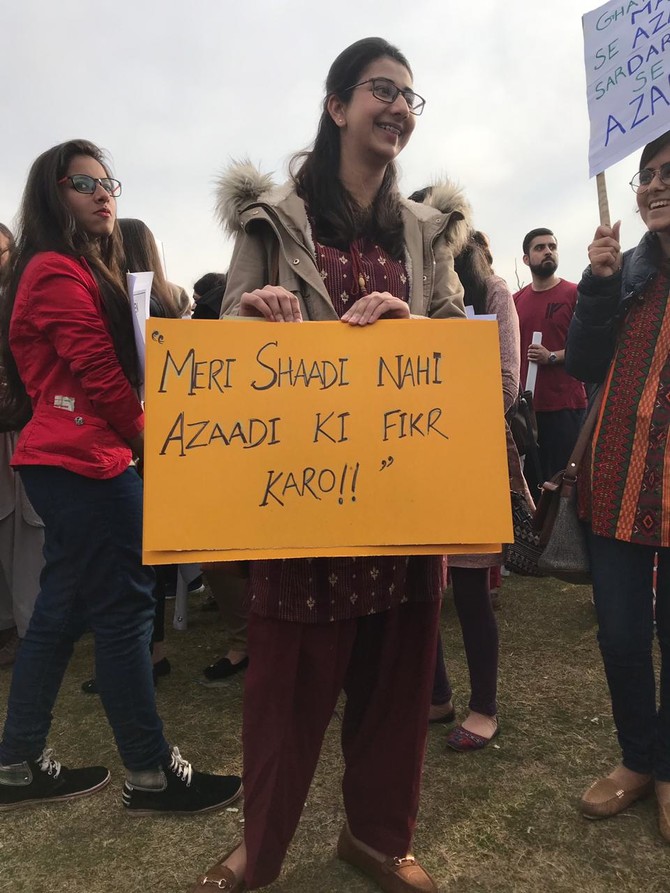
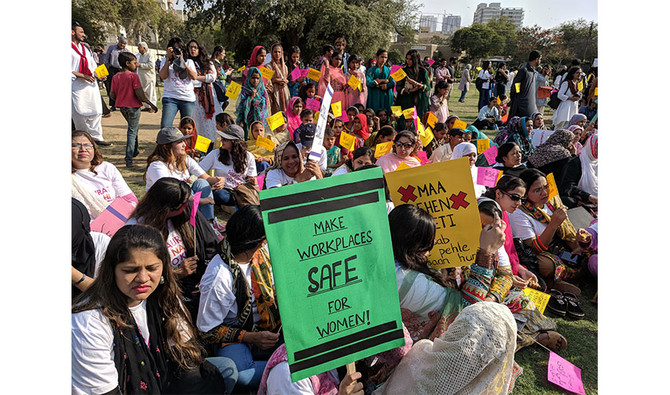
The mock funeral and the cries of "free women, free society" were part of a series of protests held around the country, dubbed Aurat March (women’s march), in which rights campaigners, activists, politicians and thousands of women from all walks of life came together to draw attention to women’s issues and gender inequality in Pakistan.

Women in wheelchairs showed up, as did young men and women carrying babies in their arms. Women who work in bonded labour at brick kilns arrived to demand higher wages. A woman who drove a rickshaw to support her family brought her vehicle along to the march in Lahore.

Domestic abuse, sexual violence, job discrimination, honour killings, acid attacks and child and forced marriages make Pakistan the world’s third-most-dangerous country for women, a 2018 Thomson Reuters Foundation expert poll showed.

“Today we are one. We are all women,” said rights activist Nighat Saeed Khan, one of the organisers of the march in Lahore. “There is no individual slogan and no slogan of a particular organisation. It is women’s day and we are women only. Let’s struggle jointly. Let’s raise our voice for women rights jointly, as one.”

According to estimates by Arab News reporters present on the scene, between 2,500-3,000 people each attended the protests in the cities of Lahore and Karachi while the Islamabad demonstration attracted less than 500 people.

The numbers were painfully small for a country of 208 million people, but passions were high.

As the clock struck 3 pm, women, girls, boys and men trickled on to the empty plot outside Islamabad’s press club, home to many of the city’s demonstrations.

The march was officially inaugurated with a performance by a group of singers and musicians from the Cholistan desert followed by speeches by organisers, activists and march participants.

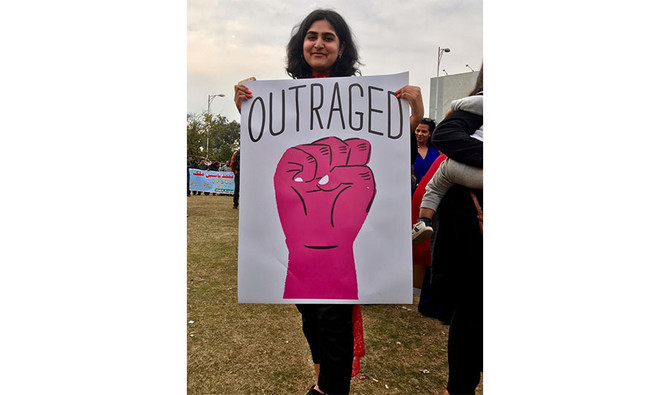
Eman Ramay, 17, attended the march with her extended family in the capital city of Islamabad, holding a poster depicting a pink fist painted under the word ‘outrage’ high in the air. Next to her, Sabine Malik, a teacher, carried a banner that read: ‘The more you kill us,  the more women will come out of their houses.”

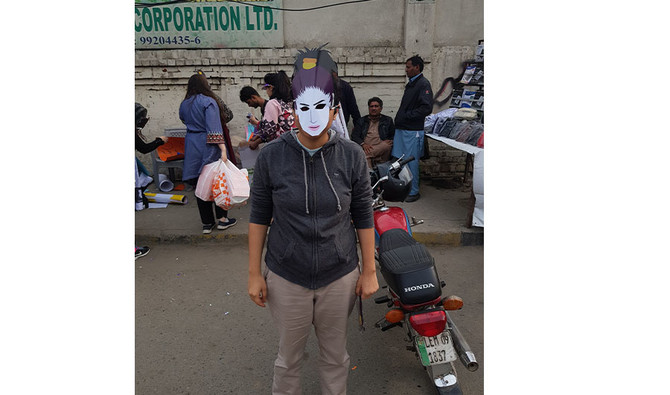
Artist Shehzil Malik had created a series of striking posters for the march to negate atypical depictions of Pakistani women as submissive. “These women mean business,” she told a newspaper reporter before the protest in Lahore.

"At least women have started speaking for themselves and it's a big change," Seema Maheshwary, a civil society activist, said standing on Karachi’s main Jinnah Road. "This is a change and one day there will be a complete change."

Zubaida Mustafa, among Pakistan's first women journalists, said she was happy to see young women finally standing up for their rights.

"I am happy that the time has come that women have understood their strength and power,” she said. “This Aurat March will lead us to a Pakistan where women will enjoy equal rights.”

While Pakistan has made some progress on women’s right in recent years, including anti-discrimination laws and reserved seats for women in parliament, there is still a long way to go.

“I don’t know what this will actually do but it feels like we need to be out here,” said Mahira Ijaaz, an 18-year-old university student in Islamabad. “When I talk to my classmates … there’s this attitude that ‘it can’t actually be that bad,’ and it’s showing up in numbers like this that gives you an idea of how many women suffer.”

Sabine Malik, 27, piped in: “No one talks about sexual abuse, marital rape, what happens in our homes! That’s why I’m here -- to speak about abuse publicly because we are discouraged from doing it anywhere else.”

For many, simply being at the march with other women was a moment of power and solidarity.

“It’s an empowering moment that all these women are together and showing each other support, there’s no hierarchy about whose issues are more important,” Sarah Khokhar, 31, a consultant attending her first march, said. “It’s about women, it’s about girls, it’s about transgender people and what they all have to face daily to live their lives.”

In Karachi, Lahore and Islamabad, many men alos showed up to march in solidarity with women.

But Ibrahim Bashir shooed away reporters who tried to talk to him outside the press club in Islamabad: “Why are you talking to me when there’s lots of women here with lots to say!”
World Bank approves $700 million for Pakistan’s economic stability

Updated 20 December 2025
Follow

World Bank approves $700 million for Pakistan’s economic stability

  • Of this, $600 million will go for federal programs and $100 million will ⁠support a provincial program in Sindh
  • The results-based design ensures that resources are only disbursed once program objectives are achieved

ISLAMABAD: The World Bank has approved $700 million in ​financing for Pakistan under a multi-year initiative aimed at supporting the country’s macroeconomic stability and service delivery, the bank said on Friday.

The funds will be released under the bank’s Public ‌Resources for Inclusive ‌Development — Multiphase ‌Programmatic ⁠Approach (PRID-MPA) that ‌could provide up to $1.35 billion in total financing, according to the lender.

Of this amount, $600 million will go for federal programs and $100 million will ⁠support a provincial program in ‌the southern Sindh province. The results-based design ensures that resources are only disbursed once program objectives are achieved.

“Pakistan’s path to inclusive, sustainable growth requires mobilizing more domestic resources and ensuring they are used efficiently and transparently to deliver results for people,” World Bank country director Bolormaa Amgaabazar said in a statement.

“Through this MPA, we are working with the Federal and Sindh governments to deliver tangible impacts— more predictable funding for schools and clinics, fairer tax systems, and stronger data for decision‑making— while safeguarding priority social and climate investments and strengthening public trust.”

The approval ‍follows a $47.9 ‍million World Bank grant ‍in August to improve primary education in Pakistan’s most populous Punjab province.

In November, an IMF-World Bank ​report, uploaded by Pakistan’s finance ministry, said Pakistan’s fragmented ⁠regulation, opaque budgeting and political capture are curbing investment and weakening revenue.

Regional tensions may surface over international financing for Pakistan. In May, Reuters reported that India would oppose World Bank funding for Pakistan, citing a senior government ‌source in New Delhi.

“Strengthening Pakistan’s fiscal foundations is essential to restoring macroeconomic stability, delivering results and strengthening institutions,” said Tobias Akhtar Haque, Lead Country Economist for the World Bank in Pakistan.

“Through the PRID‑MPA, we are launching a coherent nationwide approach to support reforms that expand fiscal space, bolster investments in human capital and climate resilience, and strengthen revenue administration, budget execution, and statistical systems. These reforms will ensure that resources reach the frontline and deliver better outcomes for people across Pakistan with greater efficiency and accountability.”

In Sindh, the program is expected to increase provincial revenues, enhance the speed and transparency of payments, and broaden the use of data to guide provincial decision making. The program will directly support the increase of public resources for inclusive development, including more equitable and responsive financing for primary health care facilities and more funding for schools.