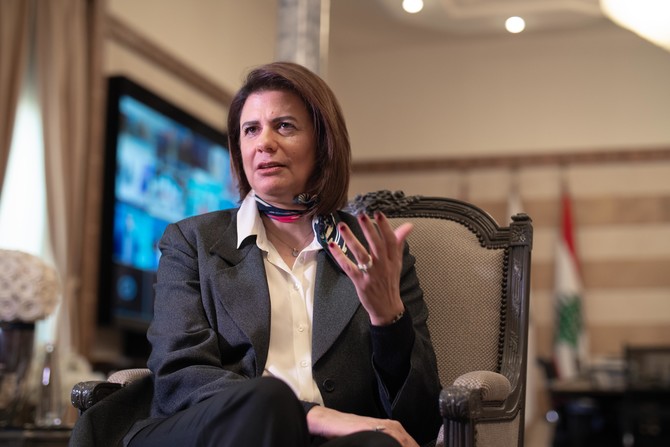
Raya Al-Hassan, the Middle East’s first female interior minister, pledges to take ‘people-centric’ approach in Lebanon

1 / 4
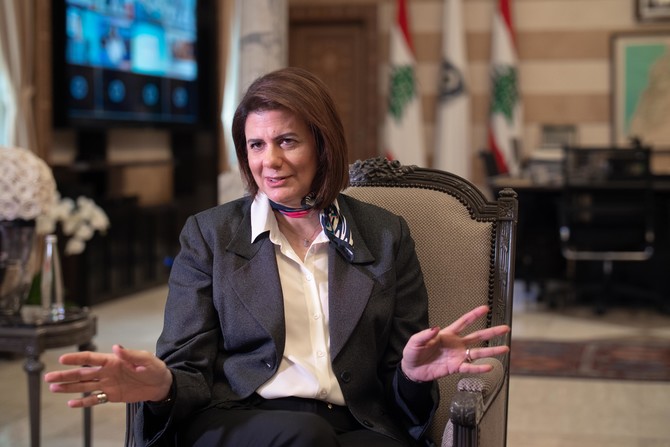
Lebanon's first female interior minister Raya Al-Hassan. (AN Photo/Tariq Keblaoui)
2 / 4
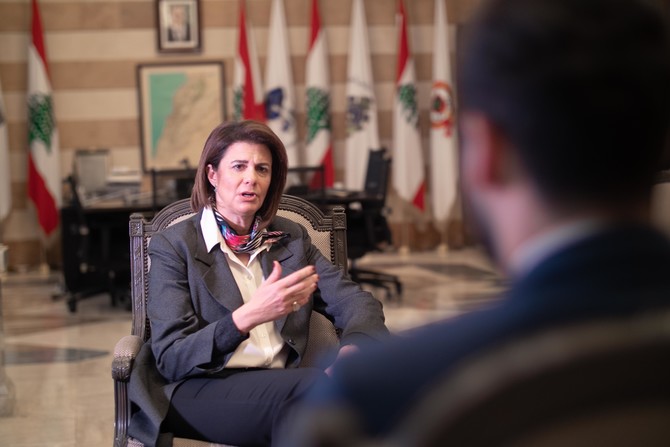
Lebanon's first female interior minister Raya Al-Hassan. (AN Photo/Tariq Keblaoui)
3 / 4
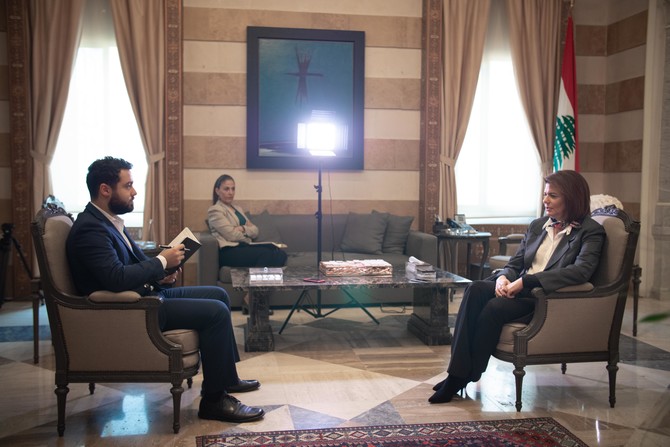
Lebanon's first female interior minister Raya Al-Hassan. (AN Photo/Tariq Keblaoui)
4 / 4
Lebanon's first female interior minister Raya Al-Hassan. (AN Photo/Tariq Keblaoui)
Updated 08 March 2019
Follow

Raya Al-Hassan, the Middle East’s first female interior minister, pledges to take ‘people-centric’ approach in Lebanon

  • Al-Hassan spoke to Arab News in a special International Women's Day interview
  • In her new role, the minister laid down the groundwork needed to preserve freedom of speech, as well as making use of the opportunity to advocate for women’s rights issues

BEIRUT: “What, it’s been two weeks? Wait, three weeks? No!” Lebanon and the Arab world’s first woman interior minister Raya Al-Hassan exclaimed as she recalled the sunny February Friday when she was sworn in at the Ministry of Interior in Beirut.

It should come as no surprise that the minister was in disbelief at the short time that has passed, a period in which she has shaken up the system by ordering the removal of traffic-hindering roadblocks across the capital as well as reigniting the civil marriage debate, drawing protests from the conservative religious community.

“I want to make the Ministry of Interior more people-centric, more inclined to address the concerns of the Lebanese population. There has been a schism that has formed between the Lebanese and their public institutions, and that has developed into a kind of mistrust that has grown with time,” Al-Hassan told Arab News.

“I want to restore this trust, and in order to restore this trust, you have to be closer to the people and listen to their concerns and try to address the issues that are closest to their hearts,” she said.

Al-Hassan was named as interior minister by Prime Minister Saad Al-Hariri in January after nine months of political deadlock left the country teetering on the edge of political and economic crisis. 

Together with three other female ministers, it is the highest-ever representation of women in the 30-seat Lebanese Cabinet.

“I like to think I can act as a role model for women who are involved in the public sector and who aspire to also assume decision-making responsibilities in the public sector and who look at me as somebody who is not a traditional politician but has been able to assume such a responsibility,” she said.

“There is always this sort of subliminal message that, as a woman, this is going to be even harder for me than a man, and I don’t think this should be the case. It’s hard, it’s a challenge but it’s the same for men as it is for women,” she added.

Headlines around the world broke the news of Al-Hassan’s appointment as the first female minister of interior, a role that has been dominated by men across the region.

Al-Hassan is already used to breaking the mold in a “boys’ club” job as she was the first woman to be selected as minister of finance in 2009.

“It wasn’t that I parachuted and fell into the minister of interior position, but I moved progressively,” she said.

After graduating from George Washington University with an MA in business administration, Al-Hassan started at the Ministry of Finance in 1992 working under Finance Minister Fouad Siniora, then moved to the prime minister’s office, where she worked on reform agendas and economic reform conferences such as Paris II and Paris III before she became the minister of finance.

In her new role, the minister laid down the groundwork needed to preserve freedom of speech, as well as making use of the opportunity to advocate for women’s rights issues.

“Sitting in the Ministry of Interior, there are a lot of files that concern women, whether it’s the right of citizenship for children of Lebanese mothers, domestic abuse violations or other rights that are awarded to women in the personal status laws,” she said.

While progress for equal opportunity for women in the region is slow, Al-Hassan is confident that objectives are being reached and more doors are being opened.

“I think if we look at the Arab world, there has been, in the last five years, good developments that also bode well for future participation of women, whether in the job market or the public sector,” she said.

Al-Hassan stressed the need to address all of these through reforms, saying that this can only be done “by opening up, diversifying economies, modernizing economies.”

Apart from having a full-time job in one of Lebanon’s top positions, Al-Hassan is a mother to three daughters.

“It’s difficult. When I address women, I always say, ‘don’t let anybody kid you that this is easy.’ Frankly, it’s not easy. As a mother, you always experience guilt that you’re not doing enough, that you’re not spending enough quality time, that maybe you’re not around when they need you, and that is difficult.

“But it’s something that every hard-working mother has to learn how to deal with,” she said.

“There is always this guilt element, but you can fall back on a good support system, so we’re lucky in the Arab world in that sense that we have a good support system, whether it’s family, whether it’s parents, whether it’s friends, even. We’re lucky and wherever I’m missing, I think through the love of other members of the family I hope I can at least try to fill some of that (absence).” 

When she’s not busy catching up on security files or taking care of her children, Al-Hassan likes to enjoy a big pot of meat-stuffed vine leaves, a delicacy from her native Tripoli.

“This is something that reminds me of my childhood, of the family gatherings. I am developing a taste for tabikh (home cooking),” she said, joking that “I used to eat fast food and stuff like that, but now I like hefty stews, Lebanese rice and vegetables, because I think this is more digestible with time.”

Finding a life balance is already difficult, but Al-Hassan is confident that as soon as she gets used to a routine, she will jump into healthy eating and a 20-minute daily workout.

“If I have to do my job well, I have to take care of myself physically,” she said.


Israeli army takes journalists into a tunnel in a Gaza city it seized and largely flattened

Updated 10 December 2025
Follow

Israeli army takes journalists into a tunnel in a Gaza city it seized and largely flattened

  • Israel and Hamas are on the cusp of finishing the first phase of the truce, which mandated the return of all hostages, living and dead, in exchange for Palestinians held by Israel
  • Hamas has said communication with its remaining units in Rafah has been cut off for months and that it was not responsible for any incidents occurring in those areas

RAFAH, Gaza Strip: One by one, the soldiers squeezed through a narrow entrance to a tunnel in southern Gaza. Inside a dark hallway, some bowed their heads to avoid hitting the low ceiling, while watching their step as they walked over or around jagged concrete, crushed plastic bottles and tattered mattresses.
On Monday, Israel’s military took journalists into Rafah — the city at Gaza’s southernmost point that troops seized last year and largely flattened — as the 2-month-old Israel-Hamas ceasefire reaches a critical point. Israel has banned international journalists from entering Gaza since the war began more than two years ago, except for rare, brief visits supervised by the military, such as this one.
Soldiers escorted journalists inside a tunnel, which they said was one of Hamas’ most significant and complex underground routes, connecting cities in the embattled territory and used by top Hamas commanders. Israel said Hamas had kept the body of a hostage in the underground passage: Hadar Goldin, a 23-year-old soldier who was killed in Gaza more than a decade ago and whose remains had been held there.
Hamas returned Goldin’s body last month as part of a US-brokered ceasefire in the war triggered by the militants’ Oct. 7, 2023, attack on southern Israel in which 1,200 people were killed and hundreds taken hostage. Israel’s retaliatory offensive has killed more than 70,000 Palestinians, according to Gaza’s Health Ministry, which operates under the Hamas-run government. The ministry does not differentiate between civilians and combatants, but says roughly half the dead have been women and children.
Israel and Hamas are on the cusp of finishing the first phase of the truce, which mandated the return of all hostages, living and dead, in exchange for Palestinians held by Israel. The body of just one more hostage remains to be returned.
Mediators warn the second phase will be far more challenging since it includes thornier issues, such as disarming Hamas and Israel’s withdrawal from the strip. Israel currently controls more than half of Gaza.
Israeli Prime Minister Benjamin Netanyahu is set to travel to Washington this month to discuss those next steps with US President Donald Trump.
Piles of rubble line Rafah’s roads
Last year, Israel launched a major operation in Rafah, where many Palestinians had sought refuge from offensives elsewhere. Heavy fighting left much of the city in ruins and displaced nearly one million Palestinians. This year, when the military largely had control of the city, it systematically demolished most of the buildings that remained standing, according to satellite photos.
Troops also took control of and shut the vital Rafah crossing, Gaza’s only gateway to the outside world that was not controlled by Israel.
Israel said Rafah was Hamas’ last major stronghold and key to dismantling the group’s military capabilities, a major war aim.
On the drive around Rafah on Monday, towers of mangled concrete, wires and twisted metal lined the roads, with few buildings still standing and none unscathed. Remnants of people’s lives were scattered the ground: a foam mattress, towels and a book explaining the Qur’an.
Last week, Israel said it was ready to reopen the Rafah crossing but only for people to leave the strip. Egypt and many Palestinians fear that once people leave, they won’t be allowed to return. They say Israel is obligated to open the crossing in both directions.
Israel has said that entry into Gaza would not be permitted until Israel receives all hostages remaining in the strip.
Inside the tunnel
The tunnel that journalists were escorted through runs beneath what was once a densely populated residential neighborhood, under a United Nations compound and mosques. Today, Rafah is a ghost town. Underground, journalists picked their way around dangling cables and uneven concrete slabs covered in sand.
The army says the tunnel is more than 7 kilometers (4 miles) long and up to 25 meters (82 feet) deep and was used for storing weapons as well as long-term stays. It said top Hamas commanders were there during the war, including Mohammed Sinwar — who was believed to have run Hamas’ armed wing and was the younger brother of Yahya Sinwar, the Hamas leader who helped mastermind the Oct. 7 attack. Israel has said it has killed both of them.
“What we see right here is a perfect example of what Hamas did with all the money and the equipment that was brought into Gaza throughout the years,” said Lt. Col. Nadav Shoshani. “Hamas took it and built an incredible city underground for the purposes of terror and holding bodies of hostages.”
Israel has long accused Hamas of siphoning off money for military purposes. While Hamas says the Palestinians are an occupied people and have a right to resist, the group also has a civilian arm and ran a government that provided services such as health care, a police force and education.
The army hasn’t decided what to do with the tunnel. It could seal it with concrete, explode it or hold it for intelligence purposes among other options.
Since the ceasefire began, three soldiers have been killed in clashes with about 200 Hamas militants that Israeli and Egyptian officials say remain underground in Israeli-held territory.
Hamas has said communication with its remaining units in Rafah has been cut off for months and that it was not responsible for any incidents occurring in those areas.
Both Israel and Hamas have accused each other of repeated violations of the deal during the first phase. Israel has accused Hamas of dragging out the hostage returns, while Palestinian health officials say over 370 Palestinians have been killed in continued Israeli strikes since the ceasefire took effect.