CARACAS, Venezuela: A US journalist was seized by security forces at his apartment early Wednesday amid Venezuela’s escalating political turmoil, then was freed several hours later, executives at his Miami-based TV station said.
Cody Weddle was taken to the airport outside Caracas for a flight back to the United States, said ABC affiliate Local 10 News, a station he sent dispatches as a freelance correspondent.
It wasn’t clear why he was detained. Government officials did not comment on the case.
Early Wednesday, a squad of five men dressed in black uniforms and carrying a written order demanded entry into Weddle’s Caracas apartment building, neighbors said. The officers emerged two hours later with the Virginia-born Weddle carrying a large suitcase and equipment bag.
“He didn’t say anything,” said the building’s doorman, Juan Jose Araque. “He went quietly.”
Since the start of the year, Venezuela has been shaken by political unrest sometimes erupting in violence after US-backed opposition leader Juan Guaido announced he was invoking the constitution as head of congress to wrest power from President Nicolas Maduro.
Weddle’s apparent arrest came the same day as Maduro ordered the expulsion of Germany’s ambassador after the envoy expressed support for Guaido, escalating a diplomatic standoff with a group of about 50 nations that recognize the opposition leader as Venezuela’s interim president.
Weddle had reported from Venezuela for more than four years, most recently working as a freelance journalist for the ABC affiliate in Miami, a stronghold of Venezuelan exiles, although he also contributed to the Miami Herald and The Telegraph in Britain. He arrived in the country as an English-language correspondent for state-run network Telesur.
Also freed was Weddle’s Venezuelan assistant, Carlos Camacho, who had been swept from his home across town in a similar manner, local media reported.
Marco Ruiz, head of Venezuela’s National Union of Press Workers, said on Twitter before the release that officials with the Directorate General of Military Counterintelligence confirmed to him that the journalists were taken into custody of the agency, which is responsible for dealing with national security threats.
Both men were interrogated, Ruiz said. He said officials provided no further details.
Foro Penal, a lawyer co-op that handles politically sensitive cases, said Weddle was held at a prison in Caracas alongside some of Maduro’s fiercest opponents as well as five other American citizens — all of them dual nationals — who worked at Houston-based Citgo, a subsidiary of Venezuela’s state-run oil monopoly.
Espacio Publico, a Caracas-based media advocacy group, said 49 media workers have been detained in Venezuela over the past two months in a sign of an eroding environment of free speech. Many were released after a few hours, although at least one reporter, German-born Billy Six, has been held since November on what his family says are trumped-up charges of spying .
A team of American journalists led by Univision’s Jorge Ramos in late February said they had their camera equipment and phones seized at Venezuela’s presidential palace after Maduro abruptly ended an interview.
Ramos, one of the most influential Spanish-speaking journalists, said Maduro cut short the interview after 17 minutes when he was shown video on an iPad shot a day earlier of young Venezuelans eating food scraps out of the back of a garbage truck.
Weddle’s mother, Sherry Weddle of Meadowview, Virginia, said she sent her son a text messages early Wednesday, a daily routine they have kept since turmoil began increasing in the South American country. This time there was no reply, she said.
“Usually I get back: ‘I’m fine. Are you OK?’” she said. “I’m just very concerned.”
She told the Miami ABC affiliate that she was relieved to learn her son had been let go.
The US State Department had said in a statement that “the world is watching” Maduro’s handling of the case.
“Being a journalist is not a crime,” the State Department said. “Freedom of expression remains under threat in Venezuela by the Maduro regime.”
E. R. Bert Medina, CEO of ABC’s South Florida affiliate, said in a statement that being unable to reach Weddle was unsettling. “Cody has been dedicated and committed to telling the story in Venezuela to our viewers,” Medina said.


Venezuelan authorities release detained US journalist

Venezuelan authorities release detained US journalist
- Weddle has reported from Venezuela for more than four years, most recently working as a freelance journalist for the ABC affiliate in Miami, a stronghold of Venezuelan exiles


To infinity and beyond: Grendizer’s 50 years of inspiring Arabs
- 50 years after its creation, the Grendizer anime series continues to capture Arab imagination
- Arab News Japan speaks to creator Go Nagai, Middle Eastern fans and retells the story behind the UFO Robot tasked with protecting our planet
LONDON: Few cultural imports have crossed borders as unexpectedly, or as powerfully, as Grendizer, the Japanese giant robot that half a century ago became a childhood hero across the Arab world, nowhere more so than in Saudi Arabia.
Created in Japan in the mid-1970s by manga artist Go Nagai, Grendizer was part of the “mecha” tradition of giant robots. The genre was shaped by Japan’s experience during the Second World War, and explored themes of invasion, resistance and loss through the medium of science fiction.
But while the series enjoyed moderate success in Japan, its true legacy was established thousands of kilometers away in the Middle East.

The anime “UFO Robot Grendizer” arrived on television in the region in 1979, dubbed into Arabic and initially broadcast in Lebanon during the Lebanese civil war. The story it told of the heroic Duke Fleed, a displaced prince whose planet had been destroyed by alien invaders, struck a chord with children growing up amid regional conflict and occupation by Israel.
Its themes of defending one’s homeland, standing up to aggression and protecting the innocent were painfully relevant in the region, transforming the series from mere entertainment into a kind of emotional refuge.
Much of the show’s impact came from its successful Arabization. The powerful Arabic dubbing and emotionally charged voice-acting, especially by Lebanese actor Jihad El-Atrash as Duke Fleed, lent the show a moral gravity unmatched by other cartoons of the era.

The theme song for the series, performed by Sami Clark, became an anthem that the Lebanese singer continued to perform at concerts and festivals right up until his death in 2022.
By the early 1980s, “Grendizer” had spread across the Middle East, inspiring fandoms in Saudi Arabia, Kuwait, Iraq and beyond. For many, it was not only their first exposure to anime, it also delivered lessons on values such as justice and honor.
Grendizer was so influential in the region that it became the subject of scholarly research, which in addition to recognizing the ways in which the plight of the show’s characters resonated with the audience in the Middle East, also linked the show’s popularity to generational memories of displacement, particularly the Palestinian Nakba.
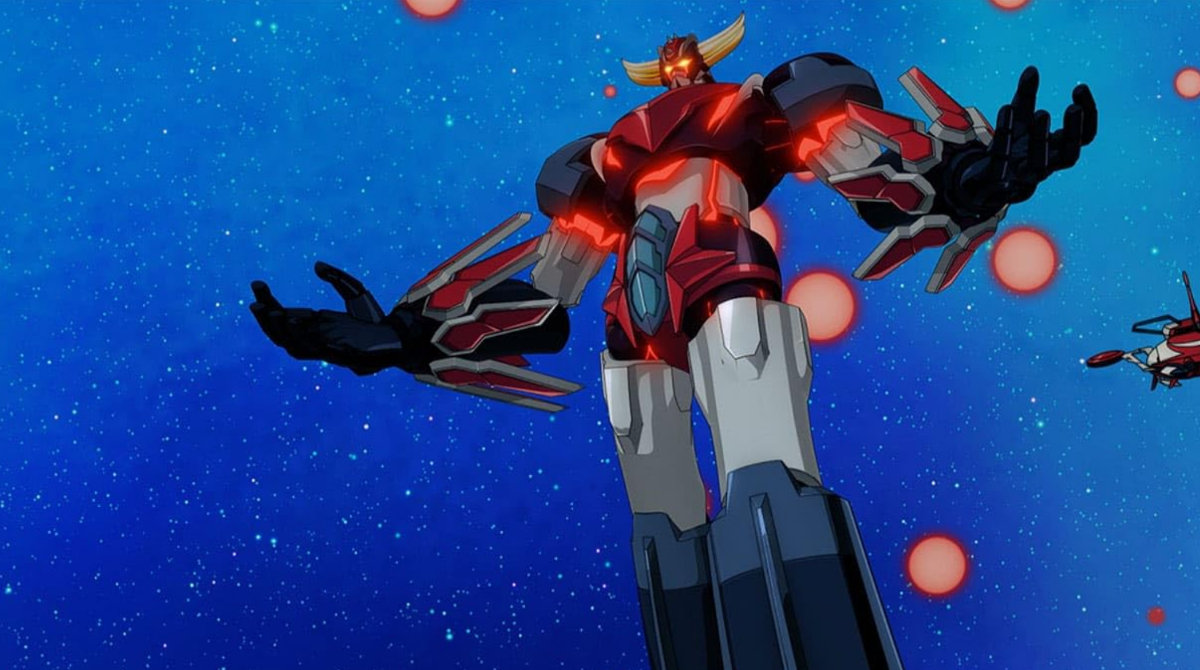
Half a century later, “Grendizer” remains culturally alive and relevant in the region. In Saudi Arabia, which embraced the original version of the show wholeheartedly, Manga Productions is now introducing a new generation of fans to a modernized version of the character, through a video game, The Feast of The Wolves, which is available in Arabic and eight other languages on platforms including PlayStation, Xbox and Nintendo Switch, and a new Arabic-language anime series, “Grendizer U,” which was broadcast last year.
Fifty years after the debut of the show, “Grendizer” is back — although to a generation of fans of the original series, their shelves still full of merchandise and memorabilia, it never really went away.


