

Moroccan climber inspires girls to conquer fears

1 / 4
Moroccan mountaineer Bouchra Baibanou is pictured in her home in the Sidi Moussa district of Sale near Rabat on November 29, 2018. (AFP)
2 / 4
Moroccan mountaineer Bouchra Baibanou is pictured in her home with a hiking cane in the Sidi Moussa district of Sale near Rabat on November 29, 2018. (AFP)
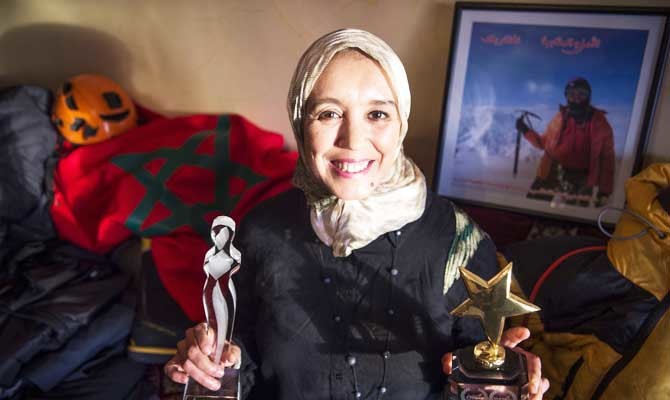
3 / 4
Moroccan mountaineer Bouchra Baibanou is pictured in her home with her trophies in the Sidi Moussa district of Sale near Rabat on November 29, 2018. (AFP)
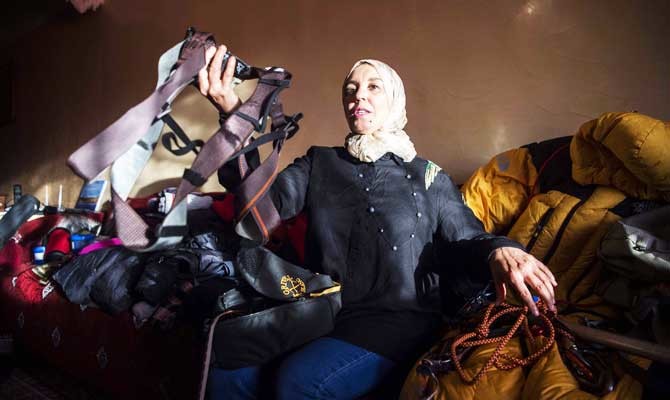
4 / 4
Moroccan mountaineer Bouchra Baibanou pauses with her harness in her home in the Sidi Moussa district of Sale near Rabat on November 29, 2018. (AFP)
Updated 06 March 2019
Follow

Moroccan climber inspires girls to conquer fears

  • Wearing a beige headscarf and black shirt, Baibanou described the mountain as “a great school” as she reeled off the attributes needed to scale a peak

SALE, Morocco: The first Moroccan to scale the seven summits of the world’s continents, Bouchra Baibanou wants to inspire a new generation of women who “dare to believe in themselves.”
“With will power and perseverance, you can get there,” said Baibanou, 49, weeks after reaching the summit of Antarctica’s Mount Vinson.
Conquering the 4,897 meter (16,066 foot) peak capped an eight-year journey, during which Baibanou traveled the globe to climb each continent’s highest mountain.
“I am proud, as a Moroccan and as a woman,” she said from her home in Sale, neighboring the capital Rabat, where trophies adorn her living room.
That pride was evident atop Vinson, where Baibanou clutched her country’s flag — and a banner with a campaign message — at temperatures of minus 40 degrees Celsius (Fahrenheit).
“From the summit of Vinson, Baibanou continues to support the fight combatting violence against women and girls,” UN Women Maghreb wrote on Twitter on January 1, after her ascent.
Wearing a beige headscarf and black shirt, Baibanou described the mountain as “a great school” as she reeled off the attributes needed to scale a peak.
“Courage, optimism, perseverance, determination and humility.”
But her passion has required a financial slog.
Baibanou is a government engineer and climbed the seven peaks with a budget of two million dirhams (185,000 euros, $210,000).
Sponsorship raised 60,000 euros for the Vinson expedition and 80,000 for Everest.
“It’s not very rewarding to be a mountaineering adventurer in Morocco,” she said.
As well as doing community work, Baibanou gives talks in schools and universities around the country.
She is also campaigning to develop mountain tourism in Morocco, especially improving the Toubkal National Park and “reinforcing security.”
In December, Morocco was shaken by the murder of two Scandinavian women hiking in the mountains.
“This terrorism act does not represent my country — one of peace and tolerance,” said Baibanou, who was outraged by the killings.

Despite her mountaineering success, Baibanou only discovered hiking aged 15 during a summer camp.
Her father, a mechanic, and her stay-at-home mother were not very interested in nature or sport.
It was not until she was 26 that Baibanou climbed her first peak in Morocco — Toubkal.
It was an exhilarating experience, spurring her on to take up mountaineering in France’s Chamonix region and climb Mont Blanc.
She still hikes close to home and last year took a group of around 30 teenagers up Toubkal, the country’s highest peak at 4,167 meters.
“I hope to be a role model, above all for young women — for those who dare to believe in themselves,” said Baibanou.
While she traveled the world mountaineering, her 14-year-old daughter was looked after by family, including her husband, who supported her ambitions.
For Baibanou, there’s nothing better than an extreme sport to “overcome ones’ fears” and learn to “not give up at the first hurdle.”
She has seen young women who were hesitant at the start of their first climb transformed by the experience.
They face “a lot of discrimination” in Morocco, said Baibanou.
“A lot of girls don’t continue their studies but, if we give them the power, they will achieve.”

Arts festival’s decision to exclude Palestinian author spurs boycott

Randa Abdel Fattah. (Photo/Wikipedia)
Updated 12 January 2026
Follow

Arts festival’s decision to exclude Palestinian author spurs boycott

  • A Macquarie University academic who researches Islamophobia and Palestine, Abdel-Fattah responded saying it was “a blatant and shameless act of anti-Palestinian racism and censorship,” with her lawyers issuing a letter to the festival

SYDENY: A top Australian arts festival has seen ​the withdrawal of dozens of writers in a backlash against its decision to bar an Australian Palestinian author after the Bondi Beach mass shooting, as moves to curb antisemitism spur free speech concerns.
The shooting which killed 15 people at a Jewish Hanukkah celebration at Sydney’s Bondi Beach on Dec. 14 sparked nationwide calls to tackle antisemitism. Police say the alleged gunmen were inspired by Daesh.
The Adelaide Festival board said last Thursday it would disinvite Randa ‌Abdel-Fattah from February’s ‌Writers Week in the state of South Australia because “it ‌would not ​be ‌culturally sensitive to continue to program her at this unprecedented time so soon after Bondi.”

FASTFACTS

• Abdel-Fattah responded, saying it was ‘a blatant and shameless act of anti-Palestinian racism and censorship.’

• Around 50 authors have since withdrawn from the festival in protest, leaving it in doubt, local media reported.

A Macquarie University academic who researches Islamophobia and Palestine, Abdel-Fattah responded saying it was “a blatant and shameless act of anti-Palestinian racism and censorship,” with her lawyers issuing a letter to the festival.
Around 50 authors have since withdrawn from the festival in protest, leaving it in doubt, local media reported.
Among the boycotting authors, Kathy Lette wrote on social media the decision to bar Abdel-Fattah “sends a divisive and plainly discriminatory message that platforming Australian Palestinians is ‘culturally insensitive.'”
The Adelaide Festival ‌said in a statement on Monday that three board ‍members and the chairperson had resigned. The ‍festival’s executive director, Julian Hobba, said the arts body was “navigating a complex moment.”

 a complex and ‍unprecedented moment” after the “significant community response” to the board decision.
In the days after the Bondi Beach attack, Jewish community groups and the Israeli government criticized Prime Minister Anthony Albanese for failing to act on a rise in antisemitic attacks and criticized protest marches against Israel’s war in ​Gaza held since 2023.
Albanese said last week a Royal Commission will consider the events of the shooting as well as antisemitism and ⁠social cohesion in Australia. Albanese said on Monday he would recall parliament next week to pass tougher hate speech laws.
On Monday, New South Wales state premier Chris Minns announced new rules that would allow local councils to cut off power and water to illegally operating prayer halls.
Minns said the new rules were prompted by the difficulty in closing a prayer hall in Sydney linked to a cleric found by a court to have made statements intimidating Jewish Australians.
The mayor of the western Sydney suburb of Fairfield said the rules were ill-considered and councils should not be responsible for determining hate speech.
“Freedom ‌of speech is something that should always be allowed, as long as it is done in a peaceful way,” Mayor Frank Carbone told Reuters.