


NEW DELHI: As tempers cool after an alarming confrontation between India and Pakistan, analysts say their leaders have emerged stronger — with Narendra Modi burnishing his nationalist credentials and Imran Khan cast as a peacemaker.
Some 400,000 people have signed petitions for Khan, the former playboy cricketer and prime minister since August, to get a Nobel prize, while Modi’s political stock has also risen ahead of looming elections.
Kashmir has been split between India and Pakistan since 1947, and two of the Asian nations’ three wars have been over the Muslim-majority mountainous territory.
An insurgency since the late 1980s — stoked by Islamabad, New Delhi says — in the part of Kashmir that India administers has killed tens of thousands of people, most of them civilians.
On Feb. 14 a suicide bombing claimed by a Pakistan-based militant group killed 40 Indian troops. Twelve days later Indian aircraft hit what New Delhi called a terrorist training camp deep inside Pakistan.
In aerial skirmishes over Kashmir the next day, at least one Indian jet was shot down and its pilot captured by Pakistan. India said it also downed a Pakistani aircraft, a claim Islamabad denied.
As the world held its breath, Khan, 66, made the surprise announcement that the captured pilot, handlebar-moustached Wing Commander Abhinandan Varthaman, would be freed in a “peace gesture.”
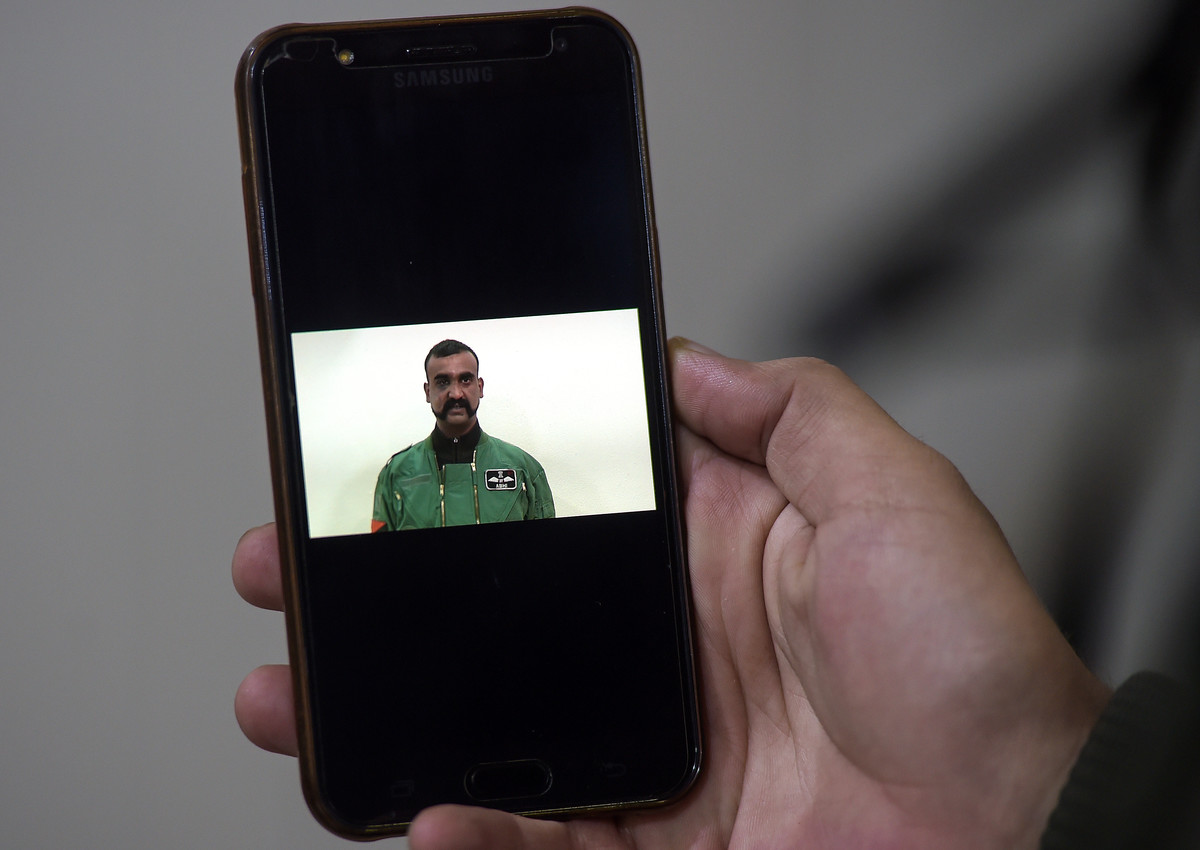
A Pakistani man watches Indian Wing Commander pilot Abhinandan Varthaman on his smartphone. (Aamir Qureshi/AFP)
Deadly shelling over the de-facto frontier and clashes between Indian security forces and militants notwithstanding, Abhinandan’s release on Friday looks to have taken the sting out the standoff for now.
Khan’s actions disarmed his opponents in parliament and on social media alike, with The News daily noting a “rare bonhomie ... between government and opposition.”
Assuming it was Khan’s decision to free the pilot — never a given in a country where the military plays such an outsized role — “it was the first correct one of (Khan’s) political career,” tweeted Gul Bukhari, a columnist who strongly opposes the government.
Modi “looks like a war-mongering minuscule leader, while the Pakistani prime minister looks like a statesman,” said analyst Mosharaf Zaidi.
Fahd Husain, a leading analyst and executive director of The Express Tribune, told AFP he has been “very pleasantly surprised” by Khan’s attitude.
“It would have been very easy for him to go the aggressive route. People would have applauded it,” he said.
Zaidi said, however, that once the dust settles, politics will be back with a vengeance.
“Pakistan has many problems: education, water, etc. And Imran Khan is the prime minister of all these problems,” he added.
Huma Yusuf, from the Wilson Center, cautioned that the challenge of initiating dialogue with India remains.
“This incident has been tactfully handled, but the India-Pak relation has gone worse, no matter how well Imran Khan has handled it,” she added.
No one is putting Modi forward for a Nobel but his tub-thumping rhetoric has won him some much-needed political points before India goes to the polls in a few weeks.
Contrasting the more conciliatory sounding Khan, Modi has talked tough, saying that his “new India” would “fight as one” and deliver a “jaw-breaking response.”
Even doubts about the efficacy of the air strikes inside Pakistan and the embarrassing shooting down of the pilot have failed to dampen the national enthusiasm for Modi’s response.
The opposition Congress party — which before the crisis was looking increasingly confident ahead of the election — criticized only how it was kept out of the loop, but not the air raid itself.
Omar Abdullah, a former chief minister of Jammu and Kashmir as well as a Modi critic, was full of praise.
“That’s a strike deep inside Pakistan and is hugely embarrassing for (Pakistan),” he tweeted.
Tavleen Singh, a veteran journalist, also lavished praise on the prime minister.
“If India had not avenged the Pulwama massacre, I would have been angry and ashamed. I believe I speak for most Indians when I say this,” she wrote in a column for the Indian Express daily on Sunday.
Many pollsters say the air strikes have given Modi just the boost he needed ahead of the election.
Political scientist Yashwant Deshmukh said Modi’s right-wing Bharatiya Janata Party could see a five-percent swing in support thanks to the nationalistic fervor gripping the country.
“Modi has the skill to keep the nationalist frenzy kicked off by this act of getting even with Pakistan going for some time,” T. K. Arun, the editor of Economic Times daily, said in a column.


