

Rival Libyan leaders agree to hold national elections, says UN

1 / 2
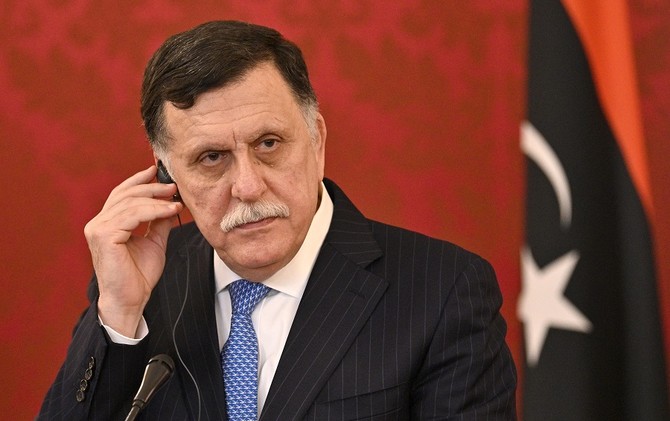
Libyan Prime Minister Fayez Al-Serraj, 3rd left, and the rival leader, military commander Khalifa Haftar, left, have met in Abu Dhabi on Wednesday. (AFP)
2 / 2
Libyan PM Fayez al-Sarraj met with eastern commander Haftar in the UAE. (File/AFP)
Updated 01 March 2019
Follow

Rival Libyan leaders agree to hold national elections, says UN

  • Libya has been torn between rival administrations and a myriad of militias
  • Unity government leader Fayez Al-Sarraj met Khalifa Haftar on Wednesday in Abu Dhabi

TRIPOLI: Libya’s internationally recognized prime minister and the military commander of its breakaway eastern half have met and agreed that national elections are necessary, the UN said on Thursday.

Wednesday’s meeting in UAE was the first to be confirmed between Fayez Al-Serraj and commander Khalifa Haftar since November, when they came face to face in Palermo, Sicily.

They agreed “on the need to end the transitional stages in Libya through holding general elections,” the UN Libya mission (UNSMIL) said in a Tweet.

“They also agreed on ways to maintain stability in the country and unify its institutions.”

The UAE has emerged as major player in the oil producing-country, whose economy and political institutions have been in turmoil since long-time leader Muammar Qaddafi was toppled in 2011.

The UN, supported by Western powers, has sought for almost two years to hold elections as a way of ending eight years of conflict. A proposed date of Dec. 10 came and went date due to lack of progress in resolving differences between the heavily divided nation’s rival powers.

Al-Serraj’s spokesman confirmed a meeting with Haftar had taken place but said no date for elections had been set. There was no immediate comment from the commander’s office.

Al-Serraj heads Libya’s internationally recognized government in the capital Tripoli while Haftar is based in the east and allied to a parallel administration. The UN gave no further details about the Abu Dhabi meeting. 

After similar encounters it has engineered it often releases pictures showing hand shakes between the participants. It made no such picture available on Thursday.

The UN tweet made no mention of a UNSMIL plan to a national conference to decide on the type of elections, an idea which has met resistance in the east where many see it as waste of time.

Haftar’s forces last month started an offensive in southern Libya, capturing the main city in the region and two oil fields.

Analysts have warned that the UN’s efforts could be threatened after Haftar’s forces launched an offensive into the south in mid-January, aimed at rooting out “terrorists” and foreign fighters.

Powerful Tripoli-based militias have condemned Haftar’s operation as a power grab, although the GNA itself has not been as explicit in its opposition. People traffickers have taken advantage of the chaos to turn Libya into a major conduit for illegal migrants.


In major policy shift on Syria, UN Security Council lifts sanctions on Hayat Tahrir Al-Sham

Updated 4 sec ago
Follow

In major policy shift on Syria, UN Security Council lifts sanctions on Hayat Tahrir Al-Sham

  • Move reflects evolving Syrian political landscape in the post-Assad era, ending a global freeze on assets, travel ban and arms embargo

NEW YORK CITY: The UN Security Council on Friday removed Al-Nusra Front, the militant group that evolved into Hayat Tahrir Al-Sham, from its so-called Daesh and Al-Qaeda Sanctions List.

The move signals a major shift in international policy toward Syria’s evolving political landscape in the post-Assad era, and ends a global freeze on assets, travel ban and arms embargo that have been imposed on the group since 2014.

Al-Nusra Front and Hayat Tahrir Al-Sham were led by Ahmad Al-Sharaa, formerly Abu Mohammed Al-Julani, who is now Syria’s president and was a leading figure in the offensive that toppled the Assad regime.

The consensus decision by the Security Council’s sanctions committee was announced by the UK, which holds the presidency of the Security Council this month and was acting in the absence of the chair of the committee. It followed a request by the new Syrian authorities to delist “Al-Nusrah Front for the People of the Levant.”

The decision means measures that were applied to Hayat Tahrir Al-Sham under Security Council Resolution 2734, adopted in 2024, no longer apply. As a result, UN member states are notrequired to freeze the group’s funds, restrict the movement of its representatives, or block the supply or transfer of arms and related materiel.

Al-Nusra Front was added to the sanctions list for its ties to Al-Qaeda and involvement in the financing and execution of militant activities during the war in Syria. The UN initially continued to treat the group’s successor organization, Hayat Tahrir Al-Sham, as a listed alias.

Al-Sharaa has said the group severed all prior transnational jihadist links and is now solely focused on local Syrian matters.