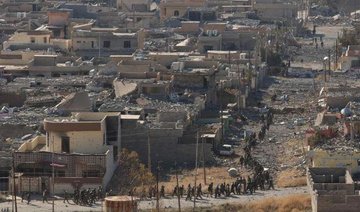
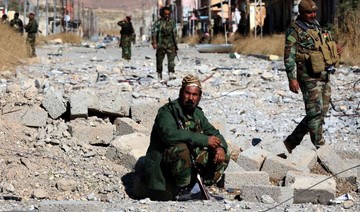
SINJAR: It is dawn in Sinjar and the only sounds are the footsteps of guards patrolling a golden-domed shrine on a hill overlooking a vista of collapsed rooftops.
More than three years after Daesh was driven out of this city in northern Iraq, all that remains in the once bustling market are the bomb-scarred facades of shops. Dozens of streets are blocked by metal barrels — a sign of unexploded ordnance that has yet to be cleared.
In a city whose former occupiers slaughtered thousands of minority Yazidis, water is scarce and power intermittent. The closest hospital to reopen is a 45-minute drive away. There are only two schools.
The physical devastation is extreme, but it is not the city’s only challenge. Caught in a power tussle between Iraq’s central government and the semi-autonomous Kurdistan Regional Government, the city also struggles with a political impasse.
“It is in ruins. There has been no progress at all,” said Ibrahim Mahmoud Ezzo, 55, the Yazidi owner of about a dozen shops, all of which are damaged.
Overrun by Daesh in 2014 and liberated by an array of forces the following year, little has been rebuilt and only a fraction of the population has returned. Residents say both the Kurdish regional government and the central government have made no effort at construction.
Sinjar lies in a sensitive area straddling the borders of Iraq’s Kurdistan region and neighboring Syria, Iran and Turkey.
“The PKK are here, the police are here, the Popular Mobilization Units are here, the army is here,” Ezzo said, listing the names of various units of the Iraqi government forces and militias that are in the city and around it.
“We don’t understand what the situation is,” Ezzo said.
The KRG had controlled the region without much objection from Baghdad since the fall of Saddam Hussein in 2003 until 2017 when, in retaliation for an independence bid, the central government pushed out the KRG, its Peshmerga forces and allies, and brought in their own.
These included a Shiite paramilitary force, the Popular Mobilization Units known as PMU, as well as the national army and the police.
Dindar Zebari, the KRG coordinator for international advocacy, said: “In Sinjar today, there is no legitimate authority, there are no official and decisive security forces.”
“The KRG is not ignoring the problem in Sinjar,” he said, urging Baghdad to share responsibility for this area with Peshmerga and ensure the removal of militias including the PMU.
A central government spokesperson could not immediately be reached for comment. Officials privately attribute the slow pace of rebuilding to security problems in the area and red tape in approving a reconstruction budget for Nineveh province.