

Pakistan has right to ‘appropriate response,’ FM Qureshi says

1 / 3
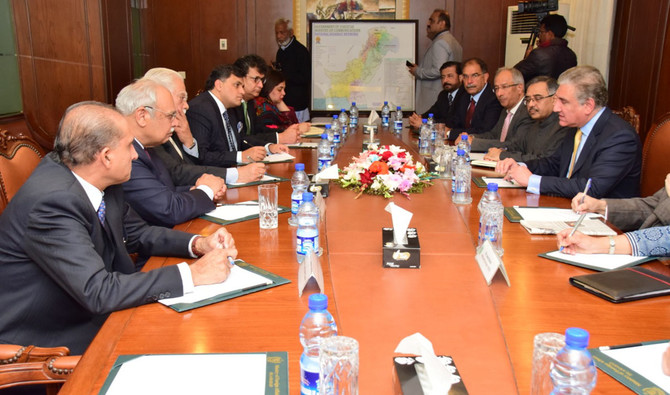
Pakistan Foreign Minister Shah Mahmood Qureshi chaired an emergency meeting of top officials and advisers in Islamabad on Tuesday after Indian fighter jets intruded about 4 km inside Pakistani airspace and dropped the payload. (Photo courtesy: Foreign Office)
2 / 3
Pakistan Foreign Minister Shah Mahmood Qureshi chaired an emergency meeting of top officials and advisers in Islamabad on Tuesday after Indian fighter jets intruded about 4 km inside Pakistani airspace and dropped the payload. (Photo courtesy: Foreign Office)
3 / 3
Pakistan Foreign Minister Shah Mahmood Qureshi chaired an emergency meeting of top officials and advisers in Islamabad on Tuesday after Indian fighter jets intruded about 4 km inside Pakistani airspace and dropped the payload. (Photo courtesy: Foreign Office)
Updated 26 February 2019
Follow

Pakistan has right to ‘appropriate response,’ FM Qureshi says

  • Indian warplanes reportedly violated the Line of Control on Tuesday but “hastily escaped” after Pakistan scrambled jets in response
  • In contradictory version, India says it struck Jaish-e-Mohammad militant camps inside Pakistan

ISLAMABAD: Pakistani foreign minister Shah Mahmood Qureshi said on Tuesday that Indian jets violated the Line of Control (LoC), or the de facto border between the two nuclear-armed countries, and Islamabad has the right to an “appropriate response.”
Early Tuesday morning, Pakistan military spokesman Major General Asif Ghafoor announced in a series of Twitter posts that Indian jets had violated the LoC which splits the disputed Kashmir region into two areas, one administered by Pakistan and the other by India. However, he said the Indian aircraft had “hastily escaped” after Pakistan scrambled its own jets after them and “no infrastructure got hit” in the confrontation. 
India’s breach has raised the possibility of military escalation between arch-rivals Pakistan and India who have fought three wars since they gained independence from the British empire in 1947, two of them over Kashmir — which the neighbors both claim in full but rule in part.
“I consider this a violation of the line of control,” Qureshi said about the early morning incursion in brief comments to the media after holding an “emergency meeting” of top officials and advisers. “Pakistan has the right to an appropriate response, it has the right to self defense.”
He added that he would now meet Prime Minister Imran Khan who had summoned a special meeting to discuss Pakistan’s options following the breach by the Indian side.

But contradicting Pakistan’s version of what transpired on Tuesday morning, Indian Foreign Secretary Vijay Gokhale said India had carried out an intelligence-based operation inside Pakistan, striking at “the biggest training camp” of the Jaish-e-Mohammad (JeM) militant group in Balakot. 
Balakot is a town in the northwestern Pakistani province of Khyber Pakhtunkhwa, about 50 km from the LoC in Kashmir. 
“In this operation, a very large number of JeM terrorists, trainers, senior commanders and groups of jihadis who were being trained for fidayeen [guerrilla] action were eliminated,” Gokhale said in a statement. 
India’s minister of state for agriculture Gajendra Singh Shekhawat also said on Twitter that the Indian Air Force had carried out an aerial strike on “terror camps” across the LoC and completely destroyed them. 
The latest confrontation comes after days of simmering tensions between Pakistan and India over a February 14 suicide bombing in Indian-administered Kashmir in which at least 40 Indian paramilitary troopers were killed. The attack was claimed by the JeM. 
New Delhi blamed Islamabad for the assault and faced with election-year pressures, Prime Minister Narendra Modi promised a “strong response.” Pakistan denies any state complicity.
Although exchanges of artillery and light weapons on the LoC are not uncommon, Tuesday’s statements from Pakistan and India are rare public admissions of airspace violations by warplanes.
In September 2016, India said it had conducted “surgical strikes” on militants in Pakistan but Pakistan “completely rejected” the claim. The alleged strikes followed a separatist attack on an army base in Uri near Pakistan and India’s disputed frontier in which 17 soldiers perished. 


Pakistan pitches digital finance reforms to foreign fintech investors

Updated 4 sec ago
Follow

Pakistan pitches digital finance reforms to foreign fintech investors

  • Khurram Schehzad highlights progress on digital banking and plans for regulating blockchain and virtual assets
  • Visiting delegation welcomes policy clarity, sees scope for long-term investment and partnerships in Pakistan

KARACHI: Pakistan on Saturday pitched its digital finance and fintech reforms to foreign investors as part of a broader effort to attract capital after macroeconomic stabilization, with a senior official highlighting progress on digital banking, payments infrastructure and regulatory overhaul.

The outreach came as Islamabad seeks to sustain reform momentum following a period of economic stress, positioning technology-led financial inclusion as a pillar of its recovery and growth strategy while courting international investors.

Khurram Schehzad, adviser to the finance minister, briefed a delegation of international fintech investors on Pakistan’s reform agenda and digital growth plans at a meeting in federal capital, according to a statement from the finance ministry.

“Consistent policy implementation and structural reforms have strengthened macroeconomic fundamentals and improved Pakistan’s investment outlook,” he said, highlighting the “renewed global confidence” in the economy.

Officials said the discussions focused on the government’s Digital Pakistan Vision, including efforts to expand digital payments, build public digital infrastructure and digitize government transactions to widen financial inclusion and formalize the economy.

Schehzad cited the role of Raast, Pakistan’s instant payment system, which enables real-time, low-cost and interoperable digital payments nationwide, as well as regulatory reforms introduced by the State Bank of Pakistan to modernize retail digital banking.

Under the new framework, easypaisa Digital Bank has been operational for nearly a year, while Mashreq Digital Bank has also begun operations, with several other digital banks moving toward launch, the statement said.

The adviser also outlined Pakistan’s plans to develop a regulatory framework for blockchain, Web3.0 and virtual assets, saying authorities were engaging with global platforms to support innovation while ensuring compliance and investor protection.

The investor delegation was led by John Sfakianakis, chairman of Fintech Solutions Holding, alongside the company’s chief executive Kirill Smolin, and was facilitated by local technology firm Tech Avenue.

The investors welcomed the “clarity of reforms and policy direction,” saying Pakistan’s combination of macroeconomic stabilization, digital infrastructure and emerging technologies offered opportunities for long-term investment and strategic partnerships, the finance ministry said.