

US envoy meets top Taliban leader in Doha ahead of formal talks on Afghanistan’s future

The Taliban political office in Doha, Qatar. The presence of the Taliban’s deputy chief at talks with the United States suggests that the insurgent group’s negotiators could have the decision making authority they lacked before. (AP)
Updated 25 February 2019
Follow

US envoy meets top Taliban leader in Doha ahead of formal talks on Afghanistan’s future

  • Khalilzad thanks Pakistan for facilitating the travel of top Taliban leaders
  • Mullah Baradar will guide the Taliban negotiating team

PESHAWAR: US Special Representative for Afghanistan Zalmay Khalilzad held an introductory meeting with Taliban co-founder Mullah Abdul Ghani Baradar in Doha, confirmed Sohail Shaheen, the group’s spokesman in Doha, while talking to Arab News on Monday.

Shaheen said the meeting took place “in a promising environment,” adding: “Mullah Baradar Akhund introduced the members of the Taliban negotiating team to the American team. He then underscored the importance of the talks, the ability of his team, and discussed the future strategy.”

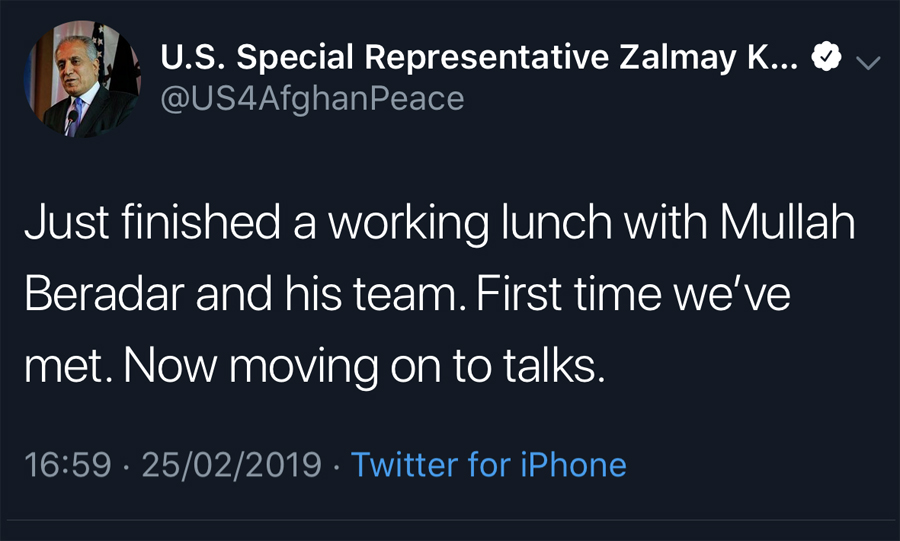
Khalilzad also tweeted about the congregation on Monday, saying it was the first time he had met Mullah Baradar and his team at a working lunch. He also indicated that the two sides were now prepared for the peace talks. 
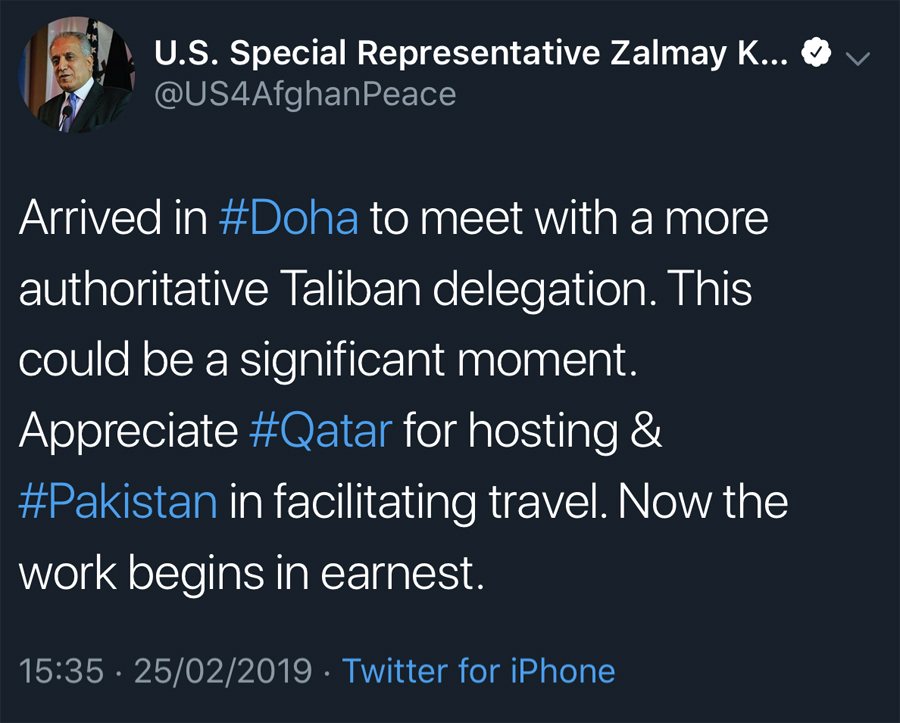
The US envoy had also tweeted about the significance of his meeting with a “more authoritative Taliban delegation” on his arrival to Doha. He had also appreciated Qatar for hosting the meeting and Pakistan for facilitating the travel of the Taliban leaders.

Mullah Baradar, Mullah Amir Khan Muttaqi, Mullah Abdul Lateef Mansoor and Maulvi Matiul Haq travelled to Doha on a chartered plane last Sunday after Pakistan made arrangements for their journey.

The US team for Monday’s meeting consisted of about 25 members, including officials of the State Department, Pentagon, Department of Defense, and some Congressmen.

The Taliban side was short of one man since Anas Haqqani, one of the 14 members of the negotiating team, remained in Afghan captivity. 
The Taliban spokesman further said the two sides would resume regular talks from Tuesday, as two working groups, created during previous rounds of talks, would begin their interaction.

The focus of their conversation would be the withdrawal of all foreign troops from Afghanistan and guarantees that the war-torn state would not be used by anyone to launch terrorist attacks against any other country.

Asked who would lead the Taliban in the future talks, Shaheen said Mullah Baradar had appointed Sher Muhammad Abbas Stanekzai for that purpose. “Being the head of the political commission, however, Mullah Baradar can join the meetings whenever he wishes,” he added. 
Earlier, Shaheen also said in a video message posted on a website that the two sides could reach an agreement at the end of the meeting.

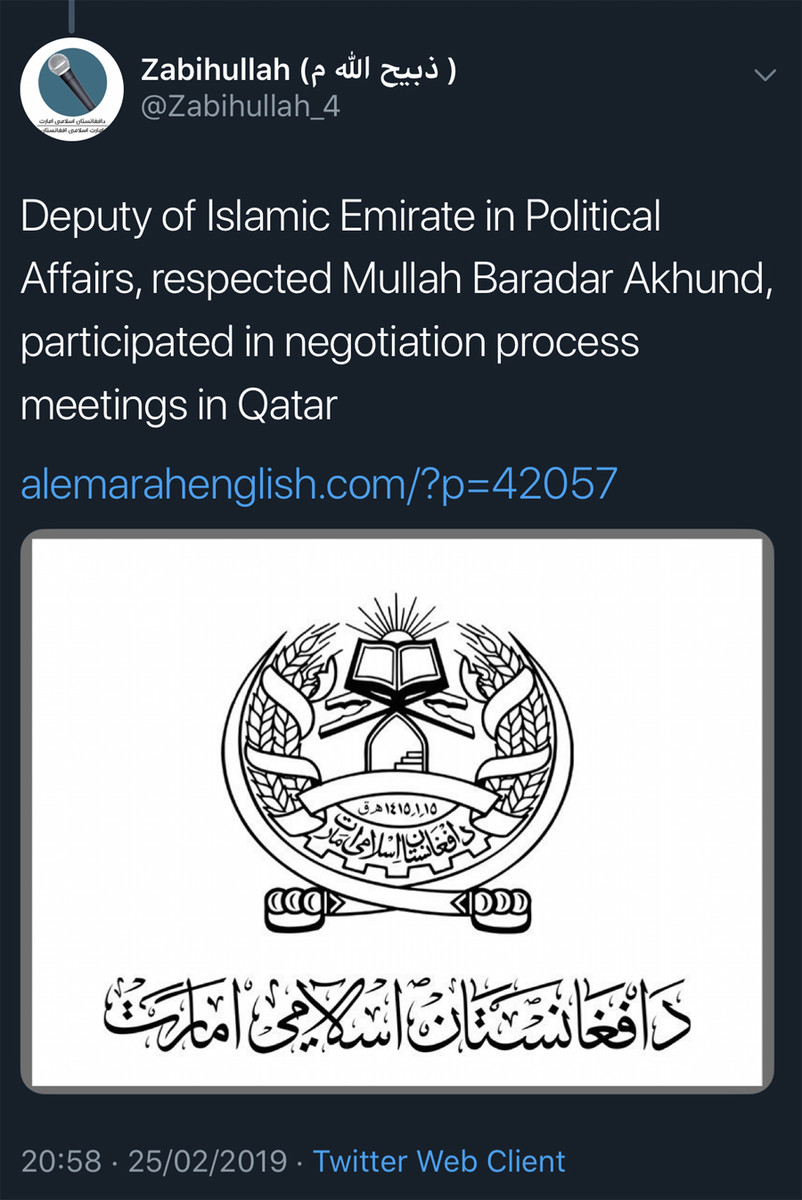
Taliban Spokesman Zabihullah Mujahid also issued a statement about the “first day of the fifth sitting.” Apart from highlighting the significance of Monday’s meeting, the statement said the talks would take place under Stanekzai’s leadership and, whenever needed, the team would consult and seek guidance from Mullah Baradar.


Pakistan reports decline in polio cases in 2025

Updated 4 sec ago
Follow

Pakistan reports decline in polio cases in 2025

  • Cases drop to 30 from 74 in 2024, with no new infections recorded since September
  • Authorities plan intensified targeted drives in 2026 to halt remaining transmission

ISLAMABAD: Pakistan reported a sharp decline in polio cases in 2025, with infections falling to 30 from 74 a year earlier, as intensified vaccination campaigns and improved surveillance helped curb the spread of the virus, health authorities said on Wednesday.

No new polio cases have been recorded anywhere in the country since September, said a statement, as Pakistan carried out six polio campaigns, including five nationwide drives, trying to reach children in high-risk areas and improve monitoring of virus circulation.

Despite the decline, the authorities cautioned that poliovirus continues to circulate in some districts, requiring sustained vigilance to prevent a resurgence.

“Targeted interventions, robust community engagement, and ongoing vaccination efforts remain essential to reach every missed child and prevent any resurgence,” the official statement said.

“Frontline health workers, security personnel, and local authorities continue to work in close coordination to maintain high immunity levels and ensure that Pakistan remains on course toward becoming polio-free,” it added.

The most recent nationwide campaign, conducted from Dec. 15 to 21, achieved more than 98 percent coverage across the country, including all four provinces, Azad Jammu and Kashmir, Gilgit-Baltistan and the capital, Islamabad.

Authorities reported an 18 percent reduction in the number of missed children compared with the previous round, with notable improvements in access and operations in southern Khyber Pakhtunkhwa, a longstanding challenge area.

Pakistan’s polio eradication drive relies on close coordination between health workers, security personnel and local authorities, amid ongoing resistance in some communities and access constraints in remote or insecure regions.

Officials said district-specific interventions, including improved microplanning, better deployment of vaccination teams and enhanced community outreach, were being used to address remaining gaps, particularly in parts of southern Khyber Pakhtunkhwa.

The statement said Pakistan plans to intensify targeted efforts in 2026 to interrupt the remaining transmission chains and move closer to eliminating the disease.