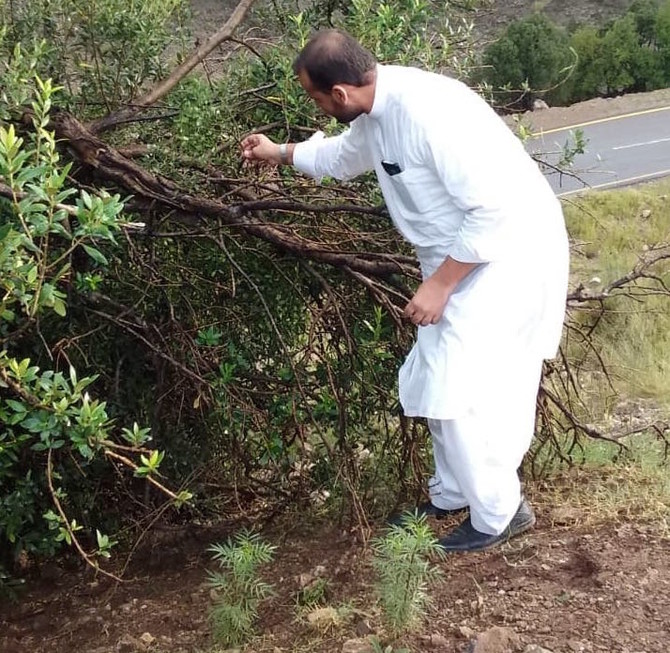
ISLAMABAD: Pakistan has commenced an ambitious drive to plant as many trees as possible from the 550,000 high-quality olive saplings imported from Spain recently.
A majority of those have been set aside for plantation in tribal areas, such as Balochistan and Khyber Pakhtunkhwa (KP), since the environment in these areas is conducive to their growth, a senior official said.
As part of the project and in order to promote the cultivation of olives for commercial purposes, the Olea Europea (European olive) – a plant of a very high-quality -- has been imported. “This is expected to be planted on 50,000 acres of land in the erstwhile Federally Administered Tribal Areas (FATA), Balochistan, KP and parts of the Potohar region in the Punjab province,” Dr. Tariq Bari, Project Director and a senior official at the Pakistan Agriculture Research Council (PARC), told Arab News.
He said Bajaur and South Waziristan tribal districts and other tribal regions are most suitable for the cultivation of olive plants. He recalled a time when the grafting program was initiated with the government of Italy extending cooperation for the purpose. Unfortunately, the initiative didn’t yield any positive results.
“Under that program, around one million wild olive plants were grafted in the tribal areas. However, their survival ratio was one percent only. Therefore, we had to stop the grafting. Now we plan to cultivate new species there instead,” he said.
However, Dr. Lal Badshah, assistant professor at the Department of Botany in the University of Peshawar, told Arab News that grafting of wild olive plants is the best viable solution to ensure that the plants produce oil. Currently, they are used locally as timber for domestic use or as wood fuel.
The Olea Ferruginea can be found in millions in the tribal areas as the species normally grows at a height of 2,500 to 4,000 feet above sea-level. “This can also help alleviate poverty and oil shortage in the country on a sustainable basis,” Badshah said.
As Pakistan’s tribal areas are rich in the resource, cultivating better-quality olive plants -- to turn it into oil-yielding flora -- could help the country achieve self-reliance and export the oil to Arab countries where its demand is high, Dr. Ashiq Saleem, principal scientific officer at PARC told Arab News.
Planting high-yielding saplings would serve the purpose of the billion tree plantation drive --- initiated by Prime Minister Imran Khan -- as part of the “Green Pakistan and Clean Pakistan” vision, he added.
Earlier, the ISPR in a statement had said that the military had helped graft nearly 25,000 wild olive plants in South and North Waziristan, Kurram, Orakzai, the and Khyber tribal districts.
It stated that a huge amount of revenue -- approximately Rs. 111 billion -- could be generated through the export of olive oil, in addition to helping create 500,000 jobs.
Dr. Badshah said that olive plants are very tolerant of biological diseases and is known to be affected only by the plant parasite. He added that it is an evergreen fodder for animals, while its berry fruits are consumed by locals, too.
“In tribal areas, ours is not an oil-yielding plant but oil can be produced if it is grafted with Olea Europea. Olive oil is very nutritious being used in daily food and medicine,” he added.
According to Fazal Maula Zahid, an agricultural researcher, edible oil is Pakistan’s largest food import commodity, which ranks second on the list – following closely on the heels of petroleum products.
He said that imports of edible oil jumped from $615 million in 2006 to $3 billion in the year 2014 and 2015 respectively. “If there is a five percent hike in consumption and a five percent price increase in international markets each year, it will jump above $7 billion in the year 2020-2021,” he added.
Dr. Bari said that Pakistan is importing edible oil worth $3.5 billion annually. “We will not only [become a] self-sufficient country in oil but we will export them primarily to Arab countries if we focus on the plantation of olive species,” he added.
Dr. Saleem said that the FATA region is rich in wild olive plants where they grow in millions but these have little commercial value and are being used as firewood and timber.
The good olive varieties include arbiqina, arbasona, koroniki, frantio, pendoleno, olivine and lecino, known for producing the best olive oil variety, he said, adding that the same species could be cultivated in tribal areas to replace the wild olive plants. “Currently in Balochistan, a mature olive oil yielding plant produces 40-50 kg of fruits with the oil recovery (extraction) of 16-22 percent, depending on good management practices,” he added.
In the South Waziristan tribal district, however, wild olive plants grow on a large scale and must be replaced with the oil-yielding varieties instead. The life span of an olive tree is more than 500 years, he said, adding that cultivation of oil-producing plants would empower local women by creating job opportunities.
Dr. Bari said that the PARC has engaged the private sector to produce high-quality olive yields such as Unique Olive, Olive Foundation and Olive Pakistan to get maximum benefit from the crop.
He added that farmers have been trained for the entire process. “I think, more olive plants will multiply the businesses of tribal people, while stabilizing the national exchequer with Pakistan exporting its oil,” he added.
Dr. Badshah said that just by cultivating 10 million oil-yielding saplings in the next five years -- in the tribal areas – the government can generate nearly 30,000 tons of oil per annum.
Currently, Spain and Italy are the top olive oil export countries. However, Pakistan can enter the race if we earnestly focus on the cultivation, protection and proper utilization of our valuable resource, he added.


![]()
![]()

Pakistan hopes to yield self-reliance on olive oil with new plantation drive
Short Url
https://arab.news/zwr37
Pakistan hopes to yield self-reliance on olive oil with new plantation drive
- Millions of plants could be grafted for local use and export purposes, experts say
- Country’s import bill stood at $3bn in 2015 for the resource
Latest updates


© 2026 SAUDI RESEARCH & PUBLISHING COMPANY, All Rights Reserved And subject to Terms of Use Agreement.