


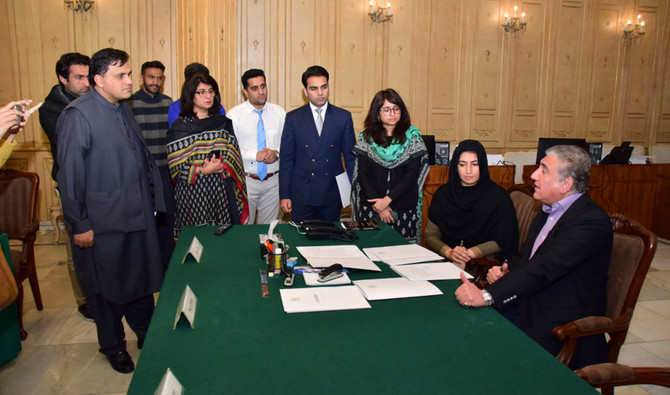
ISLAMABAD: Pakistan Foreign Minister Shah Mahmood Qureshi said on Sunday that Islamabad is taking steps to de-escalate tensions with its arch-rival India and expected a matching response from its nuclear-armed neighbor to normalize the situation.
India and Pakistan have fought two full-fledged wars in 1965 and 1971 over disputed Kashmir, but the issue stills remains unresolved and a flash-point between both the countries.
“Pakistan wants peace but it should not be misconstrued as our weakness,” Qureshi said while addressing a press conference. “India should exercise restraint and do away with its war-mongering, this won’t help any side.”
Ties between both the countries have deteriorated after a suicide bombing last week in Pulwama district of Indian-administered Kashmir in which over 40 paramilitary troops were killed. India has accused Pakistan of being involved in the attack, but Islamabad denies complicity.
Shortly after the incident, Indian Prime Minister Narendra Modi had threatened Pakistan to avenge the Pulwama attack. Alluding to Pakistan, he said those responsible for the attack will pay “a very heavy price.”
Qureshi, however, said that Pakistan will not be cowed down by Indian threats and bullish attitude.
“The whole nation is united to defend the motherland and our army, politicians, youth, and old stand shoulder to shoulder to counter any aggression by India,” he said.
The foreign minister said that amid Pakistan’s peace efforts, India was busy making emergency preparations in the disputed Kashmir to put pressure on the Islamic Republic.
India is dispatching additional ten thousand troops to Indian-administered Kashmir in anticipation of a bigger crackdown, he said, adding that Kashmiris have shut down their businesses in fear.
“Kashmiris are being tortured and their properties set alight in different areas,” he said, “Hurriyat (a political front to raise Indian atrocities in Indian-administered Kashmir) leadership has been arrested. This all is against the basic human rights.”
After the Pulwama attack, Pakistan has written separate letters to United Nations General Secretary and UN Security Council pleading their interference for peaceful resolution of the Kashmir dispute. Pakistan has also raised the issue at European Parliament and other international forums to highlight Indian brutalities and violations human rights in the disputed territory.
Tahir Malik, academic and expert on international affairs, said that Pakistan was “doing a right thing” by engaging the international community to de-escalate the tensions on border with its nuclear-armed neighbor.
“Pakistani leadership at the moment is fully focused on resolving its internal issues of governance and security, which is being lauded by the international community including the United States,” he told Arab News.
He said that Indian premier was trying to escalate the border tensions with Pakistan ahead of general elections as his BJP party “feels this will help them garner votes in the polls.”
General (retd) Talat Masood, security and defense analyst, said that Pakistan was trying its best to defuse the situation developed after Pulwama attack, but “India still appears belligerent which is dangerous for the regional peace.”
“The situation in the Indian-administered Kashmir is also going from bad to worse, and Pakistan is not left with many alternatives except raising the issue at all international forums including the UN,” he told Arab News.


