

Pakistani naval ships participate in Abu Dhabi’s International Defence Exhibition

1 / 3
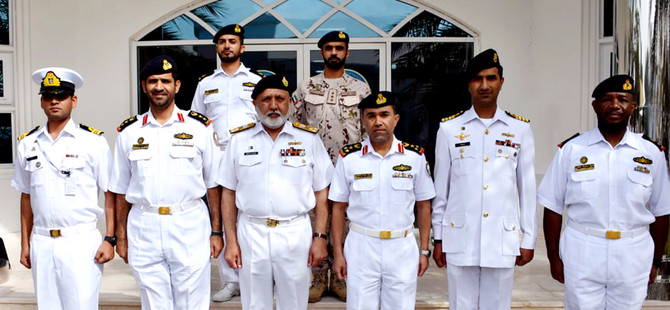
Pakistani and UAE Officials, on arrival of Pakistan Navy Ship. (Photo by Pakistan Navy)
2 / 3
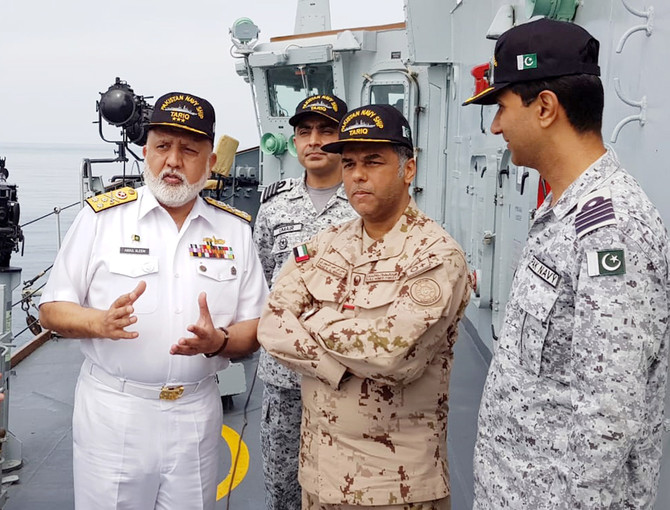
Chief of Staff (Personnel), Vice Admiral Abdul Aleem along with Pakistani and UAE officials, during Pakistan Nay ships visit to UAE. (Photo by Pakistan Navy)
3 / 3
Chief of Staff (Personnel), Vice Admiral Abdul Aleem and Fleet Commander UAE Naval Forces witnessing the bilateral exercise conducted onboard PNS TARIQ. (Photo by Pakistan Navy)
Updated 23 February 2019
Follow

Pakistani naval ships participate in Abu Dhabi’s International Defence Exhibition

  • Pakistan’s Naval Chief visited Abu Dhabi to strengthen relations with UAE military and civilian leadership
  • Two day bilateral exercise ‘Nasl al Bahr’ conducted between both navies

ISLAMABAD: Pakistan’s Naval Chief of Staff Vice Admiral Abdul Aleem was in Abu Dhabi during the International Defense Exhibition (IDEX) held last week in order to strengthen relations with the military and civil leadership of the UAE, according to a statement released by the Public Relations wing of the Pakistan Navy. 

IDEX-19 is one of the leading trade shows for defense technology in the region and is considered an ideal platform for militaries across the world to come together, share ideas and exhibit leading edge military technology.

Pakistan navy ships ‘Tariq’ and ‘Himmat’ participated in the event with a reception hosted onboard ‘Tariq’ and attended by Mrs. Zubaida Jalal, the Federal Minister for Defence Production, a number of foreign diplomats, high ranking military and civil officials from the UAE and a section of the Pakistani community and foreigners participating in IDEX-19

Navies of both countries also conducted bilateral exercises, Nasl al Bahr, which aim to enhance interoperability between the two militaries. 

During the two-day exercise, a number of evolutions pertaining to maritime security operations, search and rescue, maneuvering drills, maritime infrastructure protection, communication and warfare related exercises were undertaken.

Pakistan deputy PM speaks with Iranian FM as Saudi Arabia intercepts missiles and drones

Updated 06 March 2026
Follow

Pakistan deputy PM speaks with Iranian FM as Saudi Arabia intercepts missiles and drones

  • Ishaq Dar expresses concern over evolving regional situation as both officials agree to remain in contact
  • Pakistan earlier reminded Tehran of its mutual defense pact with Saudi Arabia during diplomatic outreach

ISLAMABAD: Pakistan’s Deputy Prime Minister and Foreign Minister Ishaq Dar spoke with Iranian Foreign Minister Seyyed Abbas Araghchi on Friday amid escalating tensions in the Gulf, including recent missile and drone attacks targeting Saudi Arabia that were intercepted by the Kingdom’s air defenses.

The call comes as Islamabad remains in contact with both Tehran and Gulf states to prevent the widening Iran conflict from spilling further across the region, particularly after attempted strikes on Saudi territory, a sensitive development for Pakistan, which signed a mutual defense pact with the Kingdom last year.

Pakistan’s foreign ministry said Dar raised concerns about the evolving regional situation during the conversation.

“Deputy Prime Minister/Foreign Minister Senator Mohammad Ishaq Dar spoke this evening with the Foreign Minister of Iran, Seyyed Abbas Araghchi,” the ministry said in a statement.

“The DPM/FM expressed concern over the evolving regional situation. The two agreed to remain in touch on the developments,” it added.

The ministry did not share details of the conversation, though it came amid fast-moving developments in the region, with Saudi Arabia saying its air defenses intercepted multiple missiles and drones early on Friday.

Earlier this week, Prime Minister Shehbaz Sharif’s adviser on political affairs Rana Sanaullah said Pakistan was in contact with Iran to discourage attacks on Gulf countries and prevent misunderstandings.

“Such attacks should not be carried out from Iran’s side,” he told Geo TV.

Prior to that, the deputy prime minister told Pakistan’s Senate that Islamabad had engaged both Iran and Saudi Arabia at the outset of Iran’s retaliation in the region, reminding Tehran of its defense agreement with Saudi Arabia and conveying assurances from Riyadh that Saudi territory would not be used against Iran.

Pakistan says its administration is striving to end the conflict, though the United States-Israeli strikes on Iran, which triggered the war and led to its spillover, have only intensified.

Iranian President Masoud Pezeshkian said on Friday some countries had begun mediation efforts but insisted Tehran would defend its sovereignty.

Meanwhile, US President Donald Trump has called for Iran’s “unconditional surrender” on his Truth Social platform as the confrontation shows little sign of easing.