

Attack by India will be “paid back in same coin,” Pakistan army chief warns

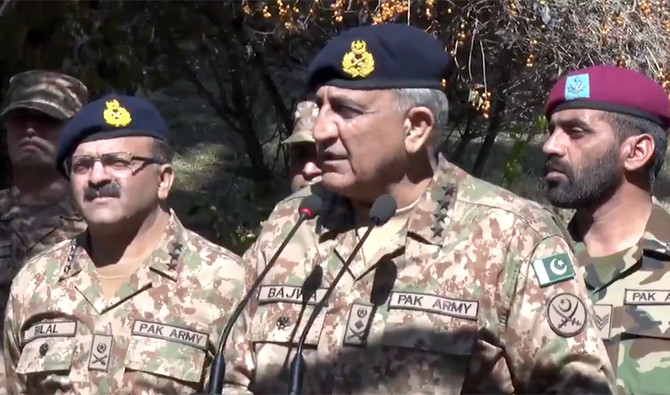
Pakistani army chief Gen Qamar Bajwa talking to Pakistan army troop on Line of Control in Kashmir on Feb. 22. (Source ISPR)
Updated 23 February 2019
Follow

Attack by India will be “paid back in same coin,” Pakistan army chief warns

  • Gen Bajwa visits Line of Control to review troop preparedness and morale
  • Military spokesman tells India: “Don’t mess with Pakistan”

ISLAMABAD: Pakistani army chief Gen Qamar Bajwa warned India on Friday against carrying out an attack on Pakistan, saying any “misadventure” would be reciprocated in equal measure.

The army chief’s statement came during a visit to the Line of Control, or de factor border, between Pakistan and India in Kashmir to review the state of troop preparedness and morale.

Tensions between nuclear-armed neighbours Pakistan and India have sharply escalated since last week’s suicide attack in the disputed region of Kashmir in which 40 Indian troopers were killed. Jaish-e-Mohammed, a group believed to be based in Pakistan, claimed responsibility for the attack and India has warned Islamabad of a “strong response” to the assault.

Pakistan denies any state complicity in the attack and said on Friday it had taken control of Jaish headquarters in the southern Punjab city of Bahawalpur and appointed an administrator.

“Pakistan is a peace-loving country but we will not be intimidated or coerced,” the chief said in an address to soldiers. “Any aggression or misadventure shall be paid back in same coin.”

Earlier on Friday Pakistan army spokesman Maj. Gen. Asif Ghafoor also warned India against military action, saying Islamabad would respond with “full force” if attacked.

“We have no intention to initiate war, but we will respond with full force to full spectrum threat that would surprise you,” Ghafoor told reporters at a press conference. “Don’t mess with Pakistan.”

India has long held that Pakistani Islamist militant groups infiltrate into the part of Kashmir that it administers to fuel insurgency and help separatist movements. Pakistan denies this, saying it only provides Kashmiris moral and diplomatic support in their struggle for self-determination.

Pakistan and India have fought three wars since they gained independence from the British in 1947, two of them over the disputed Kashmir valley.

Ghafoor said Islamabad had delayed its response to the Kashmir attack to investigate what he called New Delhi’s baseless claims of state-sponsored terrorism by Pakistan. Following this, he said, Prime Minister Imran Khan had responded in a recorded address to the nation

on Tuesday, asking India to provide “actionable intelligence” and warning retaliation if India attacked.

“Terrorism is a regional problem and Pakistan is willing to table talks with India on the matter,” the military spokesman reiterated.

The attack in disputed Kashmir came just days before a scheduled visit to Pakistan by Saudi Crown Prince Muhammed bin Salman in which he was slated to sign agreements worth billions of dollars. Pakistan and the Kingdom eventually signed agreements worth $21 billion during the crown prince’s visit.

“When an important event for Pakistan is scheduled to happen, this type of staged action arises,” Ghafoor said, referring to the crown prince’s visit.

“The attack happened miles from the Line of Control,” the army spokesman said, referring to the de-facto border between the two countries. “The explosives used were under use by Indian security forces and administration – it didn’t come from Pakistan. The vehicle used was local, not from Pakistan. The attack [was carried out ] by a young Kashmiri, who was a resident of Indian-administered Kashmir.”

Hours after Ghafoor’s press conference, Indian finance minister Arun Jaitley said in New Delhi that India would “exercise all instruments at its command, whether it is diplomatic or otherwise” to respond to Pakistan over its alleged role in the deadly Kashmir bombing.

Referring to Islamabad’s alleged support for Islamist militant groups, Jaitley added, “I think Pakistan is riding a tiger on this issue, and a tiger never spares its own rider.”


World Bank approves $400 million to expand water, sanitation services in Pakistan’s Punjab

Updated 4 sec ago
Follow

World Bank approves $400 million to expand water, sanitation services in Pakistan’s Punjab

  • Project aims to improve access for 4.5 million people and curb waterborne diseases
  • Program to prioritize women’s participation and climate-resilient urban infrastructure

ISLAMABAD: The World Bank this week approved $400 million for a new project to expand access to safe water, sanitation and hygiene services for around 4.5 million people in Pakistan’s most populous Punjab province, aiming to curb waterborne diseases and reduce long-term public health costs.

The project, known as the Punjab Inclusive Cities Program (PICP), is the second phase of the World Bank-supported Pakistan Urban Water, Sanitation and Hygiene Services Multiphase Programmatic Approach. It will focus on rehabilitating water supply networks, sewerage systems and wastewater treatment plants, while expanding stormwater drainage infrastructure across 16 secondary cities in Punjab.

Punjab faces persistent challenges in providing safe drinking water and adequate sanitation, with many urban households relying on contaminated sources. Weak infrastructure and limited hygiene services contribute to high rates of waterborne diseases such as diarrhea, typhoid and hepatitis, which disproportionately affect children and low-income communities.

“Reducing child stunting is essential for Pakistan’s future. Through the Punjab Inclusive Cities Program, we are investing in safe water, sanitation, and hygiene services to break the cycle of malnutrition and disease that holds back so many children from reaching their full potential,” the World Bank quoted its Country Director for Pakistan, Bolormaa Amgaabazar, as saying in a statement.

“In collaboration with the Punjab Government, the program represents a significant step forward in improving urban infrastructure and strengthening local institutions, thereby laying the foundation for healthier communities and a more prosperous Pakistan.”

Child stunting, a form of chronic malnutrition that leaves children too short for their age, is often linked to repeated infections, poor sanitation and unsafe drinking water, and remains a major public health concern in Pakistan.

Beyond water and sanitation, the project will also support solid waste management systems to improve sanitary waste disposal, extending services to an additional two million people in Punjab’s urban areas. The program will strengthen the capacity of local governments, including efforts to improve revenue generation and long-term service sustainability.

“The program complements infrastructure investments with capacity building and revenue generation, helping to ensure that service delivery is well sustained,” the statement quoted Amena Raja, Senior Urban Specialist at the World Bank, as saying.

“It will also help Punjab’s cities better withstand floods and droughts, ensuring urban development is both environmentally responsible and resilient to climate change.”

The program includes a gender-focused component, prioritizing the hiring of women in decision-making roles, establishing gender-compliant service desks and supporting skills development. It also aims to mobilize private capital to support water and sanitation services in Punjab’s secondary cities.

Pakistan has been a member of the World Bank since 1950 and has received more than $48 billion in assistance since. The Bank’s current portfolio in the country comprises 54 projects with total commitments of $15.7 billion, while its private-sector arm, the International Finance Corporation, has invested about $13 billion since 1956.

Earlier this year, Pakistan and the World Bank signed a first-of-its-kind agreement for a plan to focus $20 billion in lending to the cash-strapped nation over the coming decade on development issues like the impact of climate change as well as boosting private-sector growth.