WASHINGTON: The United States will leave “a small peacekeeping group” of 200 American troops in Syria for a period of time after a US pullout, the White House said on Thursday.
President Donald Trump in December ordered a withdrawal of the 2,000 American troops in Syria on the defeat of the last remnants of the Islamic State militancy there.
But he has been under pressure from some advisers to adjust his policy to ensure the protection of Kurdish forces who supported the fight against Islamic State and who might now be threatened by Turkey.
“A small peacekeeping group of about 200 will remain in Syria for a period of time,” White House spokeswoman Sarah Sanders said in a brief statement.
The decision was announced after Trump spoke by phone to Turkish President Tayyip Erdogan.
A White House statement said that the two leaders agreed, regarding Syria, to “continue coordinating on the creation of a potential safe zone.”
They noted that acting Secretary of Defense Patrick Shanahan and Chairman of the Joint Chiefs General Joseph Dunford would be hosting their Turkish counterparts in Washington this week for further talks, the White House said.

US to leave 200 troops in Syria for a period of time - White House
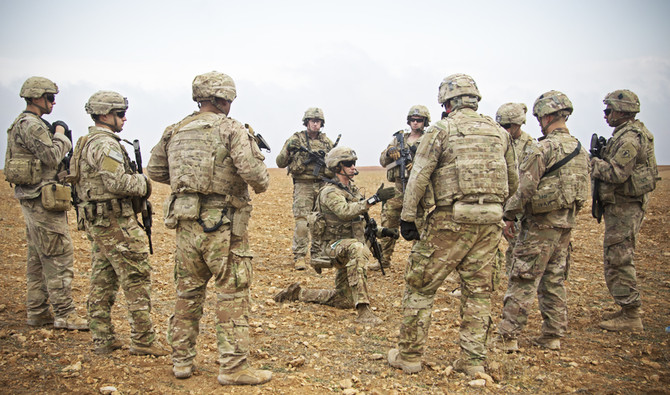
- The decision was announced after Trump spoke by phone to Turkish President Tayyip Erdogan
Hamas official says group in final stage of choosing new chief
CAIRO: A senior Hamas official told AFP on Sunday that the Palestinian movement was in the final phase of selecting a new leader, with two prominent figures competing for the position.
Hamas recently completed the formation of a new Shoura Council, a consultative body largely composed of religious scholars, as well as a new political bureau.
Members of the council are elected every four years by representatives from Hamas’s three branches: the Gaza Strip, the occupied West Bank and the movement’s external leadership.
Hamas prisoners in Israeli jails are also eligible to vote.
The council subsequently elects the political bureau, which in turn selects the head of the movement.
“The movement has completed its internal elections in the three regions and has reached the final stage of selecting the head of the political bureau,” the official said, speaking on condition of anonymity as he was not authorized to speak publicly.
He added that the race for the group’s leadership is now between Khaled Meshaal and Khalil Al-Hayya.
A second Hamas source confirmed the development within the organization, which fought a devastating war with Israel following its October 7, 2023 attack.
Hayya, 65, a Gaza native and Hamas’s chief negotiator in ceasefire talks, has held senior roles since at least 2006, according to the US-based NGO the Counter Extremism Project (CEP).
Meshaal, who led the political bureau from 2004 to 2017, has never lived in Gaza. He was born in the West Bank in 1956.
He joined Hamas in Kuwait and later lived in Jordan, Syria and Qatar. The CEP says he oversaw Hamas’s evolution into a political-military hybrid.
He currently heads the movement’s diaspora office.
Last month, a Hamas source told AFP that Hayya enjoys backing from the group’s armed wing, the Ezzedine Al-Qassem Brigades.
After Israel killed former Hamas leader Ismail Haniyeh in Tehran in July 2024, the group chose its then-Gaza chief Yahya Sinwar as his successor.
Israel accused Sinwar of masterminding the October 7 attack.
He too was killed by Israeli forces in the southern Gaza city of Rafah, three months after Haniyeh’s assassination.
Hamas then opted for an interim five-member leadership committee based in Qatar, postponing the appointment of a single leader until elections, given the risk of the new chief being targeted by Israel.
Hamas recently completed the formation of a new Shoura Council, a consultative body largely composed of religious scholars, as well as a new political bureau.
Members of the council are elected every four years by representatives from Hamas’s three branches: the Gaza Strip, the occupied West Bank and the movement’s external leadership.
Hamas prisoners in Israeli jails are also eligible to vote.
The council subsequently elects the political bureau, which in turn selects the head of the movement.
“The movement has completed its internal elections in the three regions and has reached the final stage of selecting the head of the political bureau,” the official said, speaking on condition of anonymity as he was not authorized to speak publicly.
He added that the race for the group’s leadership is now between Khaled Meshaal and Khalil Al-Hayya.
A second Hamas source confirmed the development within the organization, which fought a devastating war with Israel following its October 7, 2023 attack.
Hayya, 65, a Gaza native and Hamas’s chief negotiator in ceasefire talks, has held senior roles since at least 2006, according to the US-based NGO the Counter Extremism Project (CEP).
Meshaal, who led the political bureau from 2004 to 2017, has never lived in Gaza. He was born in the West Bank in 1956.
He joined Hamas in Kuwait and later lived in Jordan, Syria and Qatar. The CEP says he oversaw Hamas’s evolution into a political-military hybrid.
He currently heads the movement’s diaspora office.
Last month, a Hamas source told AFP that Hayya enjoys backing from the group’s armed wing, the Ezzedine Al-Qassem Brigades.
After Israel killed former Hamas leader Ismail Haniyeh in Tehran in July 2024, the group chose its then-Gaza chief Yahya Sinwar as his successor.
Israel accused Sinwar of masterminding the October 7 attack.
He too was killed by Israeli forces in the southern Gaza city of Rafah, three months after Haniyeh’s assassination.
Hamas then opted for an interim five-member leadership committee based in Qatar, postponing the appointment of a single leader until elections, given the risk of the new chief being targeted by Israel.
© 2026 SAUDI RESEARCH & PUBLISHING COMPANY, All Rights Reserved And subject to Terms of Use Agreement.


