‘He is alive in our hearts’: Pakistani flood hero remembered by family

1 / 2
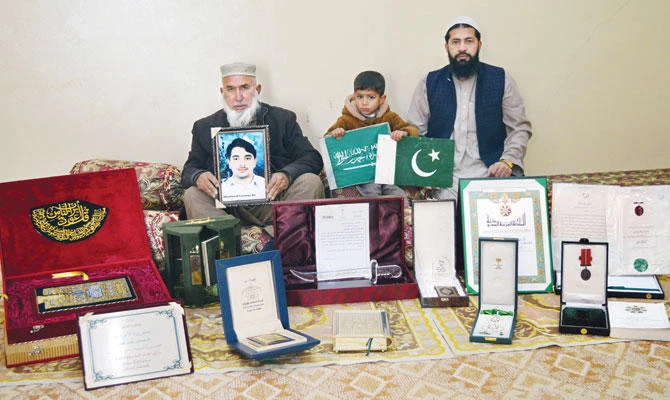
Farman Ali Khan’s father Umar Rehman displays the King Abdul Aziz Medal of the First Order. (AN photos by Rafi Ullah)
2 / 2
Farman Ali Khan’s father Umar Rehman displays the King Abdul Aziz Medal of the First Order. (AN photos by Rafi Ullah)
Updated 18 February 2019
Follow

‘He is alive in our hearts’: Pakistani flood hero remembered by family

  • Saudi and Pakistan governments posthumously honored Farman Ali Khan for his bravery

KARACHI: The daughters of a Pakistani man considered a hero in both his home country and Saudi Arabia for his rescue of 14 people during torrential floods in Jeddah say he “will always be alive in our memory.”
In late November 2009, as flash floods roared through the port city, Farman Ali Khan secured a rope to his waist and jumped into the roaring floodwaters to rescue people.
Khan saved 14 lives, but lost his own while attempting to rescue a 15th person.
He was posthumously awarded the King Abdul Aziz Medal of the First Order by the Saudi government and Pakistan’s Tamgha-e-Shujat by then President Asif Ali Zardari.
Khan’s three daughters, Zubaida, Madeeha and Javeriah, told Arab News by phone from his hometown of Swat this week that they remembered their father as a patient, mild-mannered family man who loved to joke and lived to help others.
“He always dreamt of being a doctor, but financial troubles forced him to stop his education and become a grocer in Jeddah,” said Zubaida. “He couldn’t become a doctor, so now we will fulfil his dream,” she said.
“We unluckily spent little time with our father,” she said. “But he will be alive in our memories forever. Everyone in our neighborhood and school knows us as the children of a hero. Khan is our superstar.”
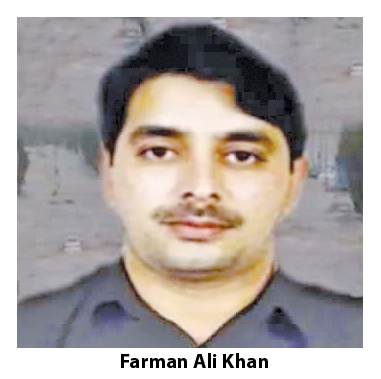

Khan’s father, Umar Rehman, told Arab News his son was one of nine siblings, and was hardworking and always busy. “But he would call his family in Pakistan every chance he got.”
“He was brave and fearless, but very kind and obedient,” Rehman said. “He would always talk in a light way, laughing out loud. I remember that when his grandmother would get upset, he would crack jokes until she started laughing. I never saw him angry or arguing with anyone.”
Rehman said he was devastated when he heard about his son’s death, but the story of his bravery “started healing my wounds, gradually.”
Shortly after Khan’s death, the family received a condolence letter from Saudi King Abdullah and accepted an invitation to visit the Kingdom as special state guests. A grand reception was held at the palace where the king awarded Khan the King Abdul Aziz Medal of the First Order.
His father said that just weeks before his death, Khan had planned to get him a longer-term Hajj visa so they could spend time together.
“Farman from his childhood had learned to live for others. He gave us the message that those living for others live long, even if their souls journey to another world.
“Farman is alive, in our hearts and in our memories,” Rehman said.
Saudi traditional meal anchors Al-Balad’s culinary scene

Ghalib Naji Al-Shadwy (center) with his son (right) and longtime customer Abu Samer Al-Sulami (left). (AN photo)
Updated 14 December 2025
Follow

Saudi traditional meal anchors Al-Balad’s culinary scene

  • Slow-cooked sheep’s head is drawing new generations and visitors to Jeddah’s historic district

JEDDAH: In the streets of Al-Balad, where centuries-old buildings frame one of Saudi Arabia’s most storied districts, culinary heritage continues to draw visitors as powerfully as architecture. 

Among the area’s enduring attractions is Al-Shadwy for Sheep Head Meat, a family-run restaurant that has served one of the Kingdom’s most traditional dishes since 1958, turning a once-necessity meal into a symbol of Saudi food culture and hospitality.

Tucked into Baba Makkah, Al-Balad’s historic core, Al-Shadwy began as a modest corner table before becoming a landmark destination for locals, food enthusiasts and tourists seeking an authentic taste of the past.

Eating sheep’s head has long been rooted in Arab culinary traditions, shaped by the principle of using the entire animal and avoiding waste. (AN photo)

Now run by the third generation of the Al-Shadwy family, the restaurant remains devoted to a single specialty; sheep’s head, slow-roasted over charcoal using a recipe unchanged for decades.

Eating sheep’s head has long been rooted in Arab culinary traditions, shaped by the principle of using the entire animal and avoiding waste. In Saudi Arabia, the dish evolved into communal meal associated with generosity, warmth and social gathering.

Sixty-five-year-old owner Ghalib Naji Al-Shadwy, who inherited the restaurant from his grandfather and father, remains a familiar presence at the restaurant, overseeing the service and greeting customers. 

FASTFACTS

• Al-Shadwy for Sheep Head Meat is a family-run restaurant in Al-Balad that has served one of the Kingdom’s most traditional dishes since 1958.

• It began as a modest corner table before becoming a landmark destination for locals, food enthusiasts and tourists seeking an authentic taste of the past.

He told Arab News that the dish has been central to Saudi culinary culture for generations.

“The sheep’s head has been a staple in Saudi Arabia and other GCC countries culinary culture for centuries,” he said. “Traditionally, it was a meal served during cold winter mornings to provide energy and warmth. In many regions of Saudi Arabia, the sheep head (is) always on the top of the main plate for guests, and families festive holidays gather in restaurants or at home to enjoy the sheep’s head, making it a social and festive occasion.”

In Saudi Arabia, the dish evolved into communal meal associated with generosity, warmth and social gathering. (AN photo)

Speaking about its significance in hospitality culture, he added: “Serving it to guests is considered an act of generosity and care.” Rich and filling, it is most commonly eaten as breakfast or an early morning meal.

Preparing sheep’s head is a slow, careful process. According to Al-Shadwy, the heads are cooked at low temperatures to soften the tendons and connective tissue, resulting in tender meat and deep flavor.

The preparation includes curing and slow cooking, a method that has remained largely unchanged at the restaurant for more than six decades. 

Being a family-owned restaurant here for so many years makes us a part of Jeddah’s history.

Ghalib Naji Al-Shadwy, Al-Shadwy for Sheep Head Meat owner

“I’ve cooked many sheep heads a while back and I still enjoy it,” he said. “Most of the customers actually prefer the head and the brain.”

Despite its small size and somewhat tucked-away location, the restaurant’s popularity is unmistakable. Long queues form outside each morning, often guiding first-time visitors to its door. A sign reading “Al-Shadwy Mandi” in Arabic marks the entrance, while the steady crowd confirms its reputation.

Over the years, the restaurant has attracted officials, celebrities and social media figures, with photographs of notable guests lining the walls. Al-Shadwy said the steady attention reflections Al-Balad’s growing appeal as a cultural and culinary destination.

He said that interest in sheep’s head is no longer limited to older generations. Younger Saudis, he said, are increasingly curious about traditional dishes, while tourists often see it as an adventurous experience. 

“For many visitors, trying sheep’s head is considered ‘extreme food’ or a challenging dish,” he said. “But it gives them a sense of adventure and a unique story to tell.”

Inside the lively restaurant one morning, longtime customer Abu Samer Al-Sulami, who has been dining there for 40 years, described it as a rare example of authentic Saudi cuisine.

“I am a regular customer here and always come early in the morning because when you eat the sheep’s head it really gives you energy for work,” he said. 

Demand is highest in the early hours, particularly on Fridays. Al-Shadwy said the restaurant often sells out by mid-morning, making early visits essential.

“The number of sheep heads our restaurant sells daily varies but it reaches around 200 heads,” he added.

As he works alongside his two sons, Al-Shadwy says preserving the family legacy is as important as serving the fish. 

“Being a family-owned restaurant here for so many years makes us a part of Jeddah’s history,” he said.