Saudi Arabia, Pakistan sign seven investment MoUs worth $21 billion

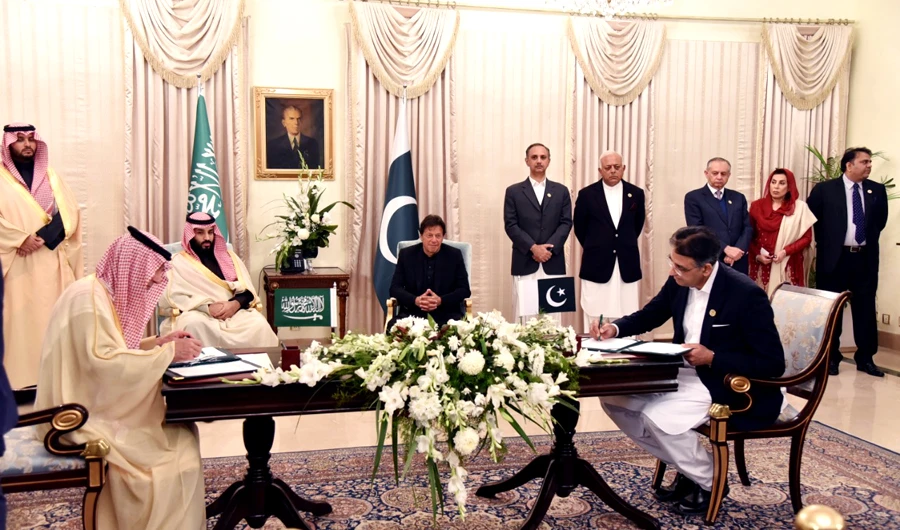
Prime Minister Imran Khan and Saudi Crown Prince Mohammed bin Salman watch officials of the two countries sign seven memoranda of understanding worth $20 billion in Islamabad on Sunday. (PM Office)
Updated 18 February 2019
Follow

Saudi Arabia, Pakistan sign seven investment MoUs worth $21 billion

  • Short-term projects include $4 billion RLNG plants, $2 billion investment in renewable energy, $1 billion Saudi Fund for Pakistan
  • Package also includes $1 billion each for petrochemical and food, agricultural projects, $10 billion oil refinery in Gwadar, $2 billion for minerals sector Aamir Shah

ISLAMABAD: Pakistan and Saudi Arabia have signed short-, mid- and long-term investment agreements worth $21 billion during the visit to Islamabad of Saudi Crown Prince Mohammed bin Salman, the Pakistani government said on Monday.
The crown prince is on a two-day visit to Pakistan as part of a rare tour of Asia which includes trips to India and China.
“Pakistan and Saudi Arabia today are entering into a new economic partnership which will lead to shared prosperity, regional stability and mutual respect based on long term investment, strategic and social ties,” the government of Pakistan said in a tweet from its official Twitter account.
The government also provided a breakdown of the seven memorenda of understanding (MoUs) signed between Pakistan and Saudi Arabia on Sunday night.
Short-term projects include two Re-Gasified Liquefied Natural Gas plants for $4 billion, a $2 billion investment by Saudi power producing company ACWA Power in Pakistan’s renewable energy sector and a $1 billion Saudi Fund for Pakistan.
Mid-term projects include $1 billion each for petrochemical and food and agricultural projects. The long-term investments are $10 billion for the construction of the multi-billion-dollar Saudi Aramco oil refinery in Gwadar and $2 billion for the minerals sector.
The total investment comes to $21 billion, according to government figures.
“These agreements will lay the foundation for enhanced economic cooperation between Pakistan and the Kingdom of Saudi Arabia,” Pakistan’s Foreign Office said in a statement shortly after the signing of the agreements in the presence of Pakistani Prime Minister Imran Khan and the Saudi crown prince on Sunday night.
Saudi Arabia and Pakistan are historically close allies, and Riyadh’s investment comes at a time when Islamabad is facing a balance-of-payments crisis and a widening current account and fiscal deficit. Saudi Arabia and the United Arab Emirates have already extended $6 billion ($3 billion each) in cash assistance to Islamabad to stave off its economic meltdown.
In a press conference last week, Pakistani foreign minister Shah Mehmood Qureshi said Saudi Arabia would give Pakistan a total of $9.6 billion in loans and oil on deferred payments in the next three years. 
Announcing the Saudi investment in Pakistan, the crown prince said on Sunday night: “It’s big for phase one, and definitely it will grow every month and every year, and it will be beneficial to both countries.”
“I want to thank you for the way you helped us when we were in bad situation,” PM Khan said.
Senior economist Muzamil Aslam said the Saudi investments were “good news for all Pakistanis” and would help stabilize the country’s economy and create job opportunities for skilled and unskilled youth.
“Saudi investment in different sectors will help Pakistan lure businessmen from other countries as well,” he told Arab News. “More Middle Eastern countries, especially the U.A.E., will invest in Pakistan in the coming months and years following the Kingdom.”  

Imran Khan not a ‘national security threat,’ ex-PM’s party responds to Pakistan military

Updated 4 sec ago
Follow

Imran Khan not a ‘national security threat,’ ex-PM’s party responds to Pakistan military

  • Pakistan’s military spokesperson on Friday described Khan’s anti-army narrative as a “national security threat”
  • PTI Chairman Gohar Ali Khan says words used by military spokesperson for Khan were “not appropriate”

ISLAMABAD: Former prime minister Imran Khan’s Pakistan Tehreek-e-Insaf (PTI) party on Saturday responded to allegations by Pakistan military spokesperson Lt. Gen. Ahmed Sharif Chaudhry from a day earlier, saying that he was not a “national security threat.”

Chaudhry, who heads the military’s media wing as director general of the Inter-Services Public Relations (ISPR), spoke to journalists on Friday, in which he referred to Khan as a “mentally ill” person several times during the press interaction. Chaudhry described Khan’s anti-army narrative as a “national security threat.”

The military spokesperson was responding to Khan’s social media post this week in which he accused Chief of Defense Forces Field Marshal Asim Munir of being responsible for “the complete collapse of the constitution and rule of law in Pakistan.” 

“The people of Pakistan stand with Imran Khan, they stand with PTI,” the party’s secretary-general, Salman Akram Raja, told reporters during a news conference. 

“Imran Khan is not a national security threat. Imran Khan has kept the people of this country united.”

Raja said there were several narratives in the country, including those that created tensions along ethnic and sectarian lines, but Khan had rejected all of them and stood with one that the people of Pakistan supported. 

PTI Chairman Gohar Ali Khan, flanked by Raja, criticized the military spokesperson as well, saying his press talk on Thursday had “severely disappointed” him. 

“The words that were used [by the military spokesperson] were not appropriate,” Gohar said. “Those words were wrong.”

NATURAL OUTCOME’

Speaking to reporters earlier on Saturday, Pakistan’s Defense Minister Khawaja Asif defended the military spokesperson’s remarks against Khan.

“When this kind of language is used for individuals as well as for institutions, then a reaction is a natural outcome,” he said. 

“The same thing is happening on the Twitter accounts being run in his [Khan’s] name. If the DG ISPR has given any reaction to it, then I believe it was a very measured reaction.”

Khan, who was ousted after a parliamentary vote of confidence in April 2022, blames the country’s powerful military for removing him from power by colluding with his political opponents. Both deny the allegations. 

The former prime minister, who has been in prison since August 2023 on a slew of charges he says are politically motivated, also alleges his party was denied victory by the army and his political rivals in the 2024 general election through rigging. 

The army and the government both deny his allegations.