India, Pakistan to argue at World Court amid tensions

Indian friends of Kulbhushan Jadhav hold a photograph of them with Jadhav in the neighborhood where he grew up in Mumbai. (File/Reuters)
Updated 15 February 2019
Follow

India, Pakistan to argue at World Court amid tensions

  • For four days next week, the two countries will argue their case in open court in The Hague
  • Jadhav’s death sentence provoked outrage in India and the case has added to the long-running tensions between the nations

THE HAGUE: The World Court will hear arguments on Monday in a dispute between India and Pakistan about a former Indian navy commander sentenced to death by Islamabad for allegedly being an intelligence agency spy.
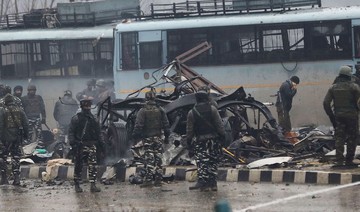
The hearings come at a time of particularly strained relations between the nuclear-armed neighbors following a suicide attack on a convoy in Kashmir on Thursday that killed 44 Indian paramilitary policemen.
Pakistan has dismissed Indian accusations it was involved in the bombing, but Indian Prime Minister Narendra Modi warned Islamabad on Friday to expect a strong response.
Pakistani authorities say Kulbhushan Sudhir Jadhav, 48, was arrested in March 2016 in Pakistan’s Baluchistan province, the site of a long-running conflict between security forces and separatists. He was convicted of espionage and sabotage by a military court.
But India won an injunction from the World Court, formally known as the International Court of Justice, the following year. It ordered his execution stayed after India argued that Jadhav had been denied his right to diplomatic assistance under the 1963 Vienna Convention.
For four days next week, the two countries will argue their case in open court in The Hague. The court’s rulings are final and cannot be appealed, but the UN body has no mechanism to enforce its decisions, which major powers have ignored in the past.
Jadhav’s death sentence provoked outrage in India and the case has added to the long-running tensions between the nations, with each accusing the other of supporting cross-border violence along the disputed Kashmir border.
India wants the ICJ to order Pakistan to annul the conviction, ensure the death sentence is not carried out, and release Jadhav.
Pakistan has argued that the ICJ is not a criminal appeals court and said the measures sought are not proportionate to the alleged wrongdoing on the part of Islamabad by not facilitating consular assistance to Jadhav.
India contests Pakistan’s version of events and has said that Jadhav was not arrested in Pakistan, but kidnapped from Iran, where he was working after retiring from the navy.
India also dismissed Pakistani assertions that Jadhav confessed that he was an agent for the Indian intelligence service and had been hired with the intent to “destabilize and wage war against Pakistan”.


Iran war unsettles India’s packaged water makers as bottles, caps get pricey

Updated 12 March 2026
Follow

Iran war unsettles India’s packaged water makers as bottles, caps get pricey

  • Higher polymer ‌prices hurt bottled water industry
  • Industry worth $5 billion has big multinational players like Pepsi, Coca-Cola

NEW ​DELHI: The Iran war is rattling India’s $5 billion packaged water market just ahead of the sweltering summer season.
One of the world’s fastest growing bottled water markets is seeing some manufacturers hike prices for distributors, as supply disruptions linked to the war fuel higher costs in everything from plastic bottles to caps, labels and cardboard boxes.
Though retail prices are yet to feel the heat and bigger companies are absorbing the pain, about 2,000 smaller bottled water makers have increased rates for their resellers by around 1 rupee per ‌bottle, a ‌5 percent hike, which will rise by a further 10 percent in ​coming ‌days, ⁠according ​to the ⁠Federation of All India Packaged Drinking Water Manufacturers’ Association.
Consumers usually pay less than 20 rupees, or around 20 US cents, for a one-liter bottle.
“There is chaos and within the next 4-5 days, this will start impacting customer prices,” said Apurva Doshi, the federation’s secretary general.
Rising oil prices have increased the cost of polymer, which is made from crude oil and is a key material for the industry’s plastic bottles. The cost of material used in making ⁠plastic bottles has risen by 50 percent to 170 rupees per kilogram, ‌while the price of the caps has more than ‌doubled to 0.45 rupees apiece. Even corrugated boxes, labels and ​adhesive tape are costing much more, ‌industry letters showed.
Clean water is a privilege in the country of 1.4 billion people where ‌researchers say 70 percent of the groundwater is contaminated, leaving people reliant on bottled water. Companies including Bisleri, Coca-Cola’s Kinley, Pepsi’s Aquafina, billionaire Mukesh Ambani’s Reliance and Tata all compete for a share of the $5 billion market. The companies did not respond to Reuters request for comment.
PREMIUM WATER FACES HEAT ‌TOO
Within the broad bottled water market, natural mineral water is a $400 million business in India and a new, fast-growing wellness product for ⁠India’s wealthy.
The premium ⁠water segment accounted for 8 percent of the bottled water market last year in India, compared to just 1 percent in 2021, Euromonitor says.
Aava, which sells mineral water sourced from the foothills of the Aravalli mountains, has increased prices of its water bottles by 18 percent for resellers, Shiroy Mehta, CEO of the company, told Reuters.
“Most manufacturers are absorbing 40-50 percent of the cost to ensure that they don’t lose clients. It’s a poor situation for the beverage industry ahead of the summer season,” he said.
The mass market, however, is dominated by companies that produce “drinking water” to be sold in 1-liter bottles to customers. Clear Premium Water, a brand of India’s Energy Beverages, said in a notice to its distributors there ​had been an “unprecedented and continuous surge” in ​prices of key raw materials used in packaging and production.
“It is no longer possible for us to absorb the escalating costs while maintaining existing product prices,” the notice said.