

Khyber Pakhtunkhwa excited about Saudi crown prince’s Pakistan visit

1 / 5
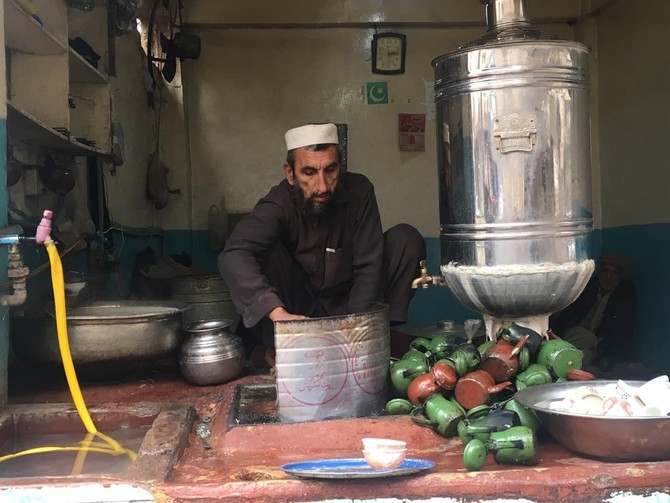
Jalal, a tea stall owner, expects the dawn of a new era of economic and cultural relations between KSA and Pakistan with the upcoming visit of Saudi’s crown prince to the country. (AN photo)
2 / 5
Syed Bacha has spent more than three decades in KSA and now runs his own barber shop in Peshawar. He believes that the relations between the two countries will be stronger going forward. (AN photo)
3 / 5
Rickshaw driver Amjad Khan expects Saudi Crown Prince Mohammed bin Salman to extend further support to Prime Minister Imran Khan’s government. (AN photo)
4 / 5
KSA and Pakistan share many cultural and Islamic values. These should be stronger for the future generations, Jalal said. (AN photo)
5 / 5
A dry fruit vendor, Anwar Shah, said that Saudi Arabia is a highly-revered place by Pakistanis and the royal’s visit is a moment of pride for the country. (AN photo)
Updated 16 February 2019
Follow

Khyber Pakhtunkhwa excited about Saudi crown prince’s Pakistan visit

  • Pakistanisl who once lived in the Gulf country nostalgically recall their time in the Kingdom
  • Crown Prince Mohammed bin Salman's visit seen as a step toward greater economic and defense relations

PESHAWAR: The stage is set, as are the residents of Pakistan, for the historic visit of Saudi Arabia’s Crown Prince Mohammed bin Salman on February 16.

Syed Jalal, a 57-year-old tea stall owner in Peshawar’s busy Super Market termed the visit as the beginning of a new era of mutual trust. “The relationship between Pakistan and KSA has been colorless in the past few years,” he said, adding that the new government wants “respectable, cordial and brotherly relations with the most important and sacred Saudi Arabian government.”

A thought that was echoed by other returnees from the Gulf country.

Rickshaw driver Amjad Khan, 30, has few years of experience working in Saudi Arabia which he described as the best of his life. “I was a laborer in Pakistan but earned enough in Saudi Arabia to own three rickshaws and feed my family without any difficulty,” he said. 

Thousands of Pakistanis work in the health, education, construction and other developmental sectors of the Kingdom. According to the Bureau of Emigration and Overseas Employment website, in December last year, 1,00,091 Pakistanis were employed in various sectors of the country.

In January this year, overseas Pakistanis contributed $403.92 million in remittances, as per statistics revealed by the State Bank of Pakistan. Remittances from KSA are the highest followed by those from the UAE, UK and the US. 

For decades, the Saudi government has assisted Pakistan and its people in the worst of its times, Khan said, adding that this time, too, the crown prince’s visit was “to support Imran Khan’s government in this bad spell.”

“Imran Khan wants to get rid of it’s dependency on the Americans and the International Monetary Fund (IMF) and the crown prince’s visit is a step toward greater economic and defense relations,” Anwar Shah, a dry fruit vendor, said, adding that the “Pakistani people would be in the front line, if any country dares a misadventure against Saudi Arabia”.

“Narrowing the gap between Arab countries and Pakistan is much needed now, the moderate crown prince would knot both nations accurately this time”, fruits vendor Iqbal Shah, 43, stated. “We are of the same belief and share alike Islamic values and culture, lets stand with each other against enemies” he added. 

Said Bacha hails from the Khyber district of the erstwhile Federally Administered Tribal Areas (FATA) and worked for more than 30 years in KSA as a barber. “I have seen splendid rulers,” he said. “The crown prince’s visit will further strengthen the warm, friendly and affectionate relations of both the Muslim nations.”

Beside the bilateral and trade ties, a huge number of Pakistanis visit the Kingdom to perform Umrah and Hajj holy cities.


Pakistan to begin first phase of Hajj 2026 trainings from today

Updated 31 December 2025
Follow

Pakistan to begin first phase of Hajj 2026 trainings from today

  • Training programs to be held in phases across Pakistan till February, says religion ministry
  • Saudi Arabia allocated Pakistan a total quota of 179,210 pilgrims for Hajj 2026

ISLAMABAD: Pakistan’s religious affairs ministry has said that it will begin the first phase of mandatory Hajj 2026 training for pilgrims intending to perform the pilgrimage from today, Thursday.

The one-day Hajj training programs will be held in phases across the country at the tehsil level until February. The ministry directed intending pilgrims to bring their original identity cards and the computerized receipt of their Hajj application to attend the training sessions.

“Pilgrims should attend the one-day training program according to their scheduled date,” Pakistan’s Ministry of Religious Affairs (MoRA) said in a statement.

The ministry said training schedules are being shared through the government’s Pak Hajj 2026 mobile application as well as via SMS. It added that details of the schedule are also available on its website.

According to the ministry, training programs will be held in Abbottabad on Jan. 2; Ghotki, Thatta and Kotli on Jan. 3; and Tando Muhammad Khan and Khairpur on Jan. 4.

Hajj training sessions will be held in Rawalakot, Badin and Naushahro Feroze on Jan. 5, while pilgrims in Fateh Jang, Dadu and Tharparkar will receive the training on Jan. 6.

The ministry said training programs will be conducted in Umerkot and Larkana on Jan. 7, followed by sessions in Mirpurkhas, Shahdadkot and Mansehra on Jan. 8.

Pakistan’s religious affairs ministry has previously said these trainings will be conducted by experienced trainers and scholars using multimedia.

It said the training has been made mandatory to ensure that intending pilgrims are fully aware of Hajj rituals and administrative procedures.

Saudi Arabia has allocated Pakistan a quota of 179,210 pilgrims for Hajj 2026, of which around 118,000 seats have been reserved under the government scheme, while the remainder will be allocated to private tour operators.

Under Pakistan’s Hajj scheme, the estimated cost of the government package ranges from Rs1,150,000 to Rs1,250,000 ($4,049.93 to $4,236), subject to final agreements with service providers.