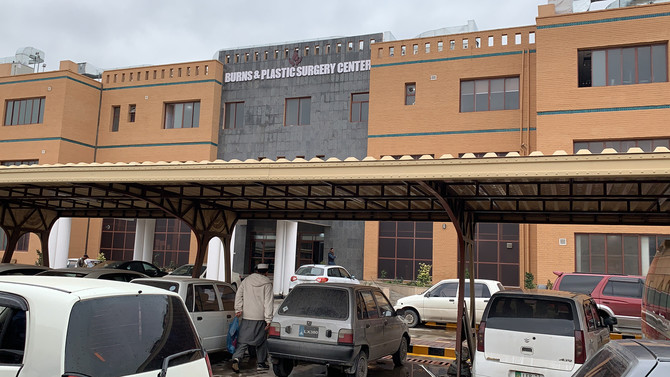
PESHAWAR: After decades of waiting, Khyber Pakhtunkhwa’s first specialized Burns and Plastic Surgery Center (BPSC) will be formally inaugurated later this month, officials said on Thursday.
Professor Dr. Tahir Khan, the center’s project director, told Arab News that the medical facility, which boasts state-of-the-art equipment, became operational in November last year after facing several delays due to the non-availability of funds.
“A plastic surgery unit started operating at the Hayatabad Medical Complex in February 1997. However, it did not have a dedicated burns unit, and many people in the province were forced to go to the Burns Center in Kharian, Punjab, or similar health facilities in Islamabad. Treating burn injuries is expensive, and some of the victims ended up paying more than half a million rupees to these medical facilities,” he said.
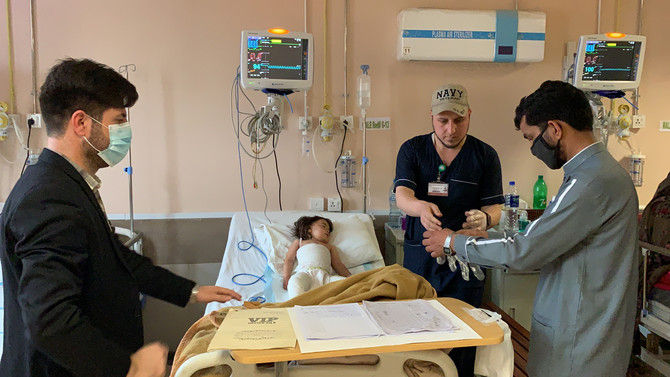
The three-story building has 50 beds for patients, including a ward each for male, female and child patients, eight Intensive Care Units, and separate isolation and dressing chambers.
The plastic surgery section has three wards comprising 18 rooms each, including four operation theaters and five high dependency units.
Khan said that the facility cost nearly Rs3 billion to set up. “The USAID donated $15 million while the Khyber Pakhtunkhwa Workers Welfare Board and others gave nearly Rs3 billion to restart construction work on the project in 2017. We purchased most modern equipment from other countries,” he said.
“Thanks to our partners, including a German non-governmental organization, we were able to send five of our staff members for specialized training to the UK for two months. We intend to arrange more training programs like that to equip our staff with modern skills,” he said.
“The facility has treated 3,362 patients in less than three months after it became operational. A total of 528 burn surgeries and 487 plastic surgeries were also performed during this period,” Dr. Iqbal said, adding that the center provided preliminary emergency care, hand replants, free tissue transfer, trauma care and treatment for skin tumor.
The BPSC will also be supporting peripheral units in Bannu, Chitral and Dir districts of the Khyber Pakhtunkhwa province, besides providing free medicines and staff training to two similar units in Afghanistan.
“Almost 40 percent of our patients come from Afghanistan. They get the same free-of-cost treatment as our local patients,” Professor Khan said, adding that the BPSC was also training doctors at Peshawar’s Lady Reading Hospital and the Khyber Teaching Hospital.
Professor Khan added that the provincial government had been asked to establish 20-bed units for burn victims at the divisional level to provide timely medical care to patients belonging to far-flung areas.


![]()
![]()
![]()
![]()
![]()
![]()
![]()
![]()

Khyber Pakhtunkhwa’s first plastic surgery center to get a facelift


Khyber Pakhtunkhwa’s first plastic surgery center to get a facelift
- Facility provides free medicines and training to similar organizations in Afghanistan
- Province also expected to set up small-scale burn units at the divisional level
Latest updates


© 2026 SAUDI RESEARCH & PUBLISHING COMPANY, All Rights Reserved And subject to Terms of Use Agreement.