

Pakistan concludes 45-nation naval exercise in the Arabian Sea

1 / 21
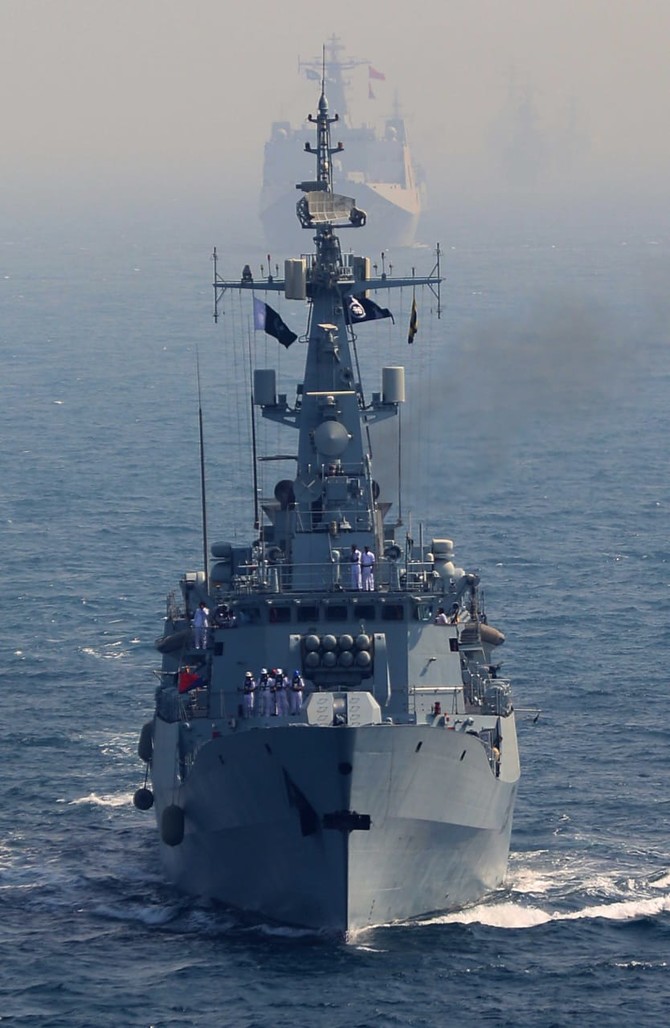
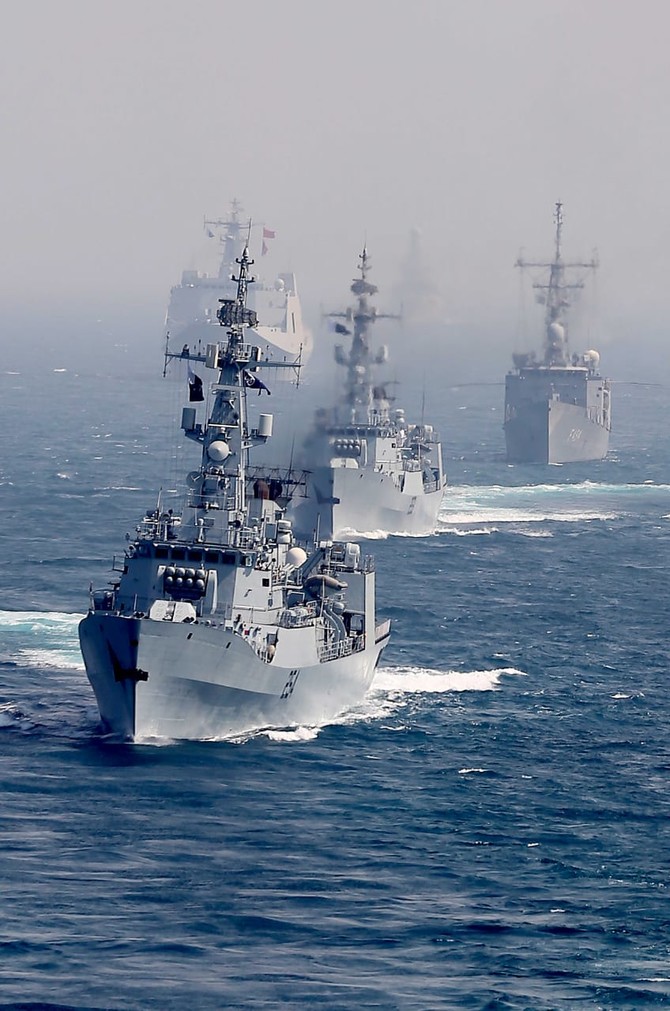
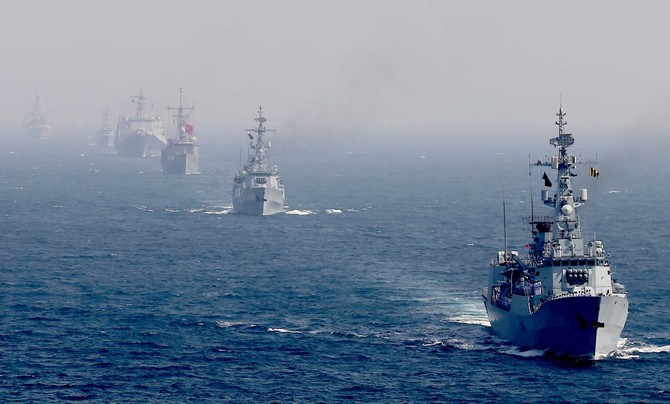
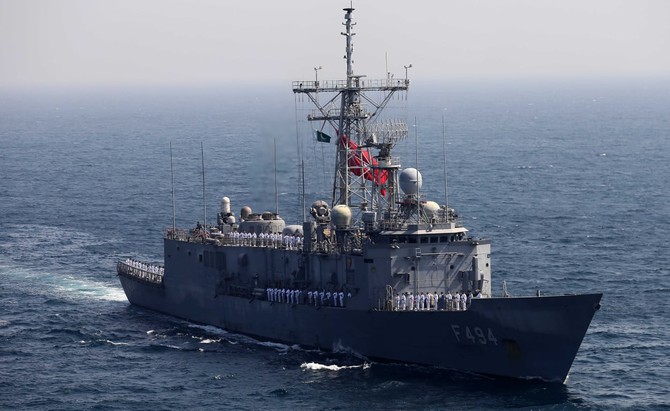
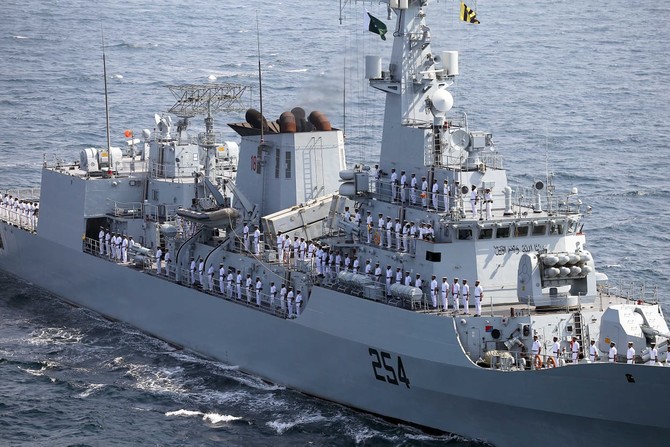
Twenty-one naval warships of different countries, including US, China, U.K, Pakistan, Italy, and Australia participated in International Fleet Review at Arabian sea around 40 nautical miles away from Karachi here on Tuesday, Feb. 12, 2019. (AN photo)
2 / 21
Twenty-one naval warships of different countries, including US, China, U.K, Pakistan, Italy, and Australia participated in International Fleet Review at Arabian sea around 40 nautical miles away from Karachi here on Tuesday, Feb. 12, 2019. (AN photo)
3 / 21
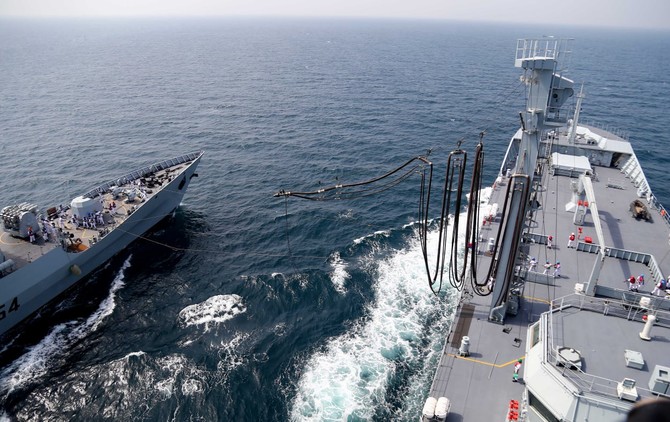
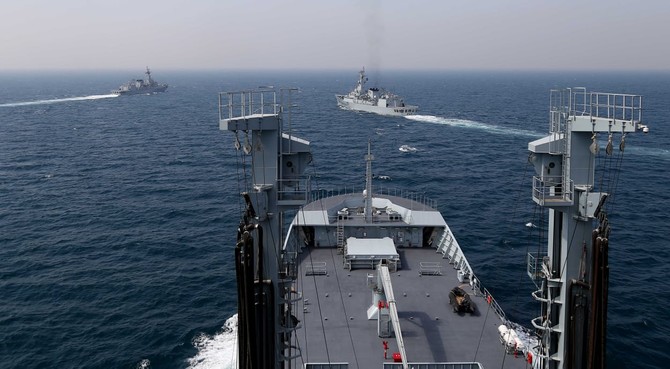
PNS Moawin, a Pakistan Navy’s fleet replenishment tanker commissioned on 16 October 2018, is refueling PNS Aslat and PNS Saif during multinational naval exercises Aman-19 at Arabian sea around 40 nautical miles away from Karachi here on Tuesday, Feb. 12, 2019. (AN photo)
4 / 21
Twenty-one naval warships of different countries, including US, China, U.K, Pakistan, Italy, and Australia participated in International Fleet Review at Arabian sea around 40 nautical miles away from Karachi here on Tuesday, Feb. 12, 2019. (AN photo)
5 / 21
Twenty-one naval warships of different countries, including US, China, U.K, Pakistan, Italy, and Australia participated in International Fleet Review at Arabian sea around 40 nautical miles away from Karachi here on Tuesday, Feb. 12, 2019. (AN photo)
6 / 21
Forty-Five countries, including Kingdom Saudi Arabia, US, U.K, Australia, Italy, and China participated in Pakistan’s multinational exercises Aman -19. (AN Photo)
7 / 21
Forty-Five countries, including Kingdom Saudi Arabia, US, U.K, Australia, Italy, and China participated in Pakistan’s multinational exercises Aman -19. (AN Photo)
8 / 21
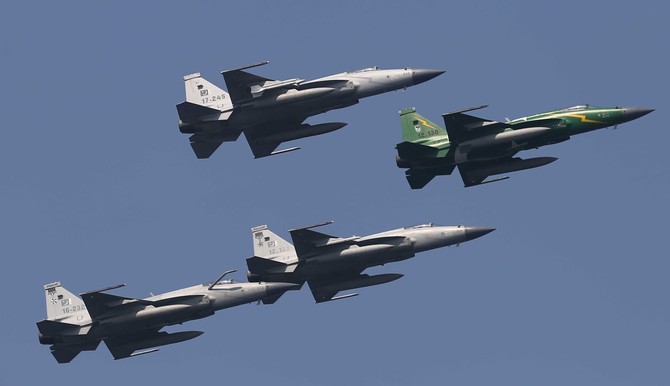
Pakistan Air force’s JF Thunder are flying past during multinational naval exercises Aman-19 at Arabian sea around 40 nautical miles away from Karachi here on Tuesday, Feb. 12, 2019. (AN photo)
9 / 21
Fleet commander Pakistan Navy Commodore Muhammad Saleem, right, speaking to Media naval exercises Aman-19 here on Tuesday, Feb. 12, 2019. (AN photo)
10 / 21
Twenty-one naval warships of different countries, including US, China, U.K, Pakistan, Italy, and Australia participated in International Fleet Review at Arabian sea around 40 nautical miles away from Karachi here on Tuesday, Feb. 12, 2019. (AN photo)
11 / 21
Forty-Five countries, including Kingdom Saudi Arabia, US, U.K, Australia, Italy, and China participated in Pakistan’s multinational exercises Aman -19. (AN Photo)
12 / 21
Twenty-one naval warships of different countries, including US, China, U.K, Pakistan, Italy, and Australia participated in International Fleet Review at Arabian sea around 40 nautical miles away from Karachi here on Tuesday, Feb. 12, 2019. (AN photo)
13 / 21
PNS Moawin, a Pakistan Navy’s fleet replenishment tanker commissioned on 16 October 2018 is refueling PNS Aslat and PNS Saif during multinational naval exercises Aman-19 at Arabian sea around 40 nautical miles away from Karachi here on Tuesday, Feb. 12, 2019. (AN photo)
14 / 21
Forty-Five countries, including Kingdom Saudi Arabia, US, U.K, Australia, Italy, and China participated in Pakistan’s multinational exercises Aman -19. (AN Photo)
15 / 21
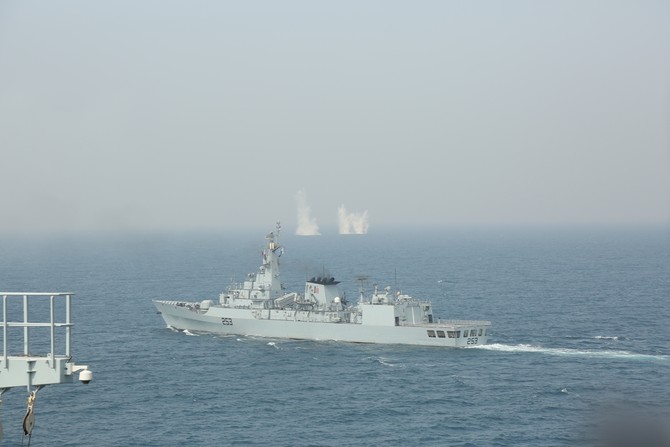
Pakistan naval ships are conducting depth charge (RDC) firing during multinational naval exercises Aman-19 at Arabian sea around 40 nautical miles away from Karachi here on Tuesday, Feb. 12, 2019. (AN photo)
16 / 21
Twenty-one naval warships of different countries, including US, China, U.K, Pakistan, Italy, and Australia participated in International Fleet Review at Arabian sea around 40 nautical miles away from Karachi here on Tuesday, Feb. 12, 2019. (AN photo)
17 / 21
Twenty-one naval warships of different countries, including US, China, U.K, Pakistan, Italy, and Australia participated in International Fleet Review at Arabian sea around 40 nautical miles away from Karachi here on Tuesday, Feb. 12, 2019. (AN photo)
18 / 21
Twenty-one naval warships of different countries, including US, China, U.K, Pakistan, Italy, and Australia participated in International Fleet Review at Arabian sea around 40 nautical miles away from Karachi here on Tuesday, Feb. 12, 2019. (AN photo)
19 / 21
Twenty-one naval warships of different countries, including US, China, U.K, Pakistan, Italy, and Australia participated in International Fleet Review at Arabian sea around 40 nautical miles away from Karachi here on Tuesday, Feb. 12, 2019. (AN photo)
20 / 21
Twenty-one naval warships of different countries, including US, China, U.K, Pakistan, Italy, and Australia participated in International Fleet Review at Arabian sea around 40 nautical miles away from Karachi here on Tuesday, Feb. 12, 2019. (AN photo)
21 / 21
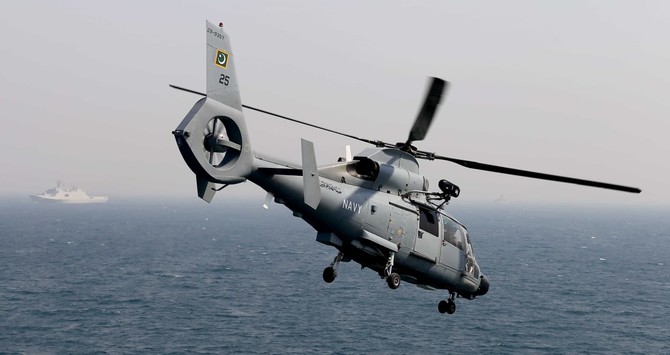
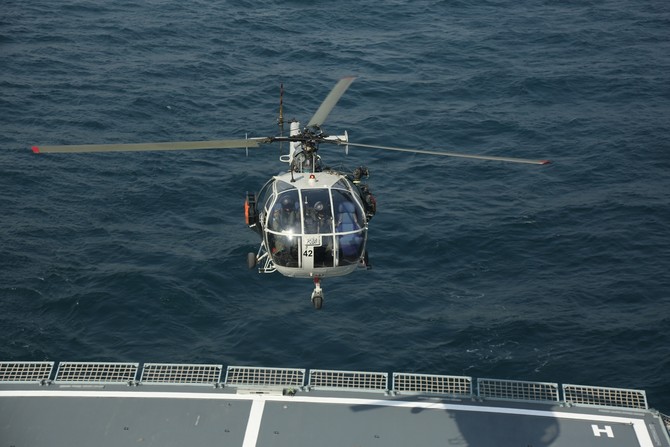
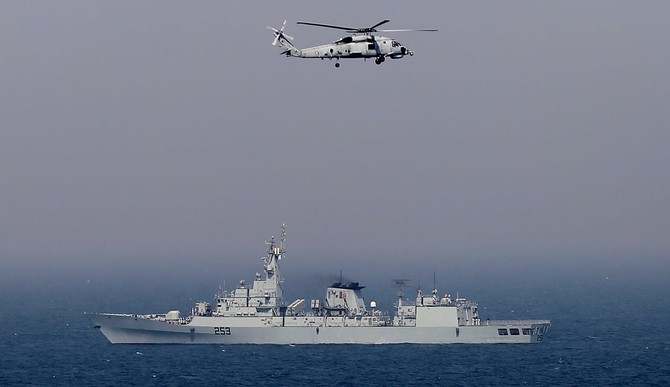
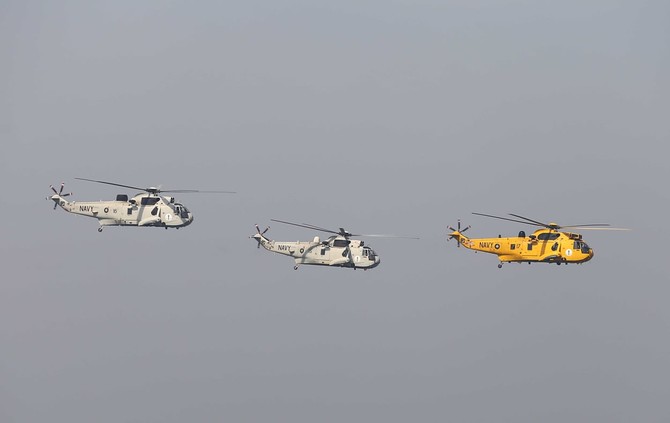
Helicopters of Pakistan Navy are flying past during multinational naval exercises Aman-19 at Arabian sea around 40 nautical miles away from Karachi here on Tuesday, Feb. 12, 2019. (AN photo)
Updated 12 February 2019
Follow

Pakistan concludes 45-nation naval exercise in the Arabian Sea

  • Final day of Aman-19 saw refueling of ships, surface firing, flypast, and an international fleet review
  • Event sends out loud and clear message that Islamabad is not alone, top official says

KARACHI: The final installment of the Aman-19 naval exercises, which were hosted by Pakistan in the Arabian Sea, concluded with an international fleet review here on Tuesday.
President Dr. Arif Alvi was the chief guest at the event which began on Friday last week.
Around 21 naval warships of different countries — including Pakistan, the US, China, the U.K, Australia, and Italy ---acknowledged Dr. Alvi with a mark of respect during the international fleet review.
Earlier, as part of the exercise, the PNS Moawin – a Pakistan Navy’s fleet replenishment tanker commissioned on October 16 last year – conducted the refueling exercise for PNS Aslat and PNS Saif.
After being refueled, the PNS Aslat and PNS Saif maneuvered to the front and rear end of the PNS Moawin for a Rocket Depth Charge firing in a mock attack on submarines. In the third phase, they were joined by Turkish and Chinese ships for surface firing.
A flypast by aircraft belonging to the navy — and including helicopters of Chinas, Turkey, Italy, Australia, and the Pakistan Air force’s JF-17 Thunder — were some of the highlights of the fourth phase of the exercises.

Sharing details of the event, Commodore Muhammad Saleem told Arab News that 45 countries had participated in the drill. “The level of participation varied,” he said, adding that “around 12 navies, including those of the US, UK, China, Turkey, Australia, Sri Lanka, and Oman participated with their warships” while others acted as observers.
“The harbor phase has ended and today was the sea phase, which concluded with the international fleet review which is the final event of this exercise,” the naval official said, adding that after the conclusion of the drill, some countries will leave while others will stay back for joint exercises.
“The purpose of these biannual drills [which] started in 2007 is to sit together and learn from each other’s experiences with respect to combating piracy, counter-terrorism, and combating smuggling through sea,” he said.
Detailing the benefits of the exercise for Pakistan, he said that when the navies of different countries sit together, it sends out a diplomatic message which is loud and clear. “The message is that Pakistan is not isolated. It’s an important country not only in the region but in the world community as well. It also highlights the value that other countries give to the Pakistan Navy,” he said.
With respect to the China Pakistan Economic Corridor (CPEC), he said, Pakistan’s navy has instilled a sense of safety mechanism and security in all CPEC-related activities, which will be done through the sea. “Pakistan has also setup the taskforce 88, which patrols around Gwadar and adjacent areas and provides security to all ships that arrive in or leave the Gwadar port,” he said.
Pakistan is fully responsible for the security, he said “but of course when a large number of countries gather at our platform it also gives a strong message that this route is safe and secure. So, indirectly this exercise will augment the security and safety of this region”.
Earlier on Monday, the three-day International Maritime Conference organized along the theme of “Global Geopolitics in Transition: Rethinking Maritime Dynamics in the Indian Ocean Region” concluded in Karachi. 
Federal Minister for Defense, Pervez Khattak, who was the chief guest on the occasion, said that the current maritime threats and the emerging geo-strategic situation was posing new challenges and risks to all stakeholders in the region. 
“The situation will provide constructive dialogue and develop collective mechanism,” he said expressing confidence that the deliberations and recommendations made during the conference will provide crucial insight to maritime stakeholders for effective policy-making.
“CPEC is rightfully considered a gamechanger, not only for Pakistan but for the economic well-being and prosperity of the entire region. With the progress of CPEC and Gwadar port, maritime activities would increase manifold, especially in the western Indian Ocean,” he said, adding that the responsibilities of the country’s navy would increase with time, especially in terms of maintaining a secure maritime environment for the smooth flow of sea trade.


Pakistan military says 92 militants, 15 troops killed in coordinated Balochistan attacks

Updated 4 sec ago
Follow

Pakistan military says 92 militants, 15 troops killed in coordinated Balochistan attacks

  • BLA militants hit Quetta, Gwadar and seven other towns as security forces launched a counteroffensive
  • Military says 18 civilians, including women and children, were killed in attacks on laborer families

QUETTA/KARACHI/ISLAMABAD: Pakistan’s military said on Saturday it killed 92 militants, including three suicide bombers, while repelling coordinated attacks across the southwestern province of Balochistan, as security forces carried out large-scale clearance operations following assaults on civilians and law enforcement personnel.

The attacks, involving gunfire and explosions, targeted several locations including the provincial capital Quetta and the coastal city of Gwadar, as well as Mastung, Nushki, Dalbandin, Kharan, Panjgur, Tump and Pasni, according to the military’s media wing.

The Inter-Services Public Relations (ISPR) said in a statement that militants launched multiple attacks “to disrupt peace in Balochistan.”

“Security Forces and Law Enforcement Agencies being fully alert immediately responded and successfully thwarted the evil design of terrorists,” it said. “Our valiant troops carried out engagement of terrorists with precision and after prolong, intense and daring clearance operation across Balochistan, sent ninety two terrorists including three suicide bombers to hell, ensuring security and protection of local populace.”

The military said 18 civilians, including women, children, elderly people and laborers, were killed in attacks in Gwadar and Kharan. It said 15 security personnel were also killed during clearance operations and armed standoffs.

The ISPR said the attacks were launched by “Indian sponsored Fitna al Hindustan,” a reference to the separatist Balochistan Liberation Army (BLA), saying intelligence reports confirmed the violence was orchestrated and directed by militant leaders operating from outside Pakistan, who were in direct communication with attackers during the assaults.

The BLA also issued a statement earlier in the day, saying it had launched what it called “Operation Herof 2.0” and claiming responsibility for attacks in multiple locations.

Pakistani officials describe BLA militants as Indian proxies, a charge New Delhi denies.

The military said sanitization operations were continuing across the affected areas and that those involved in planning, facilitating or carrying out the attacks would be brought to justice.

Prime Minister Shehbaz Sharif praised security forces for foiling what he described as organized attempts to destabilize Balochistan, and paid tribute to personnel killed during the operations.

The ISPR said 41 additional militants were killed in separate operations a day earlier in Panjgur and Harnai, bringing the total number of militants killed in the past two days to 133.

Balochistan, which borders Iran and Afghanistan, has faced a decades-long insurgency by separatist militant groups, with Pakistani authorities frequently accusing foreign actors of backing the violence. India has repeatedly denied such allegations.