

OECD: Fourth Industrial Revolution ‘exciting’ but has downsides

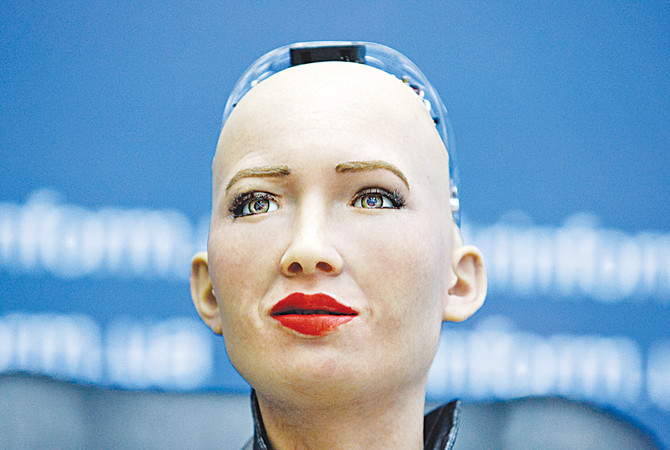
Face of the future: The humanoid robot Sophia was granted citizenship in Saudi Arabia, the first robot in the world to be given nationality. (Getty Images)
Updated 12 February 2019
Follow

OECD: Fourth Industrial Revolution ‘exciting’ but has downsides

  • Challenge is how to empower half of the workforce that will be displaced
  • National leaders urged to broaden their horizons and make appropriate decisions to create a better future

DUBAI: The Fourth Industrial Revolution (4IR) will be exciting and full of promise, but carries downsides, Jose Angel Gurria, the secretary-general of the Organization for Economic Cooperation and Development, said on Monday.

In a discussion with CNN’s Becky Anderson at the World Government Summit (WGS) in Dubai, Gurria said: “The danger is not just about knowing the technology that is growing at breakneck speed, but how you empower half of the workforce that will be displaced.

“The Fourth Industrial Revolution will carry with it many promises and challenges in employing technology and how to use it. Half of the workforce is going to be disrupted by technology, due to over- or under-qualification. How can we motivate and upskill those that will be displaced in the process?”

Gurria focused on the need for countries to realize the effects on labor forces and on generations yet to enter the world of work.

He also urged national leaders to “broaden their horizons and make appropriate decisions in order to create a better future.”


Intellectual property in the 4IR

Intellectual property governance policies promote innovation and creativity, according to the World Intellectual Property Organization’s director general, Francis Gurry.

“Effective intellectual property systems ensure that ideas are transformed into products and services that are beneficial to people,” Gurry said. “Through intellectual property, we ensure that good ideas are translated into economic products, balance of interests and competitiveness.”

In 2018 alone, 2.5 million patent applications were filed worldwide, which, Gurry said, explained the need for stricter protection laws.

China and the US lead the world in terms of patent numbers, followed by Japan.

“We have a large number of patents on artificial intelligence, so this sequence must be protected,” Gurry added. “We expect significant changes in the distribution of capacity around the world as a result of the development of artificial intelligence in robots.”


Mobility in the 4IR

Artificial intelligence (AI) and nanotechnologies are among the UAE’s key priorities during the 4IR, according to Mattar Mohamed Al-Tayer, Dubai Road and Transport Authority (RTA) general manager.

“The importance of artificial intelligence in the transportation sector lies in three objectives: supporting the management of major events, forecasting traffic, and monitoring and dealing with accidents,” Al-Tayer said during a session at the WGS on “The Future of Mobility in the Age of 4IR.”

He highlighted the accomplishments the RTA has made over the years, turning Dubai into one of the world’s most efficient cities when it comes to mobility and transportation.

“In Dubai, we organized with international transport companies, such as Uber and others, to provide intelligent services to community members.

“The transport sector in Dubai is moving over a million people, and this figure makes us aware of the importance of establishing a solid infrastructure that enhances transportation,” he said.


Qatar residential property sales jump 44% in 2025 as prices ease: Knight Frank 

Updated 7 sec ago
Follow

Qatar residential property sales jump 44% in 2025 as prices ease: Knight Frank 

RIYADH: Qatar’s residential property sales surged 43.5 percent in 2025 to 26.6 billion Qatari riyals ($7.30 billion), driven by rising transaction volumes even as home prices softened, according to Knight Frank. 

The number of residential deals climbed 50 percent in 2025 from a year earlier to 6,831 transactions, signaling sustained liquidity in the market despite a more competitive pricing environment, the property consultancy said in its Qatar Real Estate Market Review. 

In line with broader trends across the Gulf Cooperation Council, Qatar is seeking to strengthen its real estate sector as part of its economic diversification efforts. 

Faisal Durrani, head of research at Knight Frank for the Middle East and North Africa region, said: “Although residential prices are softening, strong growth in transaction volumes highlights continued liquidity and demand in Qatar’s core residential markets and indicating stabilization, rather than a market in retreat.”  

In the fourth quarter of 2025, residential sales activity remained concentrated in key locations, led by Doha, which recorded 564 transactions with a combined value of 2.4 billion riyals. Al Wakrah followed with 387 transactions worth 895 million riyals. 

“Average villa prices fell by 1 percent during the 12 months to the fourth quarter of 2025, reflecting a more competitive pricing environment as supply expands and buyers become increasingly value-led. Despite this moderation, prime locations remain resilient, supported by steady demand for premium schemes,” said Durrani. 

Rental rates also eased, with average villa rents down 2.4 percent year on year in the fourth quarter to 12,985 riyals per month. Prime locations continued to outperform, with West Bay Lagoon averaging 18,656 riyals a month for three-bedroom villas and up to 25,696 riyals for five-bedroom units. Overall villa rents declined 3 percent in 2025. 

“Qatar’s residential rental market continues to be shaped by tenant demand for well-located, lifestyle-led communities, with pricing remaining strong for larger villas in established neighborhoods,” said Knight Frank’s Adam Stewart.

Qatar’s office market showed similar trends, with grade-A rents falling 1.4 percent year on year to 90 riyals per sq. meter per month. Demand remained focused on prime districts, led by West Bay and the Marina District, as occupiers shifted away from older buildings. 

“Economic diversification in line with Qatar’s National Vision 2030 is supporting job growth and office demand, especially in the tech, green energy, and services sectors,” said Stewart. 

He added: “These occupiers are increasingly seeking high-specification, modern buildings with advanced facilities, and we are seeing a clear shift toward prime locations in Doha and Lusail, pulling tenants away from older stock.”