NEW DELHI: The legitimate government in Yemen hopes to scale up its crude production to 110,000 barrels per day (bpd) in 2019, with exports touching about 75,000 bpd, the country’s oil minister said on Sunday.
The government of Abed Rabbo Mansour Hadi controls the southern port city of Aden and areas holding Yemen’s oil-and-gas fields. The Iranian-aligned Houthi group controls the capital Sanaa and the oil terminal of Ras Issa on the western coast.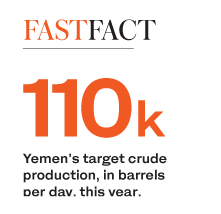
Yemen’s oil output has collapsed since 2015 when the Arab-led military coalition intervened in Yemen’s war to try to restore Hadi’s government to power.
“We will maintain production from four blocks and are planning to build a pipeline to the Arab Sea (Arabian Sea) to resume exports from these blocks,” Aws Abdullah Al-Awd, Hadi’s oil minister, said in an interview.
The conflict has choked energy output and shuttered a key export terminal and pipeline.
Yemen produced an average of 50,000 bpd of crude in 2018 compared with around 127,000 bpd in 2014. Last year it exported some quantities of oil.
The country has proven oil reserves of around 3 billion barrels, according to the
US Energy Information Administration (EIA).
The oil minister said Yemen also wanted to resume production of LNG, which had been halted as a result of the conflict.
“Our country has been affected by the war for the past three years, but now things are coming back. Hopefully, 2019 will be good for Yemen,” he said.
He predicted that LNG output would rise in 2019 to 6.7 million tons and half of that amount would be exported.
“In 2020, we hope to export all of our LNG production, mainly to customers in Asia,” he said.
He noted that companies including Total, US-based Hunt Oil and Korean companies operate the LNG project.


![]()

Recovery in the pipeline as Yemen plans major lift in oil, LNG exports
Recovery in the pipeline as Yemen plans major lift in oil, LNG exports
- Yemen produced an average of 50,000 bpd of crude in 2018 compared with around 127,000 bpd in 2014. Last year it exported some quantities of oil


Latest updates


© 2026 SAUDI RESEARCH & PUBLISHING COMPANY, All Rights Reserved And subject to Terms of Use Agreement.