ISLAMABAD: Lamenting the lack of progress in resolving the Jammu and Kashmir dispute, Prime Minister Imran Khan acknowledged the suffering of the Kashmiri people in an address to the nation on Tuesday.
His comments were made on the occasion of Kashmir Solidarity Day which is observed across Pakistan on February 5 every year.
“Seven decades have passed and the dispute of Jammu and Kashmir remains unresolved,” PM Khan said, adding that “Kashmiris have been fervently demanding an end to India’s illegitimate rule, spanning more than 70 long and bloody years.”
He added that according the Office of the High Commissioner for Human Rights (OHCHR) on Jammu and Kashmir, a report filed by the body echoed Pakistan’s repeated calls to the international community to take stock of “India’s brutal use of pellet guns, indiscriminate firing, use of human shields and promulgation of the draconian Armed Force Special Powers Act (AFSPA) and Public Safety Act (PSA) that are making lives of the people in Indian occupied Jammu and Kashmir a living hell.”
Meanwhile, President Arif Alvi, said that this year offers an opportunity to pay tribute to the unparalleled commitment of the Kashmiris for the attainment of their legitimate right to self-determination.
“On this fay, the Government of Pakistan and its people demonstrate to our Kashmiri brothers and sisters and the world-at-large that we have not forgotten the long-pending dispute of Jammu and Kashmir,” a statement released by his office read.
“The entire Pakistani nation stands with its Kashmiri brethren in their valiant struggle to achieve the legitimate right to self-determination. It is our firm belief that the Kashmiris will succeed in their struggle,” it added.
Kashmir Solidarity Day was created to commemorate the strong resolve of the Kashmiris in achieving their right to self-determination and is treated as a public holiday in Pakistan.


PM addresses nation as Kashmir Solidarity Day is observed across Pakistan

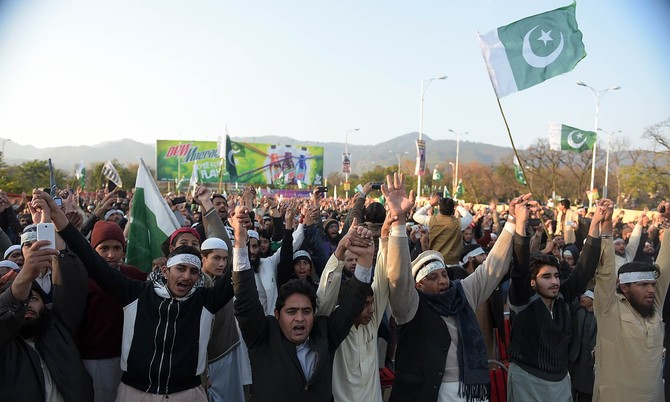
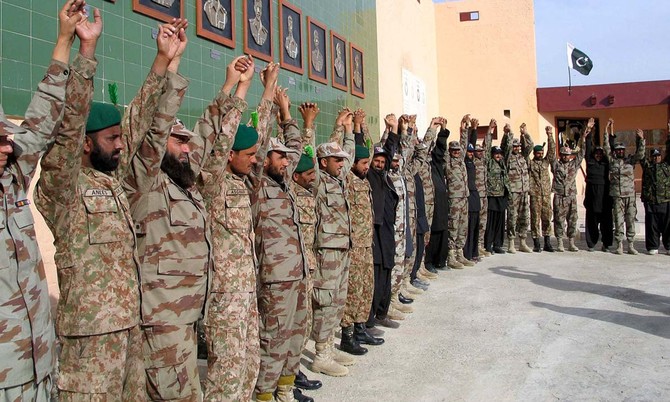
PM addresses nation as Kashmir Solidarity Day is observed across Pakistan
- Dispute between Islamabad and New Delhi remains unsolved even after seven decades, premier says
- Entire nation stands by its Kashmiri brethren, president says

Pakistan warns India-Canada uranium deal could widen nuclear imbalance in South Asia
- Islamabad says assured uranium supplies could free India’s domestic reserves for military use
- Foreign office calls for non-discriminatory nuclear cooperation framework for non-NPT states
ISLAMABAD: Pakistan on Thursday voiced concern over a uranium supply agreement and nuclear technology cooperation between India and Canada, warning the arrangement could expand India’s nuclear arsenal and undermine the global non-proliferation framework.
The statement came after Ottawa and New Delhi concluded a long-term deal covering uranium supplies and potential cooperation in advanced nuclear technologies, including small modular reactors.
The agreement was announced earlier this week as part of efforts by the two countries to deepen energy and economic ties. Canada has previously supplied uranium to India under a civilian nuclear cooperation framework first agreed in 2010 and implemented in 2013, with commercial supply contracts signed in subsequent years.
“Assured external uranium supplies effectively release India’s domestic reserves for military use, enabling the expansion of its fissile material stockpiles, accelerating the growth of its nuclear arsenal, and deepening existing asymmetries in South Asia’s strategic balance,” foreign office spokesperson Tahir Andrabi said in a statement while responding to media queries.
“The arrangement also undermines Canada’s commitment to the international non-proliferation regime and its corresponding obligations under that framework,” he added.
Andrabi said the agreement represents another country-specific exception in civilian nuclear cooperation, noting that India’s 1974 nuclear test — conducted using plutonium produced in a Canadian-supplied research reactor — led to the creation of the Nuclear Suppliers Group (NSG).
“A state whose actions necessitated the establishment of global export controls is now being granted preferential access under selective arrangements,” he added.
The foreign office spokesperson said India has not placed all of its civilian nuclear facilities under International Atomic Energy Agency safeguards and has not made binding commitments under the new arrangement to do so.
He also pointed out it was unclear what concrete non-proliferation assurances accompanied the agreement.
“Pakistan reiterates that civil nuclear cooperation must be governed by a non-discriminatory, criteria-based approach applicable equally to states that are not parties to the Nuclear Non-Proliferation Treaty (NPT),” Andrabi said.
“Selective exceptions diminish the credibility of the global non-proliferation framework and risk further destabilizing regional and global peace & security.”


