

Saudis, UAE, Yemen ask UN to pressure Houthis

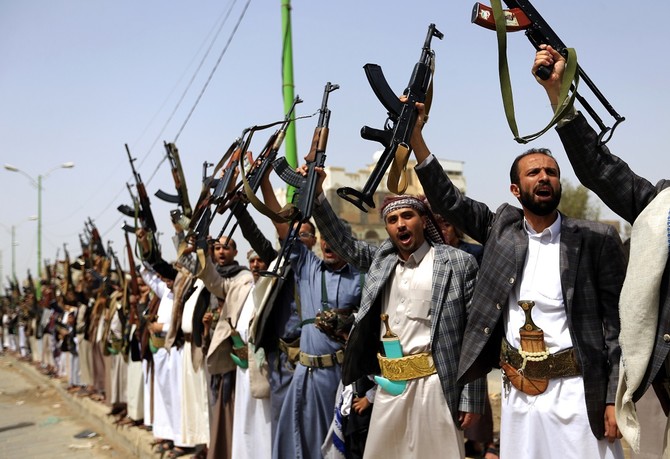
Supporters of the Houthis demonstrate in the capital Sanaa on 25 June 2018. (File/AFP)
Updated 02 February 2019
Follow

Saudis, UAE, Yemen ask UN to pressure Houthis

  • In a letter sent to the council, the three governments accused the Houthis of violating the ceasefire
  • They asked the council to impress upon the Houthis, and their Iranian backers

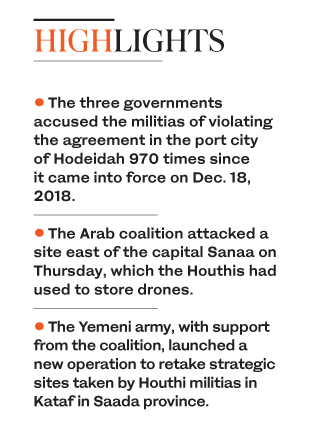
JEDDAH: Saudi Arabia, the UAE and Yemen on Thursday asked the UN Security Council to increase pressure on Houthi militias to respect a cease-fire deal. In a letter, the three governments accused the militias of violating the agreement in the port city of Hodeidah 970 times since it came into force on Dec. 18, 2018.
They asked the council to “impress upon the Houthis, and their Iranian backers, that they will be held responsible if their continued failure to comply... leads to the collapse of the Stockholm agreement.”
Yemen’s coalition-backed government and Houthi leaders agreed to the cease-fire and a redeployment of forces from Hodeidah during UN-brokered talks in Sweden last month.
UAE Minister of State for Foreign Affairs Anwar Gargash met with UN Secretary-General Antonio Guterres separately on Thursday to discuss problems in implementing the Stockholm deal.
“We understand that we need to exercise patience, but it can’t be infinite,” Gargash said. “We do not want to launch an offensive. What we want is for the UN and the international community to exert influence.”
The council also met behind closed doors to hear a report from UN envoy Martin Griffiths, after a fresh round of diplomatic talks with both sides.
A Yemeni army spokesman, Brig. Abdo Majali, said that the militias had violated the cease-fire in Hodeidah more than 760 times in the two weeks after it went into effect alone, including bombing residential neighborhoods, hospitals and schools.
He also accused Iran of complicity, saying it supported the militias by providing them with illegal munitions and land mines, later planted in populated areas.

Extensive air raid
Houthi commander Abdullah Jahaf, meanwhile, was killed in a coalition airstrike in the northwestern province of Hajjah, Al Arabiya reported on Friday.
The coalition also attacked a site east of the capital Sanaa on Thursday, which the Houthis had used to store drones, coalition spokesman Col. Turki Al-Maliki said.
The operation came after extensive intelligence gathering revealed a network of Houthi operational infrastructure, he explained, including workshops and launch sites, and came in the wake of a drone being shot down in Saudi airspace on Wednesday.

Military operation
The Yemeni army, with support from the Arab coalition, launched a new operation on Thursday to retake strategic sites taken by Houthi militias in Kataf in Saada province.
In a statement to the Yemeni News Agency, a Yemeni army spokesman said that troops from the 82nd Infantry Brigade had retaken the strategic Jabal Al-Qahar mountains, as well as the villages of Rafqua, Al-Halfa’, Al-Akimi, and Al-Markib, that had previously witnessed large scale displacement of local residents.
He added that a number of Houthi militants, including two senior commanders, had been killed, while three more had been captured.


Hundreds flee to government-held areas in north Syria ahead of possible offensive

Updated 16 January 2026
Follow

Hundreds flee to government-held areas in north Syria ahead of possible offensive

  • Many of the civilians who fled used side roads to reach government-held areas
  • Men, women and children arrived in cars and pickup trucks that were packed with bags of clothes

DEIR HAFER, Syria: Scores of people carrying their belongings arrived in government-held areas in northern Syria on Friday ahead a possible attack by Syrian troops on territory held by Kurdish-led fighters east of the city of Aleppo.
Many of the civilians who fled used side roads to reach government-held areas because the main highway was blocked with barriers at a checkpoint that previously was controlled by the Kurdish-led and US-backed Syrian Democratic Forces, Associated Press journalists observed.
The Syrian army said late Wednesday that civilians would be able to evacuate through the “humanitarian corridor” from 9 a.m. to 5 p.m. Thursday. The announcement appeared to signal plans for an offensive against the SDF in the area east of Aleppo.
There were limited exchanges of fire between the two sides.
Men, women and children arrived in cars and pickup trucks that were packed with bags of clothes, mattresses and other belongings. They were met by local officials who directed them to shelters.
In other areas, people crossed canals on small boats and crossed a heavily damaged pedestrian bridge to reach the side held by government forces.
The SDF closed the main highway but about 4,000 people were still able to reach government-held areas on other roads, Syrian state TV reported.
A US military convoy arrived in Deir Hafer in the early afternoon but it was not immediately clear whether those personnel will remain. The US has good relations with both sides and has urged calm.
Inside Deir Hafer, many shops were closed and people stayed home.
“When I saw people leaving I came here,” said Umm Talal, who arrived in the government-held area with her husband and children. She added that the road appeared safe and her husband plans to return to their home.
Abu Mohammed said he came from the town of Maskana after hearing the government had opened a safe corridor, “only to be surprised when we arrived at Deir Hafer and found it closed.”
SDF fighters were preventing people from crossing through Syria’s main east-west highway and forcing them to take a side road, he said.
The tensions in the Deir Hafer area come after several days of intense clashes last week in Aleppo, previously Syria’s largest city and commercial center, that ended with the evacuation of Kurdish fighters from three neighborhoods north of the city that were then taken over by government forces.
The fighting broke out as negotiations stalled between Damascus and the SDF over an agreement reached in March to integrate their forces and for the central government to take control of institutions including border crossings and oil fields in the northeast.
The US special envoy to Syria, Tom Barrack, posted on X Friday that Washington remains in close contact with all parties in Syria, “working around the clock to lower the temperature, prevent escalation, and return to integration talks between the Syrian government and the SDF.”
The SDF for years has been the main US partner in Syria in fighting against the Daesh group, but Turkiye considers the SDF a terrorist organization because of its association with Kurdish separatist insurgents in Turkiye.