


First cinema in Jeddah opens

1 / 4
Bader Alzahrani, center, CEO, General Commission of Audiovisual Media, cuts the ribbon at Monday’s opening of the first cinema in Jeddah. (Photo by Huda Bashatah)
2 / 4
Jeddah has the region’s first dedicated children’s cinema. (AN photo by Huda Bashatah)
3 / 4
Jeddah has the region’s first dedicated children’s cinema. (AN photo by Huda Bashatah)
4 / 4
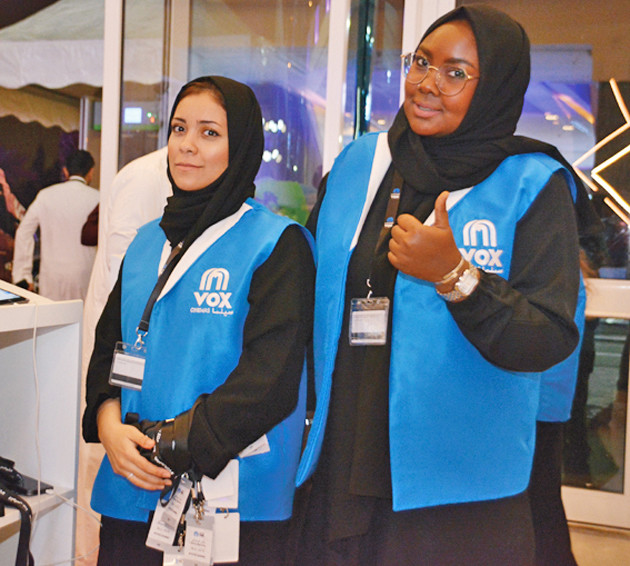
Ushers welcome moviegoers during Monday’s opening of the first cinema in Jeddah. (Photo by Huda Bashatah )
Updated 29 January 2019
Follow

First cinema in Jeddah opens

  • Total revenue expected to reach $1.5 billion by 2030: PwC Middle East
  • Decades-long cinema ban ended last April.

JEDDAH: Jeddah’s first cinema opened its doors to the public on Monday, and an industry expert told Arab News he expected up to 35 million people in the Kingdom to go to the movies every year. 

Cinemas were banned in the country for decades until the first one opened last April in Riyadh. 

Cameron Mitchell, CEO of the regional cinema chain Majid Al Futtaim, said Saudi Arabia had the capacity for high audience numbers.


He was speaking at the opening ceremony for Vox Cinemas in Jeddah‘s Red Sea Mall.

“If you look at Dubai we have some 15 million customers there per annum. On the short-term goal in Saudi Arabia we are expecting the market to reach about 30 million customers,” he said.

Research from PwC Middle East in November estimated that total cinema revenue in Saudi Arabia would reach $1.5 billion by 2030. The forecast was based on a projected 2030 population of 39.5 million, and 6.6 screens per 100,000 people. 

Last year, Vox Cinemas said it would be investing $533 million to open 600 theaters in the next five years.

“Some 95 percent of our employees here are from Saudi Arabia. In any country where we operate cinemas, we localize the team. We have an Egyptian team in Egypt and a Lebanese team in Lebanon and of course Saudis in Saudi Arabia,” Mitchell said. 

“We expect the cinemas in the Red Sea Mall to be showing…a mix of films, probably about 300 films per year with at least six new movies every single week. It will take a while for us to have enough cinemas for everyone to get to go to the cinema whenever they want to. 

“In my opinion, the cinema is a good place for families to spend time together in a social environment, especially in hot summer days, when outdoor activities are limited.” 


There will be cinemas in Tabuk by the end of this year or by early 2020 and the Saudi government has been very helpful, he said, adding: “We got the license last April and we were keen to do the required steps and follow the regulations, and that went smoothly.”

There would be no issues with gender segregation as there were cinemas for families and separate ones for bachelors, according to Mitchell.

The lifting of the cinema ban is part of the Vision 2030 reform plan.


Saudi wildlife center records rare sighting of critically endangered leatherback turtle in Red Sea

Updated 05 February 2026
Follow

Saudi wildlife center records rare sighting of critically endangered leatherback turtle in Red Sea

  • NCW says the leatherback traveled thousands of kilometers to reach the Red Sea
  • The closest known nesting grounds are located in India’s Andaman Islands, some 6,500 km distant

RIYADH: Saudi Arabia's National Center for Wildlife (NCW) has documented a rare sighting of a leatherback sea turtle in the Red Sea, marking a significant biological record for one of the planet's most critically endangered marine species.

The sighting occurred approximately 30 kilometers off the coast of Al-Qunfudhah within the Blue Holes Protected Area, a newly established marine reserve, according to the Saudi Press Agency.

The NCW confirmed that the presence of a leatherback in these waters is an exceptional event. Recognized as the largest turtle species on Earth, the leatherback can weigh up to 900 kilograms. It is easily identified by its unique leathery, black carapace—distinguished by five longitudinal ridges rather than a hard bony shell—and its ability to dive to depths exceeding 1,000 meters.

Shutterstock image

Noting the species' migratory nature, the center explained that leatherbacks travel thousands of kilometers foraging for jellyfish. The specimen likely navigated through the Bab el-Mandeb Strait in search of food. 

This is considered a remarkable journey, the NCW said, noting that the nearest known populations reside in the Indian Ocean, spanning waters from South Africa to Sri Lanka (roughly 7,000 to 8,000 kilometers away). The closest known nesting grounds are located in India’s Andaman Islands, approximately 6,500 kilometers distant. No nesting activity has been recorded in the Red Sea.

According to the IUCN Red List, the leatherback is Critically Endangered in the Indian Ocean. While data for the Red Sea and Arabian Gulf is scarce, recent isolated sightings include a juvenile recorded in Jordan in December 2025 and another off Djibouti in 2019.

The NCW emphasized that these rare appearances highlight the ecological importance of the Kingdom's marine conservation efforts in the Red Sea. The center pointed to the Farasan Islands Marine Protected Area, along with the new Blue Holes and Ras Hatiba reserves, as critical sanctuaries that could support the potential expansion of such endangered species' ranges.