Afghan President Ashraf Ghani calls on greater engagement with Pakistan

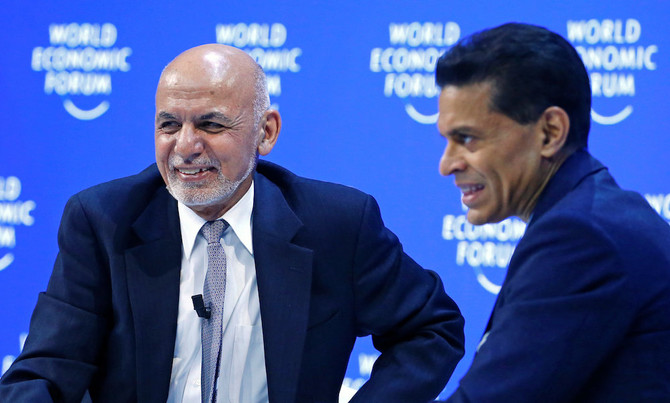
Afghan President Ashraf Ghani talks with Fareed Zakaria during the World Economic Forum (WEF) annual meeting in Davos. (Reuters)
Updated 24 January 2019
Follow

Afghan President Ashraf Ghani calls on greater engagement with Pakistan

  • Ghani said he had spoken to Pakistan’s Prime Minister Imran Khan but warned that Islamabad still needed to remove the “shadow of violence”
  • President played down talk of a breakthrough in talks between the Taliban and US officials in Doha

LONDON: Afghan President Ashraf Ghani said on Thursday he wants greater engagement with Pakistan as he claimed his country was “turning a corner.”

Ghani said he had spoken to Pakistan’s new Prime Minister Imran Khan but warned that Islamabad still needed to remove the “shadow of violence” in the country.

Pakistan has long been accused of aiding militant groups, including the Taliban, in Afghanistan. Many believe that improved relations between Kabul and Islamabad are crucial to peace in the country.

“Afghanistan wants an engagement with Pakistan,” Ghani said during a conversation with CNN’s Fareed Zakaria at the World Economic Forum in Davos. But he said that the countries needed to engage on the “issue of terrorism.” Ghani said improved relations could also make Afghanistan a stabilising force in Pakistan.

His comments came as a fourth day of talks between the Taliban and US officials were held in Qatar on Thursday. But Ghani played down speculation of a breakthrough amid frustration from Afghan leaders that they are being left out of the process.

Ghani played down talk of a breakthrough in talks between the Taliban and US officials in Doha at the World Economic Forum in Davos. “There’s discussion. But this discussion needs to be shared back (with the Afghan government),” he continued, adding that if not it “will not last.”

But he remained optimistic that the country was on the right track to bringing an end to the 17-year war with the Taliban, which still involves thousands of US troops.

“By 2024 Afghanistan will be self reliant,” Ghani said.

Afghanistan’s de facto prime minister Abdullah Abdullah also expressed his frustration at the talks in Doha, saying the Taliban are persisting in excluding his government from the negotiations

“The peace process cannot take place by proxy,” he said in Davos.

The Taliban have launched a series of attacks in recent weeks as they continue to strengthen their position in the country - now controlling about half the territory.

The insurgents killed dozens of Afghan forces this week in an attack on a military base in Wardak province.


Trump cuts India tariffs as Modi ‘agrees’ to stop buying Russian oil

Updated 13 sec ago
Follow

Trump cuts India tariffs as Modi ‘agrees’ to stop buying Russian oil

  • US will impose an 18 percent tariff on Indian goods, down from the earlier 50 percent punitive levy
  • Withdrawal from Russian oil may affect India’s relations with BRICS, expert says

NEW DELHI: The US and India have announced reaching a trade agreement after months of friction, with President Donald Trump saying that Prime Minister Narendra Modi had “agreed” to halt purchases of Russian oil.

In August, Trump accused India, which imports most of its crude oil, of funding Moscow’s war in Ukraine and subjected it to a combined tariff rate of about 50 percent on most of the exports.

Following a call with Modi on Monday, Trump took to social media to say that he would cut with immediate effect US levies on Indian goods to 18 percent after Modi “agreed to stop buying Russian Oil, and to buy much more from the United States and, potentially, Venezuela.”

At the same time, India, Trump wrote, would “reduce their Tariffs and Non Tariff Barriers against the United States, to ZERO,” committing to buy “over $500 BILLION DOLLARS of US Energy, Technology, Agricultural, Coal, and many other products.”

Modi confirmed the agreement on social media, saying: “Made in India products will now have a reduced tariff of 18 percent,” without commenting on Russian oil or duty-free imports of American goods.

When the US announced its punitive tariffs last year, India quickly moved forward with free trade negotiations with other countries — signing a deal with Oman and finalizing negotiations with New Zealand and the EU.

While the agreements were expected to partially offset the loss of exports to the US, economists did not expect they would immediately mitigate it, as shifting supply chains takes time.

The newly announced agreement with the US will therefore offer short-term relief for Indian exporters — especially of textiles, gems, jewelry and marine products — who were facing the threat of a market exit.

“In that case, the trade deal with the US is a welcome step. It provides short-term relief, allowing India to continue exporting to the US without being forced to exit the US market and diversify with a huge transition cost,” said Anisree Suresh, geoeconomics researcher at the Takshashila Institution.

“However, one shouldn’t look at it as a comprehensive long-term trade deal like the one India signed with the EU. The unpredictability of the Trump administration remains a major concern, regardless of whether there is a trade deal with the US ... India cannot treat this deal the same as other FTAs, as it is limited in scope and subject to reversal.”

When the US imposed its punitive tariffs on India, about 66 percent of total Indian exports were subject to that rate. Overall, India recorded a negative margin of 19.5 percent, meaning its exports were taxed more heavily than those of its competitors.

“From that point of view, Indian goods will have a larger market over there. However, there’s a problem when we talk about a 0 percent tariff on the US,” said Prof. Arun Kumar, a development economist.

“The US will be able to export a lot more to India, and therefore it will affect our production within the economy. And that will be a setback, so while exports may rise, the internal economy may actually suffer because of this decrease in tariffs on American goods. And especially if it affects agriculture.”

The sudden withdrawal from India’s partnership with Russia may not have a serious economic impact but politically could affect New Delhi’s relations, also with other countries, especially those from BRICS — a grouping that besides India and Russia includes also Brazil and China, and is the most powerful geopolitical forum outside of the Western world.

“You can always substitute Russian oil with some other oil, but I think it’s more of a strategic question, because India and Russia have had long-standing relationships, and if we bend to US pressure and reduce purchases from Russia, then it will affect in future also our relationship with Russia, because we will not be seen as a stable ally,” Kumar said.

“BRICS nations will not trust India very much in the future ... and that’s what Trump wants. He wants to disrupt BRICS. That’s what he has been doing right since the beginning to divide nations and deal with them individually.”