

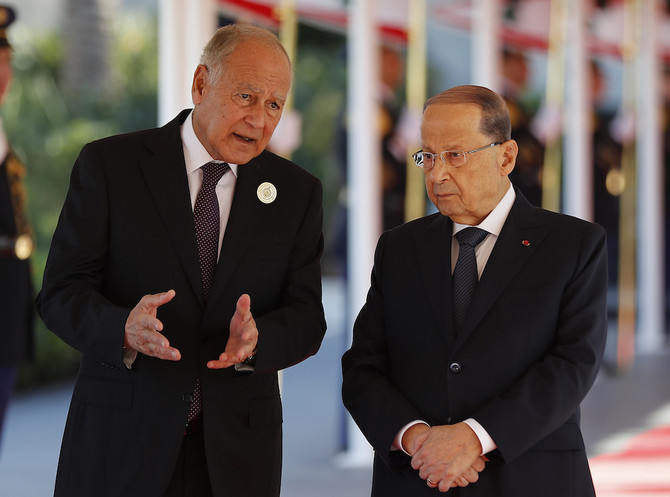
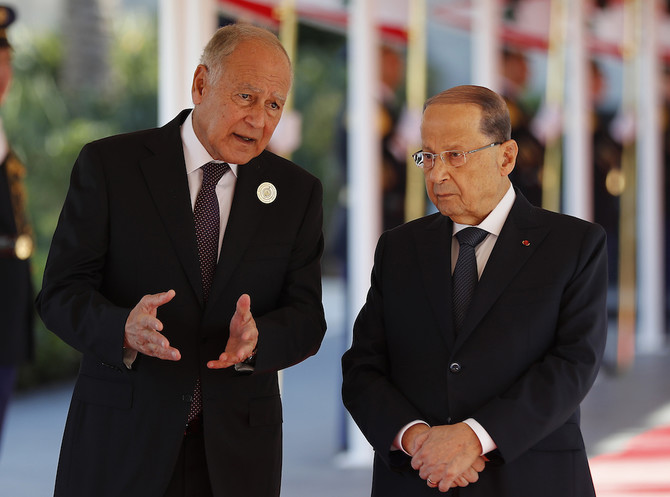
BEIRUT: The fourth Arab Economic and Social Development Summit was held in Beirut on Sunday, in an effort to, among other things, find ways to alleviate the suffering of refugees in the Middle East.
The summit, though attended by representatives from 20 Arab nations, was soured by the absence of most Arab heads of state, and was divided over several issues, including the absence of Syrian delegates, and a boycott by Libya.
The summit did, though, call for dialogue with the international community over growing tensions between Israel and Palestine.
Delegates expressed their support for the Palestinian people, and cited the “collective responsibility” of all parties towards maintaining the city of Jerusalem’s “Islamic and Christian identity.”
In a statement, the summit declared: “We reiterate Palestinian refugees’ rights of return and compensation, according to the UN General Assembly’s resolution 194 of 1948.”
Delegates also discussed at great length the need for international cooperation to support the growing digital economy across the region. They emphasized “the importance of building the necessary capacity” to benefit from the digital economy, and praised the initiative launched by the Emir of Kuwait, Sheikh Sabah Al-Ahmad Al-Jaber Al-Sabah, to create a sovereign investment fund to support the development of technology in the Gulf and the Middle East.
They urged all Arab nations to “support this initiative to strengthen the joint Arab economy,” and called on other Arab banks and funds to invest in it.
The summit also praised the role of small and medium businesses across the Arab world for their contribution to flourishing Arab economies, as well as the implementation of the Pan-Arab Renewable Energy Strategy 2030, to ensure power across the region becomes cleaner and more sustainable.
The summit was far from harmonious, though, with the Lebanese foreign minister, Gebran Bassil, addressing the hall to ask the international community “to assume its responsibilities by finding effective solutions for the return of Syrian refugees to their country.”
Bassil called on Arab nations and others to “shoulder the burden, honor their commitments and meet the refugees’ needs.”
There were also disputes over the attendance of the Emir of Qatar Sheikh Hamad bin Khalifa Al-Thani, as well as the boycott by Libyan delegates.
“I am saddened because of the absence of the Libyan delegation, and by the circumstances that led to this point,” Arab League president, Ahmed Aboul Gheit, said.
Lebanon’s president, Michel Aoun, echoed the words of his foreign minister, calling on the international community “to exert all efforts to provide the safe return of Syrian refugees to their country, and to present incentives so they can contribute to their country’s reconstruction.”
He proposed the establishment of an international Arab bank to help affected countries overcome the crisis, and invited established Arab funds to Beirut to discuss his proposals.
“I deplore the absence of other Arab presidents and kings, but each of them has his reason. Our union remains of great importance given that we will not be able to address the challenges facing our region and peoples, unless we agree on key issues,” Aoun said.
The next Arab Economic and Social Development Summit will be held in Mauritania in 2023.


