Arab Economic and Social Development meeting: A summit mired in controversy

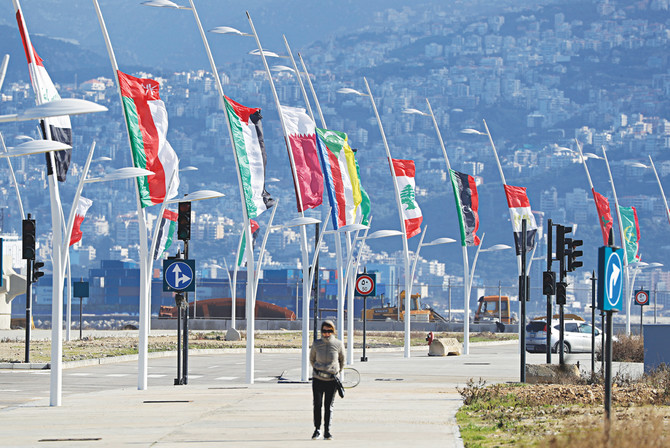
Flags of the Arab league states are seen on display ahead of the Arab Economic and Social Development Summit in Beirut on Jan. 17. (AFP)
Updated 31 May 2019
Follow

Arab Economic and Social Development meeting: A summit mired in controversy

  • Arab politicians and leaders are meeting in Beirut to discuss economic and social development
  • The meeting is overshadowed by disputes over Syria and Libya and a political crisis in Lebanon itself

BEIRUT: The plan was that heads of state from the Arab world would arrive in Beirut to discuss economic and social development. But like much in Lebanon at the moment, it did not go according to plan.

To begin with, only two heads of state — from Qatar and Mauritania — are attending the Arab Economic and Social Development summit. The meeting, which Lebanon had hoped would boost its sinking economic credentials as it struggles to form a government, has been mired in controversy for days.

Should Syria be invited? Yes, said Hezbollah and its political allies in Lebanon. No, said the Arab League.

Then a debate raged over whether Libya should receive an invitation, because of the unresolved mystery surrounding the disappearance of a Lebanese cleric in Libya four decades ago. In the end Libya boycotted the summit after Lebanese supporters of the cleric tore down a Libyan flag on a Beirut street.

Nevertheless, the summit’s media spokesman Rafic Chlala told Arab News: “The presidents who decided not to attend the summit have sent their delegates, which means the summit hasn’t failed, as some are trying to portray it.”

The delegates have much to discuss. According to the Arab League Deputy Secretary-General Houssam Zaki, there is no dispute about the items on the agenda.

They include “Arab food security, the development of an Arab Free Trade Zone, the completion of the requirements to establish the Arab Customs Union, the Arab strategy on Sustainable Development 2030, launching the work to establish the joint Arab electricity market, the strategic vision to promote and activate joint Arab work between the tourism and culture sectors in Arab states, managing solid waste in the Arab world and developing policies that deal with Arab women’s affairs and promotion of their capacities.”

The agenda also includes ”supporting the Palestinian economy and Arab strategy to protect children and promote technical and vocational education in the Arab world, and addressing the challenges facing the United Nations Relief and Works Agency for Palestine Refugees (UNRWA) and their consequences  on the Palestinian refugees.”

The issues are supposed to be economic and social, but the fallout from the Syrian civil war will inevitably dominate. Discussions took place on Saturday about a proposed Lebanese addition to the final communique calling for “the dignified return of refugees to Syria.”

Minister of Economy Raed Khoury told Arab News: “Lebanon is demanding the encouragement of the safe return of refugees to the safe zones. Some countries were rooting for the ‘voluntary return,’ while some wanted to delete the whole paragraph, on the grounds that it is a political and not an economic matter that should be discussed during the next regular Arab summit that will be held in late March, in Tunisia.”

Lebanon is currently home to more than a million refugees, which is, according to Khoury, “a huge burden on the Lebanese economy and the social situation.”

During the summit, Lebanese President Michel Aoun is expected to launch an initiative on “the development of a funding structure to rebuild Arab states that have witnessed armed conflicts.”

The assistant Secretary-General of the Arab League, Haifa Abou Ghazaleh, said: “The Beirut summit is very important as it is being held only few months before the World Sustainable Development Summit.

“Arab states have committed to implementing the 2030 sustainable development plan, with its economic, social and environmental aspects, and the Beirut summit provides an important opportunity to promote development in Arab states, by combining knowledge, youth and wealth.

“This combination gives the Arab community a great and strong chance for a new beginning, to shift toward knowledge economies. This is what we are all seeking, to build a knowledge society, turning the massive capacities, natural resources, human potential and knowledge-based wealth in the region into a base to develop social integration and cohesion, in order to reach sustainable development that will promote Arabs’ wellbeing.”

The discussions of the Arab Civil Society Forum in Beirut, which preceded the summit, indicated that the “Arab region is witnessing the highest levels in income inequality around the world, where 10 percent of its population is making 61 percent of the total income, while half of the population is only making 10 percent of it, despite the wealth of resources in the region.”

The forum called on Sunday’s summit to “adopt economic and social policies to reduce inequality in all its forms through the redistribution of wealth.”

According to the Arab League, “a strategic framework developed by the Council of Arab Ministers for Social Affairs, regarding  the elimination of multidimensional poverty” will be suggested at the summit.



Lebanese President Michel Aoun is expected to launch an initiative on reconstruction in Arab states affected by armed conflict. (AFP)

The League estimates that the number of poor people in Arab states reached 116 million in 2014.

While the issues are weighty, the view on the Beirut street is unconvinced. “Lebanon is the king of missed opportunities,” Jihad Jrab, a bank manager told Arab News. “We had the opportunity of making our image look better, especially in these trying times, so that these visiting leaders would come and give the proper attention needed to the citizens of this country. It was evident that they did all they can to not gain
this attention.”

Bassam Jrab, Jihad’s cousin and an engineer in Lebanon, said: “In order to attract people to invest in the country you need to present a solid front … to show that there is security, that there is a working government, and a respectable presidency. 

 “You have a president who invited a country to attend the summit, then an employee of the government comes and forbids it from happening, what message does this convey? That there is a strong president? Or a chair’s leg?”

Lebanon has invested $10 million in hosting the summit, with an increase in security staff and the closure of streets, schools and public institutions. Nevertheless, many Lebanese questioned the country’s ability to host the summit, after eight months without a government and a looming economic crisis. Over the past couple of weeks, two storms hit the country, tore apart its infrastructure and left refugee camps flooded.

“They spend all this money on hosting a summit, while our homes are getting flooded and roads being pulled apart by these storms. Wouldn’t it be better to use the money to help the citizens?” shop-owner Omar Itani said.

There was frustration on social media. “I wish one day you [politicians] would think about the country’s benefit and see how to rescue what’s left of our dignity,” Hayat Gharzeddine tweeted. “Shame on you, such an embarrassment.”

Others were openly apathetic. “I don’t even know what the summit is about,” film maker Sandra Tabet said. “I’ve asked so many people and no one really seems to know or care.”

Decoder

Arab Economic and Social Development summits

The Arab Economic and Social Development summits are meetings of the Arab League, held at the head of state level to address issues of economic and social development among member states.


A history of strikes on Iran from 1980 to 202

Updated 8 sec ago
Follow

A history of strikes on Iran from 1980 to 202

  • From Operation Ajax in 1953 to Epic Fury yesterday, US-Iran tensions have repeatedly spilled into open conflict
  • The latest joint Israeli-US strikes mark a turning point in a rivalry that dates back to the 1979 Islamic Revolution

LONDON: The war that generations of diplomats, generals and spies had tried to avoid began on Saturday morning, when waves of US and Israeli aircraft and missiles struck targets across Iran, including in Kermanshah, Qom, Isfahan, Tabriz and Karaj, in what President Donald Trump called a “massive and ongoing” campaign.

For nearly half a century, the US and Iran have circled each other through covert action, proxy wars, sanctions and sporadic clashes, but never tipping into open conflict. That balance has now collapsed.

Ajax, Eagle Claw, Nimble Archer, Prime Chance, Praying Mantis, Midnight Hammer and now – in collaboration with Israel’s own Operation Lion’s Roar – Operation Epic Fury.

There has been no shortage of US military operations against Iran or Iranian forces in the Gulf ever since the two countries became sworn enemies following the overthrow of the pro-Western Shah by the Islamic Revolution in 1979.

The seeds of that revolution, and the subsequent emergence of Iran as a destructive force in the Middle East, were sown in 1953. Operation Ajax, a coup engineered by America’s CIA and the UK’s MI6, overthrew Iran’s democratically elected prime minister, Mohammed Mosaddegh, who had attempted to nationalize the British-owned Anglo-Persian Oil Company.

As part of that plot, America’s first attack on Iranian soil took place in August 1953 when, in a bid to stir up anti-Communist sentiment, CIA operatives bombed the home of a prominent Muslim in Tehran.

The coup, which led to the installation of the Shah, paved the way for the 1979 revolution, the return of Ayatollah Khomeini from exile and the foundation of the Islamic Republic of Iran.

America’s first military incursion followed shortly afterward. When news broke in 1980 that the deposed Shah had been flown to America for medical treatment, Iranian revolutionary students seized the US embassy in Tehran and held 52 Americans hostage for 444 days.

US President Jimmy Carter authorized an audacious rescue bid, Operation Eagle Claw, but it ended in disaster, thanks to poor planning and a collision between two US aircraft on the ground in central Iran, which cost the lives of eight US personnel.

It was President Ronald Reagan, Carter’s successor, who designated Iran as a state sponsor of terror following the bombing of a US base in Beirut in 1983 by Iran-backed Hezbollah, in which 241 US military personnel were killed.

Between 1987 and 1989, America and Iran came to blows several times in the Gulf during Operation Earnest Will, in which the US navy sought to protect tankers from Iranian attacks during the Iran-Iraq war.

The US Navy aircraft carrier USS Gerald R. Ford departs Souda Bay on the island of Crete on February 26, 2026, as part of the US military buildup in the Middle East. (AFP)

In a secret parallel operation, codenamed Prime Chance, US special forces attacked Iranian ships laying mines under cover of darkness, and in 1987 Operation Nimble Archer saw the US navy attack and destroy an Iranian oil platform.

The following year, two Iranian warships and three attack speedboats were sunk with the loss of 56 lives during Operation Praying Mantis (1988), launched in retaliation for the mining of a US frigate.

Also in 1988, the USS Vincennes, an American warship on patrol in the Gulf, shot down a civilian Iranian Airbus A300 on a scheduled flight to Dubai. All 290 people on board, including 65 children, were killed.

For the past 47 years, America’s main weapon against Iran has been sanctions. They were imposed for the first time in November 1979, during Carter’s presidency, in response to the takeover of the US embassy and the hostage crisis. Diplomatic ties between the US and Iran were severed the following year.

Sanctions targeted at Iran’s nuclear program and Tehran’s support for terrorist proxies, including Hamas and Hezbollah, were first imposed during Bill Clinton’s presidency in 1995.

The pressure was further increased by President Barack Obama between 2010 and 2013. But it was under his administration that, in 2015, the US agreed to ease sanctions in exchange for Iran signing up to the Joint Comprehensive Plan of Action, a deal under which it agreed to limit its nuclear program.

In May 2018, during his first presidency, President Donald Trump unilaterally withdrew the US from the JCPOA and imposed fresh sanctions on Iran.

In 2019, the Trump administration designated Iran’s Quds Force a terror organization. The following year, in the dying days of the first Trump presidency, the US killed Qassem Soleimani, the head of the organization, in a drone strike at Baghdad airport.

Trump returned to office in January 2025 and nuclear talks, mediated by Oman, began in April that year. The first round ended inconclusively. But on June 13, two days before the talks were due to resume, Israel launched a surprise attack on Iranian nuclear targets.

It was the beginning of the so-called Twelve Day War. On June 21 America joined the conflict, sending long-range bombers to hit targets including nuclear facilities at Fordow, Natanz and Isfahan in Operation Midnight Hammer.

Indirect talks between the two countries resumed in Muscat, Oman, on Feb. 6 this year, and continued in Geneva on Thursday.

They appeared to have gone well.

Afterward, Iranian Foreign Minister Abbas Araghchi said they had made “very good progress and entered into the elements of an agreement very seriously, both in the nuclear field and in the sanctions field.”

A US official described the talks as “positive,” and a further round was proposed for this week.

But for the past few weeks, even as the talks were under way, America had been assembling the largest force of warships and aircraft seen in the region since the invasion of Iraq in 2003.

On Friday, President Trump said he was not happy with the way the talks were going but implied they would continue. “We’ll see what happens,” he said. “We’re talking later.”

But the talking had stopped.

On Saturday morning, the world woke to the news that at 09:30 a.m. Tehran time, the US and Israel had launched Operation Epic Fury, a joint attack on Iran.