Hundreds throng to Kot Momin for the Orange Show

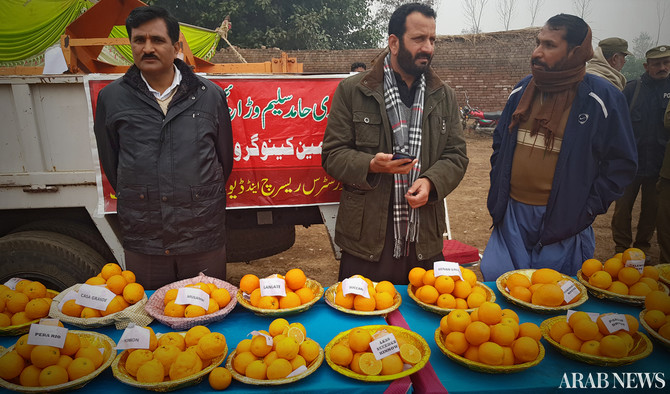
1 / 6
Local kinnow growers at their stall offering their produce. (AN photo)
2 / 6
All things Orange: The PTCD stall displays eatables made of oranges. (AN photo)
3 / 6
A little girl plucks oranges from the orchard at the Orange Festival. (AN photo)
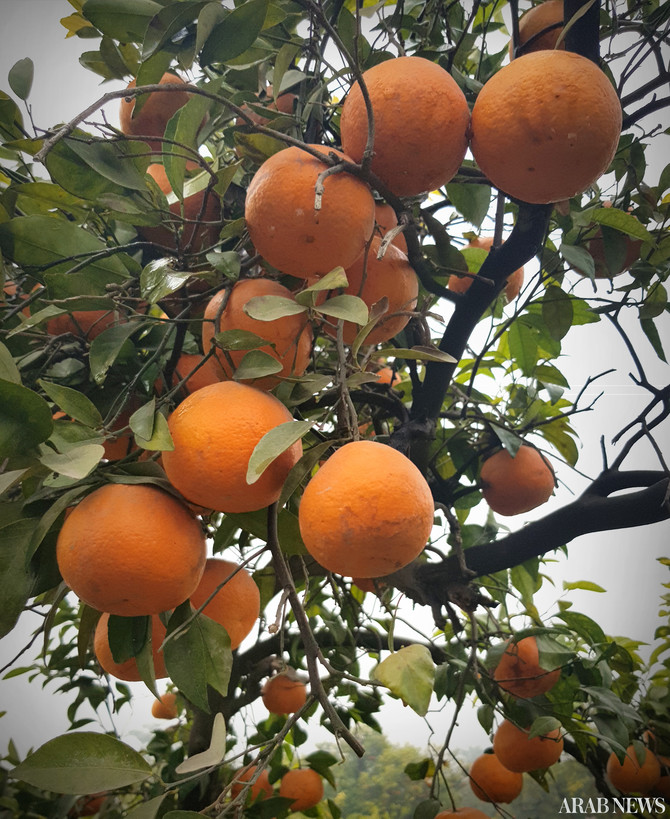
4 / 6
Pakistan’s oranges, locally produced at a farm around 200 km away from Lahore. Organic oranges from Pakistan are liked world across for their fresh aroma and refreshing taste. (AN photo)
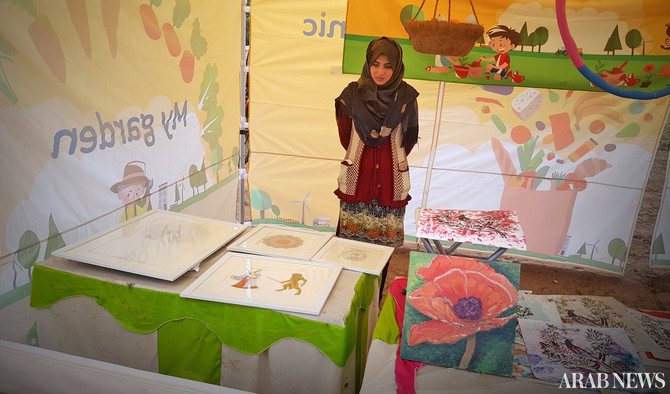
5 / 6
A university student at her stall at the festival. (AN photo)
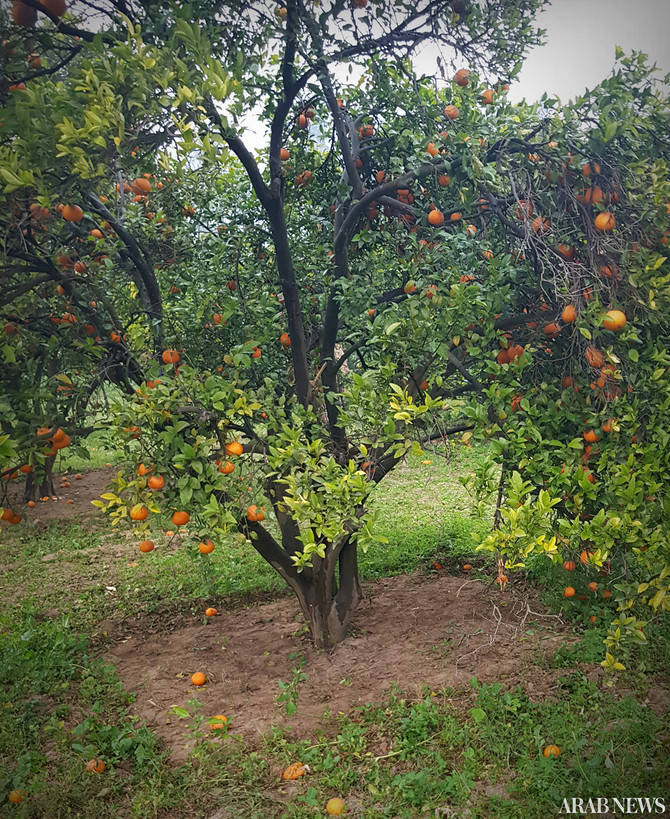
6 / 6
An orange tree at a farm in Kot-Momin. (AN photo)
Updated 23 January 2019
Follow

Hundreds throng to Kot Momin for the Orange Show

  • National Citrus Festival organized to promote agri-tourism and create awareness about exportable produce
  • Government to hold seminars and exhibitions to link Pakistan’s farmers with international markets

KOT MOMIN, LAHORE: The sweet smell of citrus pierced through the damp air as hundreds gathered in Kot Momin to celebrate the National Citrus Festival on a rainy Sunday morning.
Organized by the Tourism Development Corporation of Punjab — in cooperation with the Agri-Tourism Development Corporation of Pakistan — the initiative hopes to promote domestic consumption of the fruit, attract investors, and share expertise to add more value to the export of the citrus.
Hundreds of people from all age groups participated in the festival which was held in an area located 200 km outside of Lahore. The enthusiasm on part of attendees was unmistakable with several picking oranges and taking part in the activities at various stalls.
Nafisa Malik said she traveled 200 km just to participate in the event. “I am here just so I can physically experience picking oranges from the garden. But I didn’t realize that the best feeling is not just to pick the Kinnows, but that half the fun was just sitting under the rain with my family eating them. That is a unique experience,” she said.
Oranges are an important member of the citrus family and is valued for it’s quality of having nearly 47.5 percent of juice — the highest for all citrus fruits — while it’s sugar content is 12 percent. Additionally, 100 ml of Kinnow contains 20-25 mg of Vitamin C.
“Promoting tourism is a first priority on the government’s agenda and agri-tourism is an effort in that direction. This festival not only attracts masses, it educates them on the place they are visiting and the importance of the produce in national and international markets,” Yasir Humayun Sarfraz Raja, Punjab Minister for Tourism, told Arab News.
However, local farmers are of the view that since oranges are a major export product, foreigners should be invited to such events to promote the fruit even more.
“Pakistan produces the best oranges in the world. Our produce is recognized in the international market due to its aroma and taste. We export Kinnow to Russia, Indonesia, Middle East, and other parts of the world. The participation of foreigners in such events will enhance the export volume of the fruit,” Ahmad Hasan Gondal, a local orange farmer, told Arab News. 
In 2004, Pakistan exported approximately 0.15 million tons of orange while in 2018 the country exported a record 370,000 tons earning a revenue of around $22 million.
The Agriculture Department of Punjab expects 400,000 tons of oranges to be exported this year. With the China Pakistan Economic Corridor (CPEC) providing an easy and accessible route to the neighboring country, Pakistani exporters are vying for a place in the Chinese market, too.
For this, the agriculture department of Punjab is making an effort to introduce better seeds in the market.
Meanwhile, the Citrus Research Institute in Sargodha (CRIS) has developed seedless oranges which have already been introduced in the market. This kind of the fruit will further enhance the export volume of Pakistani oranges,” Muddasar Abbas, PRO agriculture department, told Arab News.
The government is trying to facilitate farmers and exporters by holding exhibitions and seminars where foreign delegates are being invited so as to introduce them to the international markets.


Islamabad dismisses claims about paying up to 8 percent interest on foreign loans as ‘misleading’

Updated 22 February 2026
Follow

Islamabad dismisses claims about paying up to 8 percent interest on foreign loans as ‘misleading’

  • Pakistan has long relied on external loans to help bridge persistent gaps in public finances and foreign exchange reserves
  • Pakistan’s total external debt, liabilities stand at $138 billion at an overall average cost of around 4 percent, ministry says

KARACHI: Pakistan’s finance ministry on Sunday dismissed as “misleading” claims that the country is paying up to 8 percent interest on external loans, saying the overall average cost of external public debt is approximately 4 percent.

Pakistan has long relied on external loans to help bridge persistent gaps in public finances and foreign exchange reserves, driven largely by a narrow tax base, chronic trade deficits, rising debt-servicing costs and repeated balance-of-payments pressures.

Over the decades, successive governments have turned to multilateral and bilateral lenders, including the International Monetary Fund, the World Bank and the Asian Development Bank, to support budgetary needs and shore up foreign exchange reserves.

The finance ministry on Sunday issued a clarification in response to a “recent press commentary” regarding the country’s external debt position and associated interest payments, and said the figures required contextual explanation to ensure accurate understanding of Pakistan’s external debt profile.

“Pakistan’s total external debt and liabilities currently stand at $138 billion. This figure, however, encompasses a broad range of obligations, including public and publicly guaranteed debt, debt of Public Sector Enterprises (both guaranteed and non-guaranteed), bank borrowings, private-sector external debt, and intercompany liabilities to direct investors. It is therefore important to distinguish this aggregate figure from External Public (Government) Debt, which amounts to approximately $92 billion,” it said.

“Of the total External Public Debt, nearly 75 percent comprises concessional and long-term financing obtained from multilateral institutions (excluding the IMF) and bilateral development partners. Only about 7 percent of this debt consists of commercial loans, while another 7 percent relates to long-term Eurobonds. In light of this composition, the claim that Pakistan is paying interest on external loans ‘up to 8 percent’ is misleading.

The overall average cost of External Public Debt is approximately 4 percent, reflecting the predominantly concessional nature of the borrowing portfolio.”

With respect to interest payments, public external debt interest outflows increased from $1.99 billion in Fiscal Year (FY) 2022 to $3.59 billion in FY2025, representing an increase of 80.4 percent, not 84 percent as reported. In absolute terms, interest payments rose by $1.60 billion over this period, not $1.67 billion, it said.

According to the State Bank of Pakistan’s records, Pakistan’s total debt servicing payments to specific creditors during the period under reference were as follows: the IMF received $1.50 billion, of which $580 million constituted interest; Naya Pakistan Certificates payments totaled $1.56 billion, including $94 million in interest; the Asian Development Bank received $1.54 billion, including $615 million in interest; the World Bank received $1.25 billion, including $419 million in interest; and external commercial loans amounted to nearly $3 billion, of which $327 million represented interest payments.

“While interest payments have increased in absolute terms, this rise cannot be attributed solely to an expansion in the debt stock,” the ministry said. “Although the overall debt stock has increased slightly since FY2022, the additional inflows have primarily originated from concessional multilateral sources and the IMF’s Extended Fund Facility (EFF) under the ongoing IMF-supported program.”

Pakistan secured a $7 billion IMF bailout in Sept. 2024 as part of Prime Minister Shehbaz Sharif’s efforts to stabilize the South Asian economy that narrowly averted a default in 2023. The government has since been making efforts to boost trade and bring in foreign investment to consolidate recovery.

“It is also important to note that the increase in interest payments reflects prevailing global interest rate dynamics. In response to the inflation surge of 2021–22, the US Federal Reserve raised the federal funds rate from 0.75-1.00 percent in May 2022 to 5.25–5.50 percent by July 2023. Although rates have since moderated to around 3.75 percent, they remain significantly higher than 2022 levels,” the finance ministry said.

“The government remains committed to prudent debt management, transparency, and the continued strengthening of Pakistan’s macroeconomic stability,” it added.