BENGHAZI, Libya: The forces of Libyan strongman Khalifa Haftar on Wednesday announced a military operation to “purge” extremists and criminal gangs from the south of the conflict-hit nation.
A spokesman for the self-proclaimed Libyan National Army (LNA) said its fighters had advanced in “several regions in the south” from an air base some 650 kilometers (400 miles) from the capital Tripoli.
The aim is to “assure security for inhabitants in the south-west from terrorists, be they the Daesh group or Al-Qaeda, as well as criminal gangs,” spokesman Ahmed Al-Mesmari said.
The LNA said it was also looking to secure petroleum facilities and tackle flows of clandestine migrants heading northwards to the Mediterranean coast.
It called on armed groups in the target area, mainly made up of tribal fighters, to withdraw from military and civilian installations.
Military sources told AFP that numerous LNA units had taken up positions in recent days around the region’s main city of Sabha.
Libya has been torn between rival administrations and a myriad of militias since the NATO-backed overthrow and killing of dictator Muammar Qaddafi in 2011.
Haftar supports an administration in the east of the country that is opposed to the internationally backed Government of National Accord in Tripoli.
The chaos has seen extremists and people traffickers gain a foothold in the south of the country.
Daesh has carried out repeated attacks across the country, targeting both Haftar’s forces and the rival Tripoli-based authorities.


Libya strongman’s forces launch operation to ‘purge’ south
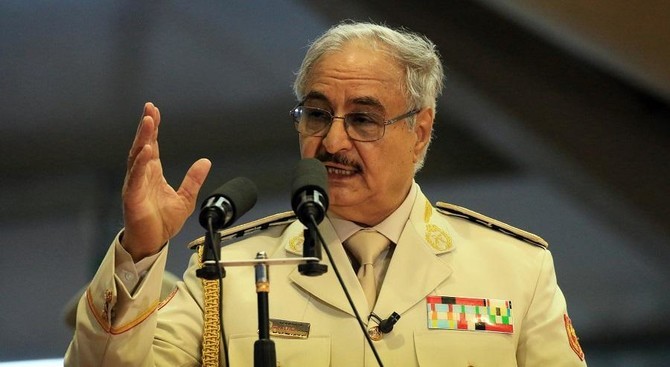
Libya strongman’s forces launch operation to ‘purge’ south

- Libya has been torn between rival administrations and a myriad of militias
- Daesh has carried out repeated attacks across the country, targeting both Haftar’s forces and the rival Tripoli-based authorities


What the government takeover of Syria’s largest oil field means for energy security
- Interim administration has regained control of Al-Omar oil field after years under Kurdish-led SDF control
- Production boost raises hopes for recovery, but damage and insecurity limit immediate economic impact
LONDON: After years under the control of the Kurdish-led Syrian Democratic Forces, Syria’s largest oil field, Al-Omar, and nearby gas fields in the eastern governorate of Deir Ezzor fell to interim government forces in late January.
It was a significant development that officials and industry experts say could benefit the country’s fragile economic recovery.
The interim government announced on Jan. 18 that the Al-Omar facility and surrounding gas fields had come under army control, after the SDF said it would redeploy east of the Euphrates River following more than a week of clashes in the northeast.
Days later, the state-run Syrian Petroleum Co. began restarting oil and gas production at the newly seized fields and routing output to the Homs and Baniyas refineries, the state news agency SANA reported on Jan. 24.
A company source told The Syria Report that oil production west of the Euphrates stood at 10,600 barrels per day. Since the takeover, production has risen to about 26,000 bpd and could reach 45,000 bpd within months, pending maintenance work.
And although experts caution that the takeover is unlikely to deliver immediate relief, it still carries longer-term significance.
Benjamin Feve, a senior research analyst at Karam Shaar Advisory, said the capture of Al-Omar is “not transformative in the short term” but remains “very important” for Syria’s economy.
“Control of Al-Omar and other Deir Ezzor fields gives Damascus revenue potential and strategic leverage,” Feve told Arab News.
“But in 2026, the contribution will be constrained by rehabilitation timelines, transport bottlenecks, and limited refining capacity, which will make the recapturing of the field a stabilizing factor for the budget and energy supply, maybe, but not really a game changer.”
Security risks further complicate the picture.
“We must also take into account the fact that the security situation in Deir Ezzor and around the Al-Omar field is not fully contained,” Feve said. “There are still risks from (Daesh) insurgents.”
Indeed, security briefings to UN bodies and partners of the US-led coalition against Daesh continue to flag Deir Ezzor and the Syrian desert as among the most at-risk areas for a resurgence.
The vast region, once a Daesh stronghold before the group’s territorial defeat in 2019, has seen a rise in “hit-and-run” attacks over the past year, with sleeper cells reportedly concentrated in the Deir Ezzor countryside.
The collapse of Bashar Assad’s regime in December 2024 left a security vacuum in western Deir Ezzor, creating conditions ripe for renewed attacks. By the end of August 2025, the SDF recorded 117 attacks, compared with 73 incidents during all of 2024.
However, recent political and military developments could improve stability.
On Jan. 30, Syria’s interim government reached a deal with the SDF, providing for the gradual integration of Kurdish forces and institutions into the state.
US Envoy Tom Barrack hailed the agreement as “a profound and historic milestone in Syria’s journey toward national reconciliation, unity, and enduring stability.”
In a long post on X, Barrack wrote that the deal paves the way for rebuilding institutions, restoring trust, attracting investment essential for reconstruction, and securing lasting peace.
Ten days earlier, he wrote that the SDF’s “original purpose” as “the primary anti-(Daesh) force on the ground” had “largely expired” as the new government in Damascus is now ready to “take over security responsibilities.”
The agreement followed weeks of violence in the north.
After US-mediated talks stalled over a March 2025 integration deal, clashes erupted in northern Aleppo in January, particularly in the predominantly Kurdish neighborhoods of Sheikh Maqsoud and Ashrafieh.
After government forces took control of the neighborhoods, they launched a broader offensive against the SDF in the northeast, later seizing Raqqa and Deir Ezzor governorates and parts of southern Hasakah.
Facing major territorial losses, the SDF agreed to a truce on Jan. 18 after talks with US officials, though reports of violations continued.
Under the Jan. 30 deal, the SDF is to withdraw from front lines, its fighters are to join the Syrian army, and its administrative bodies are to be integrated into state institutions.
The agreement also provides for the formation of a military division made up of three brigades of former SDF fighters, the coalition said in a statement on X.
Control of prisons and oil and gas fields was transferred from the SDF to the interim authorities as part of the arrangement.
Syria’s oil wealth, though diminished, remains significant.
In 2015, Oil & Gas Journal estimated the country’s proven oil reserves at 2.5 billion barrels and its gas reserves at 8.5 trillion cubic feet.
Before the civil war erupted in 2011, crude production reached about 386,000 bpd, according to the Ministry of Petroleum. Output plunged to between 24,000 and 34,000 bpd from 2014 to 2019, according to Statista.
By 2021, production averaged 85,900 bpd, though only about 16,000 bpd came from fields under the Assad regime’s control. The rest was produced in areas held by the SDF and US forces.
Gas production that year stood at 12.5 million cubic meters per day — roughly a third of prewar levels.
Early in the conflict, Daesh seized much of eastern Syria’s oil infrastructure. By 2014, the group controlled more than 60 percent of national production, producing about 50,000 bpd, which it sold at very low prices on black markets to finance operations, according to the Financial Times.
Years of fighting and neglect badly damaged oil and gas infrastructure, leaving Syria heavily reliant on Iranian supplies until Assad was overthrown in late 2024.
While the transfer of energy assets to the interim government led by Ahmad Al-Sharaa marks a pivotal moment, experts say Damascus faces many hurdles.
“The main constraints are systemic rather than geological,” Feve said, citing “widespread damage at Al-Omar and neighboring assets, degraded well integrity, reservoir mismanagement caused by years of rudimentary extraction, and a largely nonfunctional midstream network.”
He added that “key pipelines and pumping stations linking Deir Ezzor to the Baniyas refinery are out of service,” forcing the government to rely on “costly trucking to transport crude from Al-Omar to Baniyas” in the coastal region.
While Al-Omar produces light, sweet crude suitable for Baniyas, the route is operationally inefficient.
Sanctions-era shortages of spare parts, financing and qualified contractors mean “even basic rehabilitation” will take time, Feve said, “requiring lengthy technical assessments and phased rebuilding rather than a quick restart.”
Economic sanctions imposed by the US, EU, UK, and others since 2011 crippled Syria’s energy sector by restricting trade, financing and investment. Their gradual easing over the past year offers a path to recovery, though progress is likely to be slow.
Even with full rehabilitation, Al-Omar alone would not meet Syria’s total crude oil and production needs, Feve said, noting refinery constraints and mismatches in production.
“Domestic production could significantly reduce imports and improve energy security,” he said, but Syria “will continue to require substantial external supplies of crude oil and refined products for the foreseeable future, especially if no new oil discoveries are made.”
Feve warned that “depending on how much oil was extracted during the conflict — which remains unknown — calculations suggest Syria could potentially run out of oil by 2052.”
“Even in the long term,” he added, “this represents a serious and certain challenge that must be taken into consideration.”
For now, the energy crisis continues to shape daily life across Syria. Power outages last as long as 20 hours a day or more, even in the capital, while fuel for heating, transport, and generators remains scarce or unaffordable for a nation already struggling in poverty.
Any increase in production is likely to be felt gradually, experts say, and Syrians should not expect immediate relief in prices or exchange rates.
“Any ramp-up in production would first affect availability,” Feve said, including fuel for power plants, transport, and generators.
“Retail fuel prices in Syria are already at market levels. So, additional domestic supply would mainly reduce shortages and fiscal pressure from imports.
“A meaningful impact on inflation or the Syrian pound would likely take several months and depends on sustained production, reduced imports, and improved foreign exchange management.”
The price of a liter of octane-95 gasoline in Syria currently stands at about 100 Syrian pounds, or approximately $0.85, according to GlobalPetrolPrices.com. The global average is about $1.31 per liter.
For now, the return of Al-Omar is less about lowering prices than easing shortages over time, but it is unlikely to translate quickly into broader economic relief.


