



ABU DHABI: With Saudi Arabia ranking among the top five countries in the world in terms of water scarcity, the Kingdom is changing the way it produces, uses and distributes water to ensure sustainable growth.
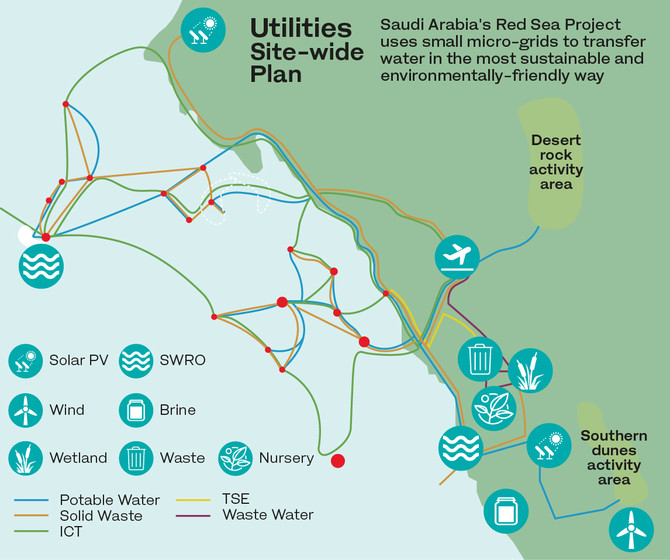
One of its key initiatives is the Red Sea Project, a luxury tourism destination with islands, nature and culture, which aims to set a new standard of sustainable development by optimizing its power, potable and sewage water, as well as solid waste.
Spearheaded by Crown Prince Mohammed bin Salman, the project is set to welcome around 1 million visitors by 2030. “We have islands, coastal areas, desert, and more than 100 mountains with over 50 volcanoes located 550 km north of Jeddah,” Martin Stahl, infrastructure director at the Red Sea Development Co., said on Monday at the Water Forum, part of Abu Dhabi Sustainability Week.
“At 28,000 sq. km, it’s nearly the size of Belgium, with 90 unspoiled islands, 200 km of coastline, and nearly 50 hotels to be built.”
The company plans to operate the largest battery plant in the world, producing 250 megawatts of diversified power, fully renewable, including wind and solar energy, and 56,000 cubic meters of water per day. “We’re trying to optimize water demand,” Stahl said. “We’ll have two plants, a photovoltaic one south of the development, one in the north, and a pilot plant for brine treatment, a wind energy plant, as well as our own nursery in agriculture and contracted wetland.”
The objective is a net positive environmental impact, maximal climate resilience, carbon neutrality, zero discharge, zero waste to landfill and zero single-use plastic. “Our sustainability goals are very challenging,” Stahl said.
“We launched an international university competition, supported by King Abdullah University of Science and Technology, that challenges young scientists and engineers to come up with new solutions in 12 months to reduce the environmental impact and create value from brine, to actively promote sustainable responsibility toward the Kingdom’s natural resources. The winner will be awarded $10,000.” The project uses a micro-grid, which entails smaller grids of water while keeping with environmental goals.
The practice is becoming more common in the region, especially in Saudi Arabia and the UAE, where hundreds of kilometers of pipes bring water to various areas.
“Because water is such a scarce resource and so vital in the area, water utility companies tend to cover large areas,” said Emmanuel Gayan, CEO and managing director of UAE-based water-treatment company Osmoflo.
“But today there’s a tendency to do things locally, and a new school of thought says maybe we should do things smaller because it brings more efficiency and fewer losses.”
Regional developers and industries are increasingly looking at producing and treating water locally through micro-grids of water.
Dr. Najib Dandachi, CEO of UAE-based consultancy Al-Usul, said: “Water, traditionally and historically, is unlike electricity and oil and gas. It’s a resource locally produced and distributed. Micro-grids existed in some shape or form because of the need for greater access to water and for water quality.” With a change in technology for water production and treatment, larger networks were then built. “But the same drivers that pushed toward enlarging that water network in water services are now driving more and more parts of the world to look into the smaller grid,” Dandachi said.
“The GCC (Gulf Cooperation Council) model of transferring water across hundreds of kilometers doesn’t really exist in many parts of the world. But what’s driving this zonal shrinking of the network is the technology across the value chain, from the production through the transmission, distribution and even customer services, that’s making the micro-grid more viable, and more attractive from a technical, commercial and quality-of-service point of view.”
The clean and renewable energy revolution is expected to strongly impact the water sector and help minimize climate change.
Leon Awerbuch, president of US-based Leading Edge Technologies, said significant efforts are being made in research and development to introduce renewable energy to the high-intensity energy desalination process.
“We’re helping to create a low-carbon future in clean water production,” he said. “A transformation in the energy and water sectors has begun, and fossil fuel domination will fade for desalination.” Saudi Arabia is working to build sewage-treatment plants related to renewable energy, with the private sector, in the cities of Taif, Jubail and Yanbu. The aim is to generate 1.45 million cubic meters of water.
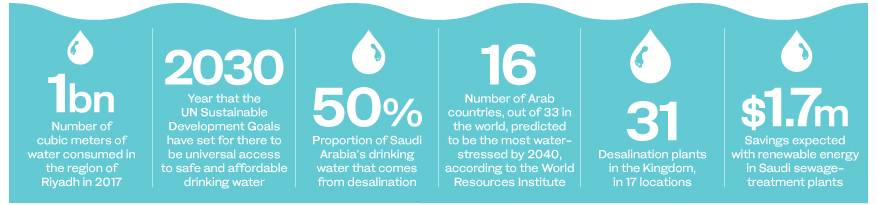
Khalid bin Zwaid Al-Quershi, CEO of the Saudi Water and Electricity Co., said: “We expect $1.7 million to be saved per year with renewables in sewage-treatment plants. Renewables offer attractive features because you avoid volatile fuel prices, and it’s more stable compared to different energy supplies. These are areas we need to focus on.”
As such, the Kingdom is embarking on ambitious water projects. Julio de la Rosa, Middle East business development director at Spain-based Acciona Agua, said: “Water is our daily concern, as well as to provide the most efficient technology solutions for our clients.”
Acciona Agua, a leading company in water treatment and desalination technology, will help build the Al-Khobar desalination plant with the Saudi government’s Saline Water Conversion Corp. on the east coast, generating a production capacity of 210,000 cubic meters per day, making it one of the largest in the country.
“We believe that cooperation between the public and private sectors will be valuable to public authorities,” said de la Rosa.
Saudi Arabia is increasingly following this collaboration process. Faisal Rashid, director of demand-side management at the Supreme Council of Energy in Dubai, said: “To have a healthy private-public partnership, it has to have a win-win situation. We also have huge projects in Dubai, with the engagement of the private sector, to build infrastructure. But more needs to be done on regulation.”
As well as technological advances helping to create clean water production, water is front and center in the exploration and generation of energy. Hani Khalifa, senior operations advisor at Saudi Aramco, said GCC oil and gas companies produce energy to the world, while simultaneously consuming a substantial amount of groundwater and freshwater.
“We also produce a lot of water. The global oil and gas industry produces 50 million cubic meters per day of a wide variety of water chemistry,” he said. “What we need is to work with technology providers and other industry partners to investigate how to turn this into a resource we can use instead of relying on a scarce resource, which puts more burden on water resources globally.”
Five to six barrels of water come with every barrel of oil. Robert Owens, business development operations manager at construction company Bechtel, said: “Historically, more than 90 percent of the water produced in that area (the oil and gas industry) is reinjected. That’s going to have to change.” He added: “We’re working with many international companies, which are expecting their water production to exceed 1 million barrels per day, which is a massive amount of water, some of which can be reused.” He said the real issue is the cost of treatment. “A series of projects to centralize water-treatment facilities for water that can be reused in other sectors is taking place,” he added.
“There’s a critical need in upstream oil and gas, and we think it will be a model for other places in the world to do something similar, like in Argentina and Poland.”
But Khalifa said this will require a change in the mindset of industries such as oil and gas, technology and regulation. “Water contains contaminants, which are difficult to treat. But if you look at the holistic approach to the challenge, it makes an economical difference,” he added. “Technology is improving rapidly, and we need more of it to be able to look at produced water. It’s not economical yet but we’re getting there. With some encouragement from regulation, we could make that move faster than ever.”


