

Kabul faces water crisis as drought, population strain supply

1 / 3
Only around 20 percent of Kabul is connected to the city’s piped water system, leaving many residents to ensure their own supply by digging wells that are often shared by several neighbors. (AFP)
2 / 3
Around 70 percent of the city’s groundwater is contaminated by waste and chemicals from leaky household septic tanks and industrial plants that can cause diarrhea or other illnesses if the water is not boiled or purified properly. (AFP)
3 / 3
Water is not only scarce in Kabul, but most of it is undrinkable, according to the National Environmental Protection Agency. (AFP)
Updated 11 January 2019
Follow

Kabul faces water crisis as drought, population strain supply

  • A shortage of rain and snow, a booming population and wasteful consumption have drained the Afghan capital’s water basin
  • Kabul’s population has more than doubled to around five million in the past 30 years, boosted by the arrival of people fleeing war and poverty

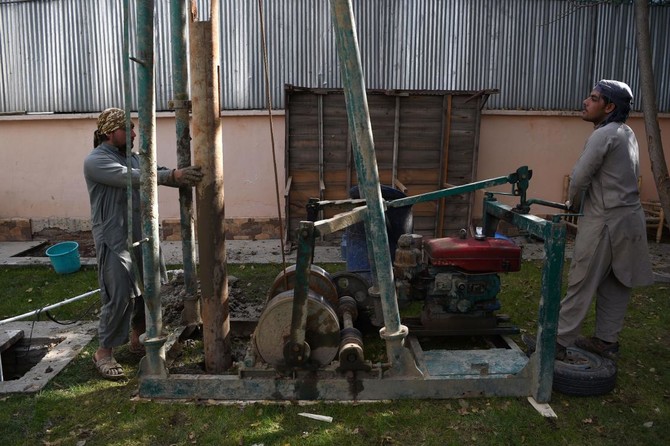
KABUL: Standing in his garden in Kabul, Baz Mohammad Kochi oversees the drilling of a new well more than 100 meters deep after his first water reservoir dried up. He is not alone.
A shortage of rain and snow, a booming population and wasteful consumption have drained the Afghan capital’s water basin and sparked a race to the bottom as households and businesses bore deeper and deeper wells in search of the precious resource.
“The water level has dropped so much that it is now necessary to reach other underground basins 100 meters, even 120 meters” deep, says well digger Mohammad Aman as his dilapidated machine pierces the ochre earth in Kochi’s yard.
Every year 80 million cubic meters (2.8 billion cubic feet) of water are extracted from Kabul’s aquifers — nearly double the natural recharge rate through precipitation, according to utility Afghanistan Urban Water Supply and Sewerage Corporation.
As a result Kabul’s water table has fallen at least 30 meters (100 feet) in recent years, says Asian Development Bank deputy country director Shanny Campbell.
Snow has fallen in the city this month but it is not nearly enough to solve the water shortage — in some areas the level has dropped 20 meters in the past year.
“The problem we have in Kabul is the massive increase in population, impact of climate change and overall less precipitation and snowfall,” Campbell explains.
Only around 20 percent of Kabul is connected to the city’s piped water system, leaving many residents to ensure their own supply by digging wells that are often shared by several neighbors.
Others buy water from private companies, or, like Mohammad Nazir, fill up jerry cans at mosques or more than 400 public taps scattered around the city.
“There is no point turning on the taps — there is no water here,” says Nazir, 50, who lives on a hill where the ground is too hard to dig a well and the city’s pipes do not reach.
“It’s the worst year we’ve ever lived.”
Water is not only scarce in Kabul, but most of it is undrinkable, according to the National Environmental Protection Agency.
Around 70 percent of the city’s groundwater is contaminated by waste and chemicals from leaky household septic tanks and industrial plants that can cause diarrhea or other illnesses if the water is not boiled or purified properly.

Efforts to increase connections to the municipal piped water network and improve sanitation systems are under way.
But progress is slow as authorities struggle to keep up with demand in one of the fastest growing cities in the world.
Kabul’s population has more than doubled to around five million in the past 30 years, boosted by the arrival of people fleeing war and poverty.
It is expected to reach eight million by 2050, according to a report published in the Washington-based SAIS Review of International Affairs in 2017.
Improving living standards for many households also means more people are showering and washing cars than ever before.
A lack of public awareness about water conservation and no restrictions on its usage means much of it is wasted.
While they try to work out how to replenish the city’s subterranean reserves, authorities are using a television campaign and the influence of religious leaders to encourage households to save water.
“In our Friday sermons, we call on the faithful not to waste water,” said Abdul Raouf, a member of the Ulema Council, the country’s highest religious body.
As they wait for the first winter snow in the city, worshippers also pray “for this drought to end as soon as possible.”
Even the Taliban are on board, issuing a statement to followers to “pray for rain.”
Authorities are not waiting for divine intervention to fix Kabul’s water problem.
With droughts, like the one affecting swathes of Afghanistan this year, expected to increase in severity and frequency as a result of climate change, a long-term solution is needed.
Among the options being explored by the ADB are “spreading basins” — large ponds that trap rainwater long enough for it to seep into the soil and recharge aquifers.
The ADB is also looking at using “pumps to inject the water directly into” the basins and the construction of a dam on the outskirts of Kabul.
“The answer is not in one technology but in a mixture,” Campbell said.
“Kabul is under a situation of water stress so we’re looking for a solution with lower impact, lower cost technology that could fix the problem quickly.”
That would be welcome news to Kochi, who cannot hide his relief as water gushes out his new well. He knows the borehole could dry up again soon.
“We have survived revolution and civil wars, the Taliban regime and suicide attacks, but this water shortage may force us to leave,” Kochi says.
“There is no life without water.”


FBI foils Daesh-inspired New Year’s Eve attack plot

Updated 2 sec ago
Follow

FBI foils Daesh-inspired New Year’s Eve attack plot

  • Christian Sturdivant,18, charged with attempting to provide material support to foreign terrorist organization
  • Investigators say he shared plans for the attack with an undercover FBI employee
CHARLOTTE, United States: The FBI said Friday it disrupted a New Year’s Eve attack plot targeting a grocery store and fast-food restaurant in North Carolina, arresting an 18-year-old man who authorities say pledged loyalty to the Daesh group.
Christian Sturdivant was charged with attempting to provide material support to a foreign terrorist organization after investigators say he shared plans for the attack with an undercover FBI employee posing as a supportive confidant.
Sturdivant was arrested Wednesday and remained in custody after a federal court appearance Friday. An attorney representing him Friday did not immediately respond to an email seeking comment. Another hearing was scheduled for Jan. 7.
The alleged attack would have taken place one year after 14 people were killed in New Orleans by a US citizen and Army veteran who had proclaimed his support for Daesh on social media.
The FBI has foiled several alleged attacks through sting operations in which agents posed as terror supporters, supplying advice and equipment. Critics say the strategy can amount to entrapment of mentally vulnerable people who wouldn’t have the wherewithal to act alone.
Searches of Sturdivant’s home and phone uncovered what investigators described as a manifesto detailing plans for an attack with knives and a hammer, FBI Special Agent in Charge James Barnacle said at a news conference Friday.
“He was willing to sacrifice himself,” Barnacle said.
US Attorney for western North Carolina Russ Ferguson said the planned attack in Mint Hill, a bedroom community near Charlotte, targeted “places that we go every day and don’t think that we may be harmed.”
Worried he might attempt violence before New Year’s Eve, the FBI placed Sturdivant under constant surveillance for days, including on Christmas, Ferguson said. Agents were prepared to arrest him earlier if he left his home with weapons, he said. “At no point was the public in harm’s way.”
The fact that Sturdivant encountered two undercover officers while allegedly planning the attack should reassure the public, Ferguson said. He declined to identify the grocery store and restaurant cited in the complaint, citing the ongoing investigation.
If convicted, Sturdivant faces up to 20 years in prison, according to court documents.
An FBI affidavit says the investigation began last month after authorities linked Sturdivant to a social media account that posted content supportive of Daesh, including imagery that appeared to promote violence. The account’s display name referenced Abu Bakr Al-Baghdadi, the former leader of the extremist group.
Some experts argue that Daesh is powerful today partly as a brand, inspiring both militant groups and individuals in attacks that the group itself may have no real role in.
The affidavit says Sturdivant had been on the FBI’s radar in January 2022, when he was a minor, after officials learned that he had been in contact with a person in Europe the FBI says was an Daesh member, and had received instructions to dress in black, knock on people’s doors and commit attacks with a hammer.
At that time, Sturdivant did actually set out for a neighbor’s house armed with a hammer and a knife but was restrained by his grandfather, the affidavit says.
The FBI in Los Angeles last month announced the disruption of a separate New Year’s Eve plot, arresting members of an extremist anti-capitalist and anti-government group who federal officials said planned to bomb multiple sites in southern California.
Other Daesh-inspired attacks over the past decade include a 2015 shooting rampage by a husband-and-wife team who killed 14 people in San Bernardino, California, and a 2016 massacre at a gay nightclub in Orlando, Florida, by a gunman who fatally shot 49 people.