

Turkey announces counterterror plan in Syria

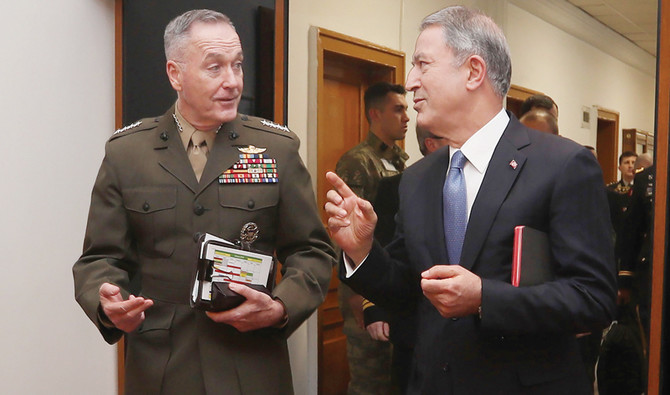
Turkish Defense Minister Hulusi Akar, right, and US Chairman of the Joint Chiefs of Staff Joseph Dunford speak during their meeting in Ankara on Tuesday. (AFP)
Updated 11 January 2019
Follow

Turkey announces counterterror plan in Syria

ANKARA: A day after American officials visited Turkey to discuss and coordinate the US military withdrawal from Syria, Ankara on Wednesday said preparations to eliminate Daesh and other terrorist groups in northern Syria are underway. 

Turkish President Recep Tayyip Erdogan previously committed to his US counterpart Donald Trump to eradicate all remnants of Daesh in Syria. 

But Ankara has strongly objected to recent American conditions for withdrawing from Syria, such as Turkey guaranteeing the safety of Syrian-Kurdish forces allied to the US. 

The meeting between National Security Adviser John Bolton, Chairman of the Joint Chiefs of Staff Gen. Joseph Dunford and special envoy on Syria James Jeffrey and their Turkish counterparts was dominated by this disagreement.

Erdogan reportedly declined to meet with Bolton. Before visiting Ankara, Bolton had said Turkey should coordinate any military moves with the US.

Experts say Turkey will not undertake a large-scale operation in northern Syria amid the presence of US troops. 

Aaron Stein, director of the Middle East program at the US-based Foreign Policy Research Institute, said Turkey’s options depend on moves by other actors in the Syrian conflict. 

“Ankara is negotiating with Russia, which is in separate talks with the SDF (Syrian Democratic Forces) and the (Syrian) regime” about the Kurdish-controlled northeast of the country in light of the US plan to withdraw, he told Arab News. 

“Moscow will want to keep Turkey in the tent, but it will also have to manage relations with Damascus, which is clearly annoyed by the prospect of even more Turkish soldiers on its territory.”

If Damascus and the Kurds can reach an agreement on the return of the regime’s authority in the northeast, that will dictate the scope of a Turkish operation or whether it will take place at all, Stein said.

The implosion of the Turkish-Russian deal over the “de-escalation zone” in Syria’s Idlib province will be influential in the near future, he added. 

“Turkey hasn’t been able to uphold its commitments (regarding the Idlib deal), which could strengthen Russian leverage over Ankara,” he said.

“Or Moscow could look the other way should things between the Kurds and the regime go south and no agreement is reached, which could give way to a Russian green light for a Turkish operation.”

Since last month, Erdogan has threatened to conduct a cross-border operation in areas held by the Syrian-Kurdish People’s Protection Units (YPG), and dispatched military reinforcements along Turkey’s border with Syria. 

Jesse Marks, Middle East analyst and Fulbright scholar at Cambridge University, told Arab News: “Turkey’s plan of action after US forces leave is dependent on how the process of withdrawal is implemented and what changes on the ground occur during this period.”

He said: “The Kurds might reach an agreement with the Syrian government over the northeast. This could pave the way for a transition of northeast Syria to Russian forces to prevent an immediate Turkish offensive, followed by a final handover to Damascus further down the line.”

Turkey is in a diplomatic position to negotiate with the US and Russia simultaneously in order to seek a better range of outcomes in its favor, Marks added. 

But it is unlikely that Turkey will receive a comprehensive green light for military action from either country, he said.  

“Ultimately, the future of northeast Syria isn’t a simple bilateral US-Turkish decision. Kurdish fears of an invasion hastened conversations with the Syrian government over some form of reunification, bringing Russian and Syrian interests into consideration,” he added. 

“If Turkey launches a military offensive after the US drawdown, it has to deal with a range of possibilities that involve Russian and Syrian military actors in the area.” 

Meanwhile, Ankara has asked the US to hand over 16 of its military bases in northern Syria, and to take back arms delivered to the YPG following the withdrawal. 

Experts say for now it is unlikely that the US will hand over any bases in Syria to Turkey because of its alliance with Syrian-Kurdish forces.


Fresh clashes kill six in Iran cost-of-living protests

Updated 4 sec ago
Follow

Fresh clashes kill six in Iran cost-of-living protests

  • The protests began on Sunday in Tehran, where shopkeepers went on strike over high prices and economic stagnation
  • Earlier Thursday, state television reported that a member of Iran’s security forces was killed overnight during protests in the western city of Kouhdasht

TEHRAN: Protesters and security forces clashed in several Iranian cities on Thursday, with six reported killed, the first deaths since the cost-of-living demonstrations broke out.
The protests began on Sunday in Tehran, where shopkeepers went on strike over high prices and economic stagnation, and have since spread to other parts of the country.
On Thursday, Iran’s Fars news agency reported two people killed in clashes between security forces and protesters in the city of Lordegan, in the province of Chaharmahal and Bakhtiari, and three in Azna, in neighboring Lorestan province.
“Some protesters began throwing stones at the city’s administrative buildings, including the provincial governor’s office, the mosque, the Martyrs’ Foundation, the town hall and banks,” Fars said of Lordegan, adding that police responded with tear gas.
Fars reported that the buildings were “severely damaged” and that police arrested several people described as “ringleaders.”
In Azna, Fars said “rioters took advantage of a protest gathering... to attack a police commissariat.”
During previous protest movements, state media has labelled demonstrators “rioters.”
Earlier Thursday, state television reported that a member of Iran’s security forces was killed overnight during protests in the western city of Kouhdasht.
“A 21-year-old member of the Basij from the city of Kouhdasht was killed last night by rioters while defending public order,” the channel said, citing Said Pourali, the deputy governor of Lorestan Province.
The Basij are a volunteer paramilitary force linked to Iran’s Revolutionary Guards, the ideological branch of the Islamic republic’s army.
Pourali said that “during the demonstrations in Kouhdasht, 13 police officers and Basij members were injured by stone throwing.”
In the western city of Hamedan, protesters torched a motorbike in what the Tasnim news agency described as an unsuccessful attempt to burn down a mosque.
The same agency reported on Thursday that 30 people in a district of Tehran had been arrested the night before for alleged public order offenses in a “coordinated operation by the security and intelligence services.”

- ‘End up in hell’ -

The demonstrations are smaller than the last major outbreak of unrest in 2022, triggered by the death in custody of Mahsa Amini, who was arrested for allegedly violating Iran’s strict dress code for women.
Her death sparked a nationwide wave of anger that left several hundred people dead, including dozens of members of the security forces.
The latest protests began in the capital and spread after students from at least 10 universities joined in on Tuesday.
Iranian President Masoud Pezeshkian has sought to calm tensions, acknowledging protesters’ “legitimate demands,” and he urged the government Thursday to take action to improve the economic situation.
“From an Islamic perspective... if we do not resolve the issue of people’s livelihoods, we will end up in Hell,” Pezeshkian said at an event broadcast on state television.
Authorities, however, have also promised to take a “firm” stance, and have warned against exploiting the situation to sow chaos.
Local media coverage of the demonstrations has varied, with some outlets focusing on economic difficulties, and others on incidents caused by “troublemakers.”
Iran is in the middle of an extended weekend, with the authorities declaring Wednesday a bank holiday at the last minute, citing the need to save energy during the cold weather.
They made no official link to the protests.
The weekend in Iran begins on Thursday, and Saturday is a long-standing national holiday.
Iran’s prosecutor general said on Wednesday that peaceful economic protests were legitimate, but any attempt to create insecurity would be met with a “decisive response.”
“Any attempt to turn economic protests into a tool of insecurity, destruction of public property, or implementation of externally designed scenarios will inevitably be met with a legal, proportionate and decisive response.”

- Viral video -

Earlier this week, a video showing a person sitting in the middle of a Tehran street facing down motorcycle police went viral on social media, with some seeing it as a “Tiananmen moment” — a reference to the famous image of a Chinese protester defying a column of tanks during 1989 anti-government protests in Beijing.
On Thursday, state television alleged the footage had been staged to “create a symbol” and aired another video purportedly shot from another angle by a police officer’s camera.
Sitting cross-legged, the protester remains impassive, head bowed, before covering his head with his jacket as behind him a crowd flees clouds of tear gas.
On Wednesday evening, Tasnim reported the arrest of seven people it described as being affiliated with “groups hostile to the Islamic Republic based in the United States and Europe.”
It said they had been “tasked with turning the demonstrations into violence.” Tasnim did not say when they were arrested.
The national currency, the rial, has lost more than a third of its value against the US dollar over the past year, while double-digit hyperinflation has been undermining Iranians’ purchasing power for years.
The inflation rate in December was 52 percent year-on-year, according to the Statistical Center of Iran, an official body.