
ANKARA: Turkish President Recep Tayyip Erdogan on Tuesday slammed as a “grave mistake” comments by White House National Security adviser John Bolton over the Syrian Kurdish militia, highlighting tensions between Ankara and Washington.
Erdogan’s comments came shortly after Bolton held more than two hours of talks in the Turkish capital with Erdogan’s adviser Ibrahim Kalin, in a key meeting focusing on the surprise US decision to withdraw US troops from Syria.
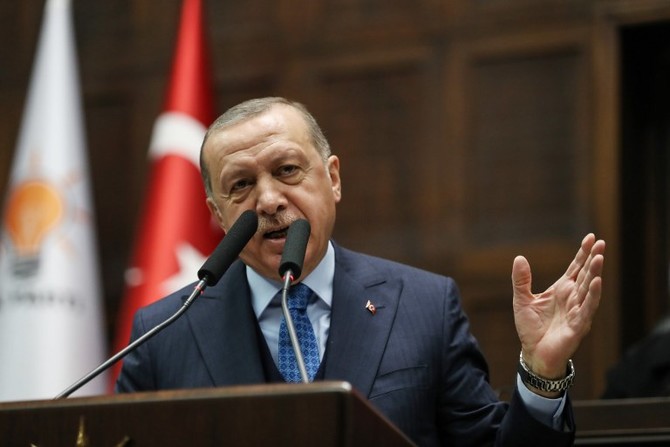
“It is not possible to accept or swallow the message given by Bolton from Israel,” Erdogan told his party’s lawmakers in parliament.
Tensions erupted ahead of the Ankara talks after Bolton said Sunday in Israel the retreat was also conditional on the safety of US-backed Kurdish fighters, considered terrorists by Turkey.
A furious Erdogan said: “John Bolton has made a grave mistake on this issue.”
US President Donald Trump caused a political storm last month when he announced the troop pullout because the battle against the Daesh group had been won.
“President Trump made the right call to withdraw from Syria,” Erdogan said in a column published in the New York Times, outlining Turkey’s “comprehensive strategy” to eliminate the causes of radicalization in the war-torn country.
US Secretary of State Mike Pompeo also drew wrath of the Turkish leadership when he said Washington will ensure Ankara does not “slaughter” Kurds in Syria as American troops withdraw.
Erdogan lambasted the comments Tuesday and said: “That Turkey targets the Kurds is the most vile, the most dishonorable, the ugliest and the cheapest slander.”
Bolton held “productive” talks with Kalin on Tuesday morning to discuss how the withdrawal would take place, his spokesman said in a statement shared on Twitter following the meeting.
“They had a productive discussion of the president’s decision to withdraw at a proper pace from northeast Syria, identified further issues for dialogue,” Garrett Marquis said.
Joining Bolton were General Joseph Dunford, the chairman of the Joint Chiefs of Staff, and the anti-Daesh group envoy James Jeffrey.
There was no meeting with Bolton on Erdogan’s schedule.
A senior official said Tuesday that Bolton did not consider himself snubbed by Turkish President Erdogan because plans for a meeting between the two had not been confirmed.
When Trump first announced the pullout of 2,000 ground troops on December 19, Ankara was a lonely voice among NATO allies welcoming the decision.
Erdogan has promised Trump that Turkey could finish off the remnants of Daesh in Syria.
“A military victory against the terrorist group is a mere first step,” he said in the New York Times, warning against premature declarations of victory.
Trump said Monday the fight against Daesh was not over.
“We will be leaving at a proper pace while at the same time continuing to fight Daesh and doing all else that is prudent and necessary!” he tweeted.
Nicholas Heras, an analyst at the Center for a New American Security, said Ankara would need support from Washington to completely eradicate Daesh, “to the point where the US military would essentially still be inside Syria.”
The US had been working closely with the Syrian Kurdish People’s Protection Units (YPG) militia under the banner of the Syrian Democratic Forces (SDF) alliance.
But US-Turkey relations have been especially rocky over American military support to the YPG.
Ankara says the YPG is a “terrorist offshoot” of the outlawed Kurdistan Workers’ Party (PKK), which has been waging an insurgency against the Turkish state since 1984.
The PKK is proscribed as a terror group by Ankara and its Western allies.
And Erdogan’s comments on Tuesday showed disagreements still existed over the future of the YPG.
The Turkish leader chastised Washington for bringing a new definition to terror. “There cannot be such a thing,” he said, assuring that Ankara would not make any concessions in the fight against the YPG.
“Those who are in the terror corridor in Syria will learn necessary lessons,” he said. “To us, there is no little difference between the YPG and the PKK.”
Last month, Erdogan threatened to launch a cross-border operation against the YPG, east of the Euphrates River, which he said later would be delayed after Trump’s order.
But Turkey has sent military convoys to its border with Syria and inside the war-ravaged country.
Turkish military analyst Metin Gurcan said Ankara was currently being held back on the operation by the issue of airspace, which was on the agenda for Tuesday’s talks.
Gurcan said it was not clear whether the US would withdraw from the airspace, but even if Washington did so, Ankara would need the support of Moscow for any operation.
Turkish military forces supporting Syrian rebels launched incursions into northern Syria against Daesh in August 2016 and against the YPG in January 2018.