79 Hindu couples say “I do” at mass wedding in Karachi

1 / 12
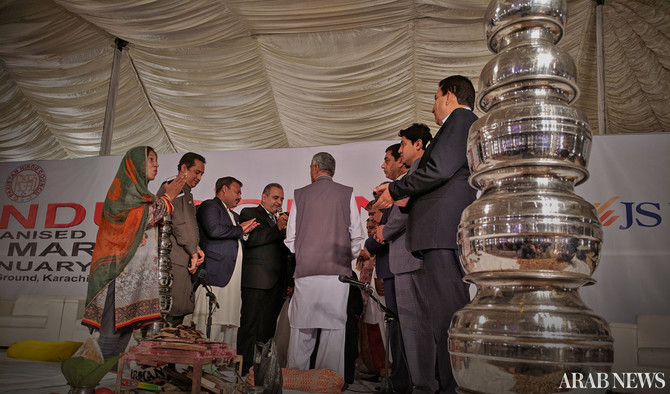
The lead couple of the mass wedding, Vijay and Lakshmi, performed marriage rituals at the stage while other 78 other couples followed them. (AN Photo by M.F. Sabir)
2 / 12
The Pakistan Hindu Council (PHC) has been organizing annual mass weddings for the past 11 years. For the purpose, they invite applications and shortlist the most deserving candidates based on income and social status. (AN Photo by M.F. Sabir)
3 / 12
Lakshmi, the bride, and Vijay, the bridegroom, performed a key marriage ritual by circling the fire seven times. (AN Photo by M.F. Sabir)
4 / 12
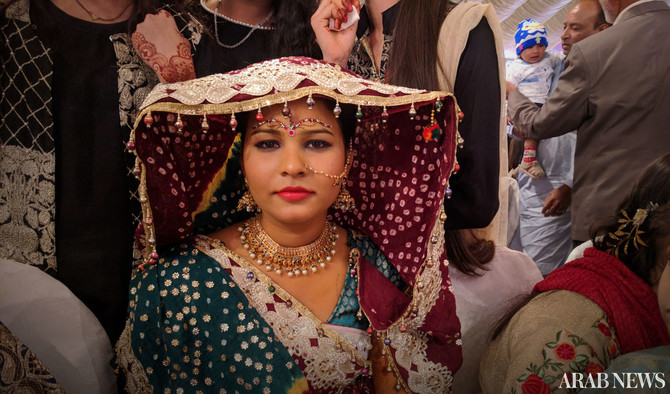
Somji Lal, 23, and his bride, Thani, wait for the mass wedding ceremony to begin. (AN Photo by M.F. Sabir)
5 / 12
Sister of a bride, Lakshmi, held a platter, a mandatory ritual in Hindu marriages in India and Pakistan, as the mass wedding was carried out in Karachi on Sunday. (AN Photo by M.F. Sabir)
6 / 12
Vijay and his bride looked happy since their dream of a huge wedding reception came true on Sunday. (AN Photo by M.F. Sabir)
7 / 12
Seventy-nine Hindu couples got married at a mass wedding in Karachi on Sunday. (AN Photo by M.F. Sabir)
8 / 12
Most of the brides and bridegrooms, from rural Sindh in Pakistan, wear local attire for their wedding ceremonies. (AN Photo by M.F. Sabir)
9 / 12
Most of the brides and bridegrooms, from rural Sindh in Pakistan, wear local attire for their wedding ceremonies. (AN Photo by M.F. Sabir)
10 / 12
Most of the brides and bridegrooms, from rural Sindh in Pakistan, wear local attire for their wedding ceremonies. (AN Photo by M.F. Sabir)
11 / 12
The Pakistan Hindu Council (PHC) has been organizing annual mass weddings for the past 11 years. For the purpose, they invite applications and shortlist the most deserving candidates based on income and social status. (AN Photo by M.F. Sabir)
12 / 12
The Pakistan Hindu Council (PHC) has been organizing annual mass weddings for the past 11 years. For the purpose, they invite applications and shortlist the most deserving candidates based on income and social status. (AN Photo by M.F. Sabir)
Updated 07 January 2019
Follow

79 Hindu couples say “I do” at mass wedding in Karachi

  • Pakistan Hindu Council has helped hundreds get married in the past 11 years
  • In addition to taking care of the overhead costs, the group also provides each pair with enough money to begin their lives with dignity

KARACHI: Vijay Kumar Waiker had always wanted his wedding to be grand.
However, the 36-year-old salesman who works at a local garment shop in the Airport Gate neighborhood of Karachi said he knew that was something that would never be possible – with a Rs 1,200 monthly salary, he lacked the funds or savings for an upscale wedding.
All that changed on Sunday when he says his “dream came true”.
Waiker, along with his 28-year-old bride, Lakshmi, changed into their wedding attire and traveled all the way to the affluent Defense Housing Authority, where Dr. Ramesh Kumar Vankwani, a Hindu community leader and lawmaker, personally welcomed them.
Later, Vankwani took them to a hall where arrangements had been made for a mass wedding ceremony for 79 Hindu couples. “As we reached Dr. Vankwani’s residence, we were welcomed with flowers, music, and fireworks,” Waiker told Arab News on Sunday, adding that “it was like a dream come true”.
“I used to pass by marriage halls at night on my way back from work, wishing that I could afford such a wedding reception,” Waiker said.
Seventy-eight other Hindu couples from various parts of Sindh, including from Tharparkar — which is one of the most destitute regions of the province – were also married on the same day.
Another resident, 23-year-old Somji Mal from Sanghar, who married his cousin, Thani, told Arab News that his family could not afford to get him married. “I work in the fields for a local landlord and earn 3,000 to 4,000 rupees a month,” he said.
“I am really happy that I got married. I did not have to take loans for that, unlike other members of my extended family,” he added.
The Pakistan Hindu Council (PHC) has been organizing annual mass weddings for the past 11 years. For the purpose, they invite applications and shortlist the most deserving candidates based on income and social status.
According to Vankwani, the council has helped 1,100 needy couples get married through the initiative. “People celebrate New Year in different ways. This is the New Year celebration for me and my colleagues at the council,” he said with a smile, adding that this also results in forging strong social bonds “among the participants as they celebrate their big day in a joint gathering”.
The PHC also provides financial support to newly-wed couples in the form of Rs100,000 for each pair, so that they can “start their new life with honor and dignity”. This is in addition to taking care of other costs such as those incurred for transportation and food.
According to the 2017 census, there are 5.5 million Hindus in Pakistan of which 90 percent live in Sindh. However, independent Hindus groups say the number is around 8 million.
Dr. Govind Ram, Chairman of Pakistan Hindu Sabha, said that due to a lack of registration with National Database and Registration Authority by members of the scheduled class, several Hindus remain uncounted.
Vankwani believes that such events also play a vital role in projecting a positive image of Pakistan on the international level. “We want to show the international community that religious minorities enjoy the freedom to organize and participate in their socio-religious ceremonies in Pakistan.”
Adding that minorities are treated with equal opportunities in Pakistan, Vankwani said: “We can see lawmakers, doctors and others professionals from the Hindu community around, which shows we, the Hindus, are fairly treated in Pakistan.”


Pakistan plans $3,500 locally made electric car to lure motorcycle users

Updated 5 sec ago
Follow

Pakistan plans $3,500 locally made electric car to lure motorcycle users

  • Government-backed program aims to speed shift to electric transport
  • Lithium battery plants and possible tax cuts seen lowering EV costs

ISLAMABAD: Pakistan is set to launch a locally manufactured low-cost electric vehicle (EV) priced at Rs1 million ($3,556), aimed at helping motorcycle users transition more easily to cars, an official from the Engineering Development Board (EDB) told Arab News on Monday.

The country has seen a gradual rise in the adoption of EVs in a market traditionally dominated by Japanese automakers. The development comes as major cities across Pakistan face some of the world’s highest levels of air pollution, leading to dense smog in winter, with road transport being a major contributor.

In June last year, Pakistan introduced its Electric Vehicle Policy 2025–30, announcing more than Rs100 billion ($353 million) in subsidies over five years to support electric bikes and rickshaws and accelerate the shift toward cleaner transport.

“The car will be fully made in Pakistan and a local company is working on it,” Zeeshan Ashraf, a spokesman for the Engineering Development Board, a government body, told Arab News. “Its full price will be Rs1 million while the government is planning to give extra subsidy on this.”

Chinese and Korean electric vehicle brands have increasingly entered Pakistan’s market in recent years, making EVs a more common sight in cities such as Islamabad, Lahore and Karachi.

Ashraf said the vehicle will be launched under the Pakistan Accelerated Vehicle Electrification (PAVE) Program, a public-sector initiative designed to promote an eco-friendly and economical transportation system in the country.

The locally manufactured low-cost EV is expected to become available across the country within the next few months, he added.

Earlier, Engineering Development Board Chief Executive Hammad Mansoor was quoted by local media as saying that Pakistan could see its first fully electric, locally manufactured car enter the market by June 2026, with an estimated price of around Rs1 million.

Speaking to journalists during an iftar dinner in Karachi this month, Mansoor also signaled that the government may lower vehicle taxes in the upcoming federal budget to make hybrid, electric and conventional fuel vehicles more affordable.

He said Pakistan’s first lithium battery manufacturing facility is expected to begin production by May, while a second plant could start operations in September.

According to him, about 74 percent of battery components will be produced locally, which could significantly reduce the cost of EVs by relying on domestically manufactured parts.