

Tesla breaks ground on Shanghai factory

1 / 4
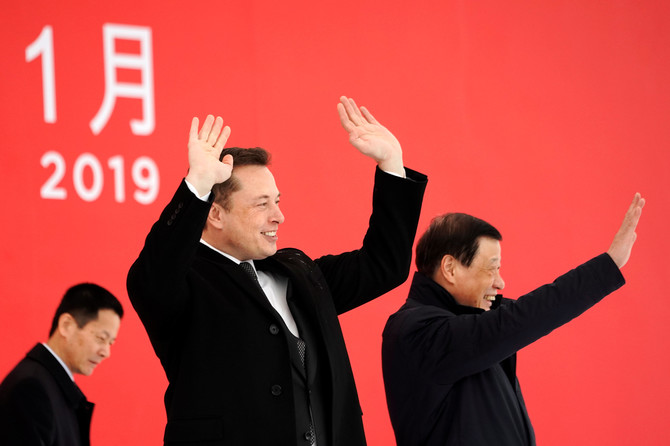
Tesla CEO Elon Musk, center, and Shanghai’s Mayor Ying Yong, right, attend the Tesla Shanghai Gigafactory groundbreaking ceremony in Shanghai. (Reuters)
2 / 4
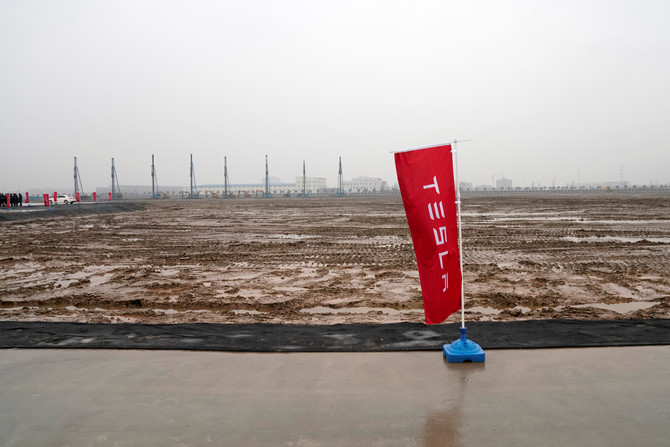
The land of Tesla Gigafactory at a groundbreaking ceremony of Tesla Shanghai Gigafactory in Shanghai. (Reuters)
3 / 4
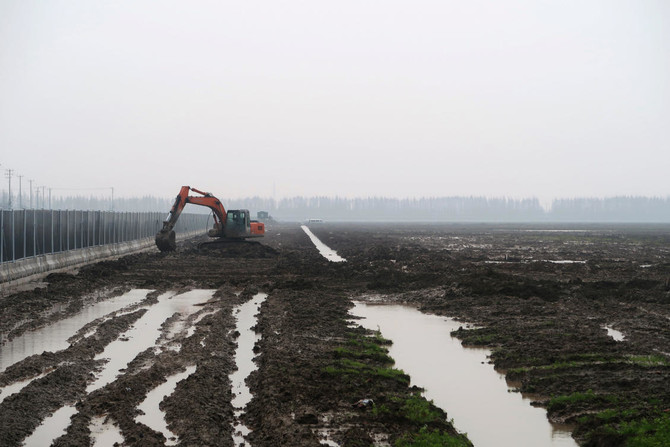
A Chinese flag is seen on the land secured by Tesla for its Gigafactory in Shanghai, China. (Reuters)
4 / 4
Tesla plans to produce its Model 3 and Model Y cars in the initial phase of production at the Shanghai plant. (Reuters)
Updated 07 January 2019
Follow

Tesla breaks ground on Shanghai factory

  • ‘Looking forward to breaking ground on the @Tesla Shanghai Gigafactory today!’ Musk wrote in a post on Twitter
  • Tesla has said it aims to produce its Model 3 mass-market car from 2019 at the new plant

BEIJING: Tesla broke ground Monday for a factory in Shanghai, its first outside the United States.

CEO Elon Musk said Monday on Twitter that the company will start production in China of its Model 3 and a planned crossover by the end of the year.

Tesla announced plans in July to build the Gigafactory 3 facility in China, the biggest electric vehicle market, despite trade tension between Beijing and Washington. That followed Beijing’s announcement it would end restrictions this year on foreign ownership of electric vehicle producers in an effort to spur industry development.

“Looking forward to breaking ground on the @Tesla Shanghai Gigafactory today!” said Musk on Twitter. “Aiming to finish initial construction this summer, start Model 3 production end of year & reach high volume production next year.”

China’s state broadcaster CCTV showed Musk and other Tesla and local officials attending a chilly ceremony in the rain Monday in Shanghai’s outskirts.

The Shanghai factory will produce “affordable versions of 3/Y for greater China,” Musk said. The company refers to a planned crossover that has yet to receive a formal name as the Y.

Higher-priced models will be built in the United States for export to China, Musk said.

Tesla, based on Palo Alto, California, global automakers including General Motors Co., Volkswagen AG and Nissan Motor Corp. that are pouring billions of dollars into manufacturing electric vehicles in China.

Local production would eliminate risks from tariffs and other import controls. It would help Tesla develop parts suppliers to support service and make its vehicles more appealing to mainstream Chinese buyers.

Tesla said in October it had signed an agreement for a 210-acre (84-hectare) site in the Lingang district in southeastern Shanghai.

Shanghai is a center of China’s auto industry and home to state-owned Shanghai Automotive Industries Corp., the main local manufacturer for GM and VW.

Tesla has yet to give a price tag but the Shanghai government said it would be the biggest foreign investment there to date.

The company faces competition from Chinese brands including BYD Auto and BAIC Group that already sell tens of thousands of hybrid and pure-electric sedans and SUVs annually.

Until now, foreign automakers that wanted to manufacture in China were required to work through state-owned partners. Foreign brands balked at bringing electric vehicle technology into China to avoid having to share it with potential competitors.

The first of the new electric models being developed by global automakers to hit the market, Nissan’s Sylphy Zero Emission, began rolling off a production line in southern China in August.

Lower-priced electric models from GM, Volkswagen and other global brands are due to hit the market starting this year, well before Tesla is up and running in Shanghai.


Saudi Arabia signs 90 deals as Global Labor Market Conference conference ends 

Updated 10 sec ago
Follow

Saudi Arabia signs 90 deals as Global Labor Market Conference conference ends 

RIYADH: Saudi Arabia signed 90 agreements and memorandums of understanding aimed at supporting global labor markets and benefiting more than 6 million people as the Kingdom wrapped up a two-day gathering in Riyadh.

The third Global Labor Market Conference saw deals struck between government entities and private-sector partners, spanning skills development, digital transformation, flexible employment and sustainable workforce partnerships. Officials said the initiatives will have an impact both inside and outside Saudi Arabia. 

The event attracted more than 10,000 participants from over 100 countries, including 40 labor ministers and more than 200 international experts. Organized by the Ministry of Human Resources and Social Development, the event was held under the theme “Future in Progress.” 

Saudi Minister of Human Resources and Social Development Ahmed Al-Rajhi stated in a post on X that the conference concluded after two days of discussions focused on practical solutions for current and future labor market challenges. 

“We discussed the future of skills, the impact of artificial intelligence, building resilient and inclusive labor markets, and empowering talent,” he said, adding that the conference is designed as a continuous platform for year-round cooperation, with partnerships and knowledge exchange extending beyond the event itself. 

Al-Rajhi also chaired a high-level ministerial meeting which was also attended by the director general of the International Labor Organization, during which participants agreed on six measures to help shape the future of work. 

The conference saw the release of several reports, including an international guide titled “What Works for Work: A Guidebook to Proven and Promising Employment Solutions,” produced in collaboration with the World Bank.

Another report, “A Decade of Progress,” reviewed the transformation of Saudi Arabia’s labor market over the past 10 years, documenting achievements since the launch of Vision 2030. 

Other outcomes included the graduation of the first cohort of the Labor Market Academy, comprising 36 graduates from 34 countries, and the launch of a second cohort. 

The event also featured a policy hackathon focused on securing first jobs for new labor market entrants, while side events highlighted milestones such as a decade of the Musaned platform for domestic workers. 

The conference concluded by reaffirming Saudi Arabia’s role in shaping the future of work globally through innovation, partnerships and workforce empowerment. 

Saudi Arabia’s economic transformation is being significantly accelerated by its booming events industry, which has evolved into a primary driver of growth alongside traditional infrastructure and giga-projects.