TAKHT BHAI, Pakistan: The government of northwestern Khyber Pakhtunkhwa (KP) has devised a multi-pronged strategy to revive and refurbish the vibrant tourism sector in the province to preserve the sacred Buddhist sites and other historic monuments of the British era.
The initiative is aimed at attracting national and international tourists and multiply businesses to the province’s tribal areas, a senior official said.
Nisar Muhammad, the Public Relations Officer (PRO) for KP’s minister for tourism, archaeology, sports, culture, and youth affairs, told Arab News that the Pakistan Tehreek-e-Insaf (PTI) government estimates the presence of more than 1,000 sites of historical and religious importance, with 132 sites situated in the newly-merged Khyber tribal district alone.
“In a bid to promote religious tourism in KP and war-ravaged erstwhile FATA region, there are many Buddhist sacred places which the followers of the religion want to visit. We have written letters to embassies of seven countries including China, Japan, and Korea about the KP government’s plans to preserve the Buddhist sites to promote religious tourism here,” he said.
Muhammad Zaman, a resident of Takht Bhai, said hundreds of people visit the Buddhist sites on a weekly basis, adding that the government should take measures to rebuild the roads and structures in the larger interest of the country and minorities.
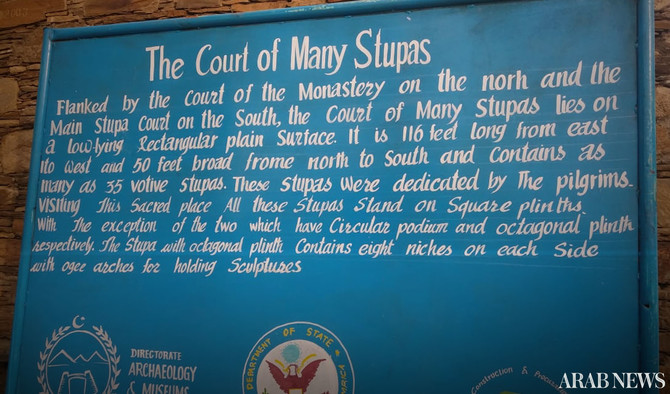
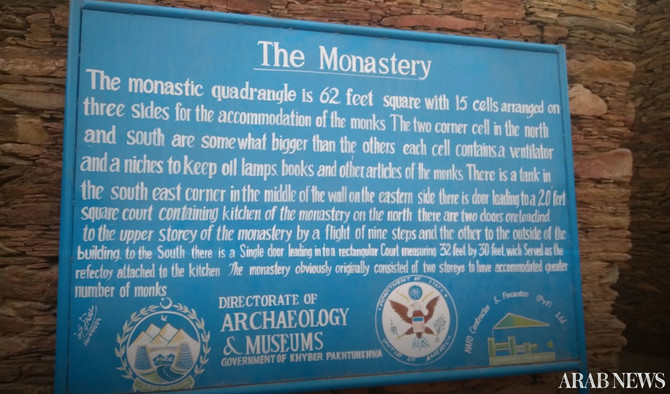
Takht Bhai — part of the World Heritage List — is one of the world’s most renowned and well-structured Buddhist monasteries. It is located almost 500 feet atop a small mountain, with a range of up to two kilometers, toward the east of Takht Bhai bazaar in the KP province.
Known as the heart of the Gandhara civilization, it attracts tourists, historians, and archaeologists from across the country but its preservation would attract Buddhists from across the world, Zaman said.
Founded in the early first century, the Takht Bhai Buddhist monastic complex (Throne of Origins) has survived successive invasions and is well preserved due to its location on top of the high hill.
A number of locals say that the Buddhist complex and the surrounding village are widely believed to be named after two wells which were found on top of the hill near the complex.
Takht — which basically means throne and bhai which means water in Persian — was named after the spring located on the left side of the Buddhist site, Sher Nawaz, another local, added.
Muhammad said that the top administrators in every district of the province have been instructed to identify historical places in their respective areas which would help pave way for a fresh survey of the places, adding that 20 more tourist spots would be identified in the next four years.
Nawaz Uddin, a research officer at the KP archaeology department, said that the provincial government is striving to initiate some work on preserving the historical sites but full-fledged work would begin once the budget for the purpose is allocated in the tribal districts.
“KP has over 6,000 historical sites, with some of them have sacred places of ancient religions but we have no scientific survey of the erstwhile FATA region. Only one district of tribal areas known as Khyber tribal district has 132 sites,” he added.
Professor Jamil Yousafzai, an archaeologist in KP, stressed that the preservation of historical sites — primarily those holding religious importance — would bolster the image of the country and lure investments as well.
“The KP government has taken a brilliant step to preserve the sites of Buddhism and other minorities. This depicts that our soil is rich and has the credit of being a cradle of world religion,” he observed.
The areas of Swat, Bunner, Swabi, Takht Bhai, Khyber tribal district, and other parts of the province and tribal regions are rich in historical sites.
Mehrab Afridi, a local from the Khyber tribal district, recalled how the decade-old wave of insurgency severely impacted the tourism sector of the province, driving tourists away from visiting the area.
“As militancy has now been banished in the wake of successive military operations, the rich tourism sector is again on a take-off position. People start visiting Buddhist-period archaeological sites in Swat, Landi Kotal, Jamrud in Khyber tribal district and other areas, which have multiplied businesses,” Afridi said.
He said that the main Stupa in Landi Kotal of the Khyber tribal district is being frequented by visitors on a daily basis. However, the sites need restoration work which would help develop the war-torn region.
Atif Khan, KP minister for tourism, archaeology, sports and culture — during his maiden visit to the newly-merged tribal district of Khyber — had pledged that a Safari train till Torkham border would be launched again which would generate employment opportunities for the locals, too.
He told media that KP has more than 1,000 sacred Buddhist sites of which 100 of them are located in the Khyber tribal district.
Muhammad said that the KP government has formally requested the central government to help the province launch the Safari train from Peshawar all the way to the Torkham border with Afghanistan.
Nawaz Uddin said preserving archaeological and historical sites should not be looked at from a financial point of view. Rather, it is an exercise to work toward preserving the country’s national heritage which depicts the rich history of Pakistan.
“We can attract foreign tourists as the newly-merged districts have a large number of sacred sites of Buddhism. The area can be turned into a religious tourism spot,” he added.


![]()
![]()
![]()
![]()
![]()
![]()
![]()

Pakistan to begin restoration work of sacred Buddhist sites, British-era monuments in KP



Pakistan to begin restoration work of sacred Buddhist sites, British-era monuments in KP
- Measures are part of province’s initiative to revive vibrant tourism sector
- Is home to more than 1,000 sites of historic and religious significance
Latest updates


© 2026 SAUDI RESEARCH & PUBLISHING COMPANY, All Rights Reserved And subject to Terms of Use Agreement.