ISLAMABAD: In a bid to freshen its air and cut planet-warming emissions, the Pakistani port city of Karachi will introduce cleaner-running buses powered by a decidedly “unclean” fuel: cow poo.
With funding from the international Green Climate Fund, Karachi will launch a zero-emission Green Bus Rapid Transit (BRT) network, with 200 buses fueled by bio-methane.
Locals said the new bus system — due to start operating in 2020 — would help reduce air pollution and street noise, but doubted whether it would have enough buses to resurrect the city’s ailing transport system.
“(Karachi’s) public transport system has totally collapsed and most people have to use online taxi-hailing services (and) auto rickshaws,” said commuter Afzal Ahmed, 45, who works as a medical sales representative.
After management problems forced the Karachi Transport Corporation to fold some two decades ago, Chinese-imported buses running on compressed natural gas fell into disrepair and were taken off the road, worsening public transport woes, he noted.
Malik Amin Aslam, adviser on climate change to Pakistan Prime Minister Imran Khan, said the BRT system was the first transport project the Green Climate Fund had approved, and would bring “multiple environmental and economic benefits.” It would not require operating subsidies, he added.
The cheap, clean bus network will cater for 320,000 passengers daily, and will reduce planet-warming emissions by 2.6 million tons of carbon dioxide equivalent over 30 years, according to project documents.
The BRT will consist of a 30-km (18.6-mile) corridor that will benefit 1.5 million residents, adding 25 new bus stations, secure pedestrian crossings, improved sidewalks, cycle lanes and bike-sharing facilities.
The Green Climate Fund, set up under UN climate talks to provide finance to developing countries to help them grow cleanly and adapt to a warming climate, will provide $49 million for the Karachi project out of a total cost of $583.5 million.
The other major funders are the Asian Development Bank and the provincial government of Sindh, where Karachi is located.
WASTE ON TAP
The BRT system, to be rolled out over four years, will have a fleet of 200 hybrid buses that will run on bio-methane produced from manure excreted by Karachi’s 400,000 milk-producing water buffaloes, and collected by the authorities.
The project will prevent about 3,200 tons of cow manure entering the ocean daily by converting it into energy and fertilizer at a biogas plant, and will save more than 50,000 gallons of fresh water now used to wash that waste into the bay, Aslam said.
Ali Tauqeer Sheikh, CEO of Leadership for Environment and Development (LEAD) Pakistan, a policy think-tank, said calculating the overall impact on the environment was complex, as the buses would be introduced in stages.
Pakistan’s authorities often lack maintenance budgets, he noted, highlighting the risk the buses could break down and not be repaired.
“Pakistan has a history that it does not utilize donors’ project funding at an optimum level,” he said.
But if all goes well, Sheikh said the project, as the country’s first green BRT system, would lay the foundation for “climate-smart urban transportation systems” in other places.
It could shake up approaches to public transport among policy makers and planners, serving as a model for other cities, including Lahore, Multan, Peshawar and Faisalabad, he said.
CLEANER AIR
Pakistan needs to launch such projects in big cities to discourage personal vehicle use, thereby easing traffic emissions and smog, and improving air quality and public health, Sheikh added.
He recommended setting a target for 70 percent of the urban population to use public transport.
Another way to ease air pollution would be to import better-quality petroleum fuels for vehicles, he added.
“We are importing low-grade fuel, and our refineries have capacity to refine only third-grade fuel,” he said.
Ahmad Rafay Alam, an environmental lawyer, said previous BRT projects in Pakistan’s large cities had not focused on environmental sustainability.
Planners should start connecting transport systems with wider urban development, Alam said.
“We need to introduce transport-oriented urban design by encouraging the use of public transport and discouraging the use of private vehicles to reduce emissions,” he said.
Zia Ur Rehman, a Karachi-based journalist covering civic issues, noted that the Sindh provincial government had run less than 50 buses in the city in the last 10 years, while private buses and mini-buses had dwindled from 25,000 to 8,000.
One reason is that buses were torched during strikes and at times of political upheaval, he said.
The new bus system alone was unlikely to resolve the city’s transport problems, but would be “a short-term relief for commuters and also help in reducing... air pollution,” he added.


Biogas guzzlers: Karachi’s public buses to run on cow poo

Biogas guzzlers: Karachi’s public buses to run on cow poo
- New bus system will start operating in 2020
- Clean bus network will cater for 320,000 passengers daily

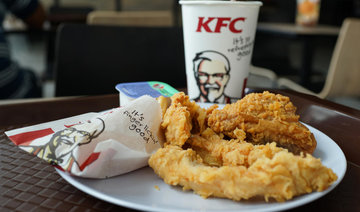
KFC readies finger-licking Japanese Christmas
- The first KFC Christmas campaign was in 1974 and there are different theories about the origins
TOKYO: KFC in Japan is gearing up for the Christmas tradition of millions of families thronging the US fast-food chain for special festive buckets of deep-fried chicken and other treats.
“Reservations for KFC Christmas typically begin around the beginning of November,” Takuma Kawamura, a KFC marketing manager, told AFP at a new upmarket pop-up eatery in Tokyo.
“From that time, stores with the Col. statue will dress him in Christmas attire,” he said, referring to KFC’s late founder Col. Sanders, a widely recognized figure in Japan.
Japan has a tiny Christian majority and Christmas is a secular festival of full-bore consumerism complete with Santa, gifts and streetlights. Couples often go on dates on Christmas Eve.
For food, families often gorge themselves on special “Party Barrels” bursting with chicken, an array of side dishes and a dessert — such as ice cream or cheesecake — stored at the bottom in a separate compartment.
December 24 — Christmas Eve — is KFC Japan’s busiest day by far, with 10 times more customers than normal, the firm said in 2020. Reportedly 3.6 million families make orders.
The first KFC Christmas campaign was in 1974 and there are different theories about the origins.
These include that Takeshi Okawara, the manager of Japan’s first KFC outlet, overheard foreigners pining for turkey, which is often eaten at Christmas in Britain and the United States.
Col. Sanders, who died in 1980, has also entered into baseball folklore in Japan.
Hanshin Tigers supporters threw a plastic statue of the Col. from a KFC restaurant into a river in Osaka in 1985 on their way to winning Japan’s version of the World Series.
This was because fans — many of whom also jumped in the dirty Dotonbori waterway — thought the statue resembled Randy Bass, an American member of the team at the time.
But the dunking spawned the legend of the “Curse of the Colonel” that said the Tigers would never win another title until the effigy was recovered.
The sludge-covered statue was dredged out in 2009, cleaned up and put on display, but it took until 2023 for the Tigers finally to win the championship again.
The plastic Col. was finally disposed of last year following a ritual at a temple attended by KFC’s Japan president, who offered sake and fried chicken.