PESHAWAR: Even as a report filed by the World Economic Forum paints a dismal picture of the condition of women in Pakistan, the country’s northwestern province of Khyber Pakhtunkhwa may have provided a silver lining by electing a journalist as the Peshawar Press Club’s first woman vice president.
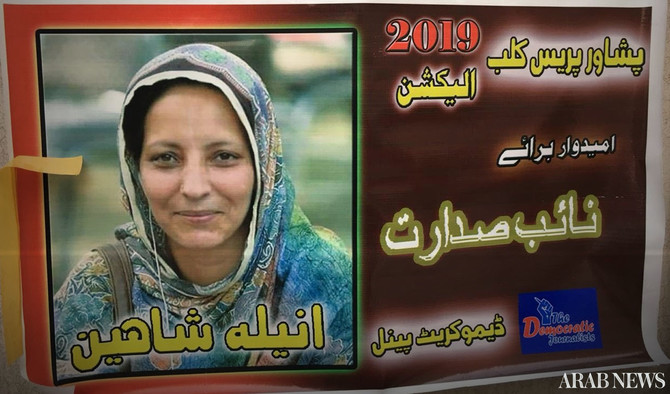
Aneela Shaheen, 38, and a mother of a daughter was crowned with the title after she won the elections on December 29 in Peshawar.
Shaheen, a Sarhad University graduate with majors in Health and Physical Education, began her career as a journalist in 2000 by working for an Urdu-language newspaper, Daily Subh, before moving on to an electronic media platform by becoming a part of Indus and Dunya Television networks.
“Indeed it is an honor and trust upon me but it also needs determination and courage to work with male colleagues particularly in a Pashtun, male-dominated society,” an ecstatic Shaheen told Arab News.
In the 18 years of being a journalist, Shaheen says she has covered all beats except those related to women’s issues. “Since the beginning of my career, I wanted to change the myth about women being weak,” she said. “I worked on [the topic of ] Swat militancy for few months for my organization and broke the stereotypes,” she added.
Shaheen currently works as a freelance journalist, with her last stint being with 24 Television, a media organization. The past year has been grim for the Pakistani media industry with several organizations reducing their headcount as part of cost-cutting measures. However, when 24 Television’s administration decided to sack Shaheen, she chose to resign from her position instead and took to social media to protest against the move.
“Journalism is no more an easy profession and journalists have to fight on many fronts,” she said.
“I, along with my press club colleagues, will formulate an acceptable way for journalists’ job and physical security in this war-torn region,” Shaheen said, adding that “now, we will not allow the owners to sack the media workers with a single verbal order”.
She will work side by side with Syed Bukhar Shah — the newly-elected president of the club.
Shah, a veteran journalist writes for The News International in Peshawar. “Peshawar Press Club members are politically aware and they have the vision and always follow merit,” he told Arab News.
“Aneela is one of the brave journalists among many and that’s why she has beaten her male colleagues,” he said, adding that among the 500 club members, “we have only 30 female members but the Peshawar Press Club appreciates and encourages women journalists”.
“Earning a name in journalism in this part of the world is very hard but without welcoming colleagues, it wasn’t possible for me to stand strong,” Shaheen said.
Founded in 1964, the Peshawar Press Club takes pride in its strive for democracy and freedom of speech. In 2009, a suicide bomber with explosives strapped to his body had tried to bomb the building but was stopped by a security guard. The attack claimed four lives and had damaged the facility too.


Peshawar Press Club elects its first woman VP

Peshawar Press Club elects its first woman VP
- Shaheen cites determination and the courage to work with male colleagues, particularly in a patriarchal Pashtun society, as ingredients to success
- Out of the organization’s 500 members, only 30 are women, newly-elected president says

World Bank approves $400 million to expand water, sanitation services in Pakistan’s Punjab
- Project aims to improve access for 4.5 million people and curb waterborne diseases
- Program to prioritize women’s participation and climate-resilient urban infrastructure
ISLAMABAD: The World Bank this week approved $400 million for a new project to expand access to safe water, sanitation and hygiene services for around 4.5 million people in Pakistan’s most populous Punjab province, aiming to curb waterborne diseases and reduce long-term public health costs.
The project, known as the Punjab Inclusive Cities Program (PICP), is the second phase of the World Bank-supported Pakistan Urban Water, Sanitation and Hygiene Services Multiphase Programmatic Approach. It will focus on rehabilitating water supply networks, sewerage systems and wastewater treatment plants, while expanding stormwater drainage infrastructure across 16 secondary cities in Punjab.
Punjab faces persistent challenges in providing safe drinking water and adequate sanitation, with many urban households relying on contaminated sources. Weak infrastructure and limited hygiene services contribute to high rates of waterborne diseases such as diarrhea, typhoid and hepatitis, which disproportionately affect children and low-income communities.
“Reducing child stunting is essential for Pakistan’s future. Through the Punjab Inclusive Cities Program, we are investing in safe water, sanitation, and hygiene services to break the cycle of malnutrition and disease that holds back so many children from reaching their full potential,” the World Bank quoted its Country Director for Pakistan, Bolormaa Amgaabazar, as saying in a statement.
“In collaboration with the Punjab Government, the program represents a significant step forward in improving urban infrastructure and strengthening local institutions, thereby laying the foundation for healthier communities and a more prosperous Pakistan.”
Child stunting, a form of chronic malnutrition that leaves children too short for their age, is often linked to repeated infections, poor sanitation and unsafe drinking water, and remains a major public health concern in Pakistan.
Beyond water and sanitation, the project will also support solid waste management systems to improve sanitary waste disposal, extending services to an additional two million people in Punjab’s urban areas. The program will strengthen the capacity of local governments, including efforts to improve revenue generation and long-term service sustainability.
“The program complements infrastructure investments with capacity building and revenue generation, helping to ensure that service delivery is well sustained,” the statement quoted Amena Raja, Senior Urban Specialist at the World Bank, as saying.
“It will also help Punjab’s cities better withstand floods and droughts, ensuring urban development is both environmentally responsible and resilient to climate change.”
The program includes a gender-focused component, prioritizing the hiring of women in decision-making roles, establishing gender-compliant service desks and supporting skills development. It also aims to mobilize private capital to support water and sanitation services in Punjab’s secondary cities.
Pakistan has been a member of the World Bank since 1950 and has received more than $48 billion in assistance since. The Bank’s current portfolio in the country comprises 54 projects with total commitments of $15.7 billion, while its private-sector arm, the International Finance Corporation, has invested about $13 billion since 1956.
Earlier this year, Pakistan and the World Bank signed a first-of-its-kind agreement for a plan to focus $20 billion in lending to the cash-strapped nation over the coming decade on development issues like the impact of climate change as well as boosting private-sector growth.