

Sudan’s Bashir tells police not to use excessive force against demonstrators

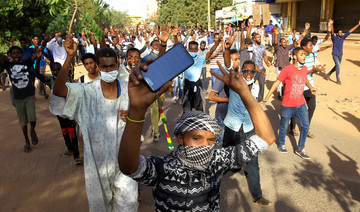
Bashir met top police officers in Khartoum and instructed them to refrain from using excessive force against demonstrators. (AFP)
Updated 30 December 2018
Follow

Sudan’s Bashir tells police not to use excessive force against demonstrators

  • Protesters have rallied after the government raised the price of a loaf of bread from one Sudanese pound to three

KHARTOUM: Sudan’s President Omar Bashir on Sunday told police to abstain from using excessive force against anti-government demonstrators as the UN called for a probe into deaths during the violent protests.

At least 19 people have been killed since Dec. 19 during protests sparked by Khartoum’s decision to hike the price of bread, according to the government.

Rights group Amnesty International says 37 people have died.

On Sunday, Bashir met top police officers in Khartoum and instructed them to refrain from using excessive force against demonstrators.

“We want to maintain security and we want the police to do that by using less force,” Bashir, dressed in a blue police uniform, said.

Protesters have rallied after the government raised the price of a loaf of bread from one Sudanese pound to three (from about 2 to 6 US cents).

Sudan is facing an acute foreign exchange crisis and soaring inflation despite Washington lifting an economic embargo in October 2017.

Inflation is running at 70 percent and the Sudanese pound has plunged in value, while shortages of bread and fuel have regularly hit several cities.

“We admit that we have economic problems... but they can’t be solved by destructions, lootings, and thefts,” Bashir said, referring to buildings and ruling offices torched by protesters in several cities during the demonstrations.

“We don’t want our country to go the way other countries in the region have gone,” he said.

“We will not allow our people to be refugees. If this happens where can we go in this region?”

UN Secretary-General Antonio Guterres appealed “for calm and restraint” and called on “the authorities to conduct a thorough investigation into the deaths and violence,” a UN spokesman said in a statement on Friday.

The UN chief is “following with concern” developments in Sudan and “emphasizes the need to safeguard freedom of expression and peaceful assembly,” the spokesman added.

Iran urges US to drop ‘excessive demands’ to reach deal

Updated 10 sec ago
Follow

Iran urges US to drop ‘excessive demands’ to reach deal

  • Longtime adversaries Iran and the United States held their third round of Omani-mediated nuclear talks on Thursday in Geneva
  • Both Iran and Oman cited progress after the talks, with technical discussions scheduled for Monday in Vienna
TEHRAN: Iran’s Foreign Minister Abbas Araghchi said on Friday that in order to reach a deal, the United States will have to drop its “excessive demands,” after the two sides held talks in Geneva.
In a phone call with Egypt’s top diplomat Badr Abdelatty, Araghchi said “success in this path requires seriousness and realism from the other side and avoidance of any miscalculation and excessive demands.”
Araghchi did not clarify what demands he was referring to, but Washington has pointed to Iran’s ballistic missile program and has repeatedly described Tehran’s uranium enrichment capability as a red line.
US President Donald Trump said on Wednesday that Tehran had “already developed missiles that can threaten Europe and our bases overseas, and they’re working to build missiles that will soon reach the United States of America.”
Also on Wednesday, US Secretary of State Marco Rubio said Iran is “not enriching right now, but they’re trying to get to the point where they ultimately can,” adding that Tehran “refuses” to discuss its ballistic missile program and “that’s a big problem.”
Iran has repeatedly said its missile program is part of its defensive capabilities and has ruled out abandoning uranium enrichment, insisting its nuclear program is solely for peaceful purposes.
Longtime adversaries Iran and the United States held their third round of Omani-mediated nuclear talks on Thursday in Geneva, seeking to avert military escalation as Washington expands its military build-up in the region.
Both Iran and Oman cited progress after the talks, with technical discussions scheduled for Monday in Vienna ahead of a fourth round expected next week.