

SC bans Fethullah Gulen movement in Pakistan

1 / 2
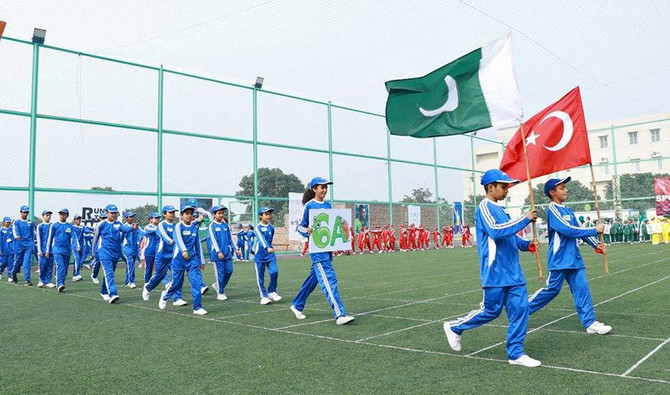
Pak-Turk schools and colleges were launched in 1995 and the group has 28 campuses across Pakistan. (Photo courtesy: Pak-Turk School/Facebook)
2 / 2
The Supreme Court of Pakistan has ordered the government to hand over the FETO-linked schools and other educational institutions to the Turkiye Maarif Foundation.
Updated 28 December 2018
Follow

SC bans Fethullah Gulen movement in Pakistan

  • Turkey had long been urging Islamabad to bar the Fetullah movement in Pakistan
  • Were running a network of “Pak-Turk” educational institutions in the country

ISLAMABAD: Pakistan’s Supreme Court on Friday directed the government to ban the Fetullah Terrorist Organization (FETO) and a foundation linked to the group which runs a network of “Pak-Turk” schools across the country, court order said.
In a 15-page judgment issued on Thursday, Pakistan’s top court also ordered the government to hand over the FETO-linked schools and other education institutions to the Turkiye Maarif Foundation (TMF).
A three-judge bench, headed by Chief Justice of Pakistan Mian Saqib Nisar, heard the petition seeking orders regarding the declaration of Pak Turk International Cag Education Foundation (PTICEP) as a terrorist organization, in compliance with Pakistan’s International Commitments, and the granting of Pak-Turk School’s custody of the TMF along with moveable and immovable assets of the PTICEF.
“We are in no manner of doubt the government of Pakistan has international obligations toward the government of Turkey to declare FETO as a terrorist organization,” the order read.
“We have been informed that the Turkish government declared the PTICEF and its related organizations as FETO. FETO was also recognized as a terrorist organization by the Organization of Islamic Cooperation (OIC) during its 43rd session of the Council of Foreign Ministers at Tashkent,” the court order read.
It added: “Pakistan being a member of the OIC was a part of the declaration and is bound by the same.”

A three-judge bench headed by Chief Justice of Pakistan, Mian Saqib Nisar, heard the petition. (Source: Supreme Court of Pakistan)

Turkey established the Maarif Foundation in 2016 to take over the administration of overseas schools linked to FETO.
Ankara maintains that FETO and its US-based leader, Fethullah Gulen, orchestrated the failed Turkish coup in 2016, a charge which Gulen denies.
Pak-Turk schools and colleges were launched in 1995 and the group has 28 campuses across Pakistan.
Turkey had long been urging Pakistan to ban FETO and it’s elements in the country. In September this year, during his visit to Islamabad, Turkish Foreign Minister Mevlut Cavusoglu had said: “I also stressed upon the importance of completely eradicating the influence of Fethullah Gülen and institutions from Pakistan.”


Ramadan tests Pakistan’s daily wage workers but faith endures

Updated 8 sec ago
Follow

Ramadan tests Pakistan’s daily wage workers but faith endures

  • Reduced work hours during fasting month cut already fragile incomes
  • Charities, local businesses step in as laborers try to support families back home

ISLAMABAD: Abdul Waqif grips a worn-out shovel and digs into the earth beneath the harsh midday sun, his body bent with age but still moving steadily. Moments later, the 70-year-old hoists a heavy bag of cement onto his shoulders and carries it toward an under-construction house, all while fasting.

For Waqif and thousands of daily wage laborers across Pakistan, Ramadan is not just a month of spiritual devotion. It is also a month of shrinking incomes.

Waqif migrated from Mohmand tribal district in northwestern Pakistan to Islamabad two decades ago in search of work. Like many laborers from rural and former tribal areas, he left behind limited local opportunities to earn a living in larger cities such as Islamabad, Lahore and Karachi.

In Pakistan, daily wage workers, particularly in construction and manual labor, are among the most economically vulnerable. They are paid only for days worked, receive no job security or benefits, and often rely on informal arrangements. Any slowdown in economic activity directly affects their ability to feed their families.

Economic activity typically slows during Ramadan, when Muslims fast from dawn to sunset. Employers often reduce work hours or postpone physically demanding projects to ease the burden on fasting workers. While intended as a gesture of consideration, it means fewer working hours and fewer earnings.

For laborers such as Waqif, who earns between Rs1,000-1,200 [$3.59-4.31] per day, even a slight reduction in work can be devastating.

His suhoor, the pre-dawn meal before fasting begins, usually consists of a few chapatis from a nearby hotel. The hunger and thirst that follow him through the day are constant companions as he lifts bricks and mixes cement in the heat.

But so is his faith.

“Allah gives me courage. I am hungry and thirsty, but I keep working,” Waqif said while wiping the sweat off his brow.

Back in Mohmand district, his wife, four daughters and two sons depend on the money he sends home. Every rupee matters.

“I support them with this work,” Waqif said. “I eat three meals a day here and I also have to save money for my children and send it to them.”

The reduction in work during Ramadan weighs heavily on him.

“I don’t find much work in Ramadan, and I’m worried for my family,” Waqif said.

‘HONEST LIVING’

Finding food for suhoor is sometimes a challenge. On some mornings, someone offers him a piece of flatbread. Other times, he buys what little he can afford from a nearby eatery.

Muhammad Sajid, owner of Al-Hadi restaurant in Islamabad’s G-15 sector, says he tries to ease that burden by offering meals to laborers at half price.

“We don’t let anyone go hungry,” Sajid told Arab News. “We offer sehri and iftar as much as anyone can afford.”

The restaurant serves tea, yogurt, several types of curries and parathas.

Charity groups also expand operations during Ramadan, when community support traditionally increases. The Junaid Welfare Foundation runs a roadside dastarkhwan, or communal meal spread, serving hundreds daily.

Haq Rawan Shareefi, a manager at the foundation, said around 500 people are provided iftar meals each day. The cost of one person’s iftar is Rs200 [$0.72].

“That means, on iftar and sehri, our expenses range from Rs150,000 [$538.97] to Rs200,000 [$718.63],” Shareefi said.

For Waqif, breaking his fast at sunset brings temporary relief from the physical strain of the day. But the financial uncertainty remains.

“I ask Allah for this,” he said. “May Allah give me strength to earn honest living for my children.”