

Yemen govt to pay civil servants in militia-held Hodeidah

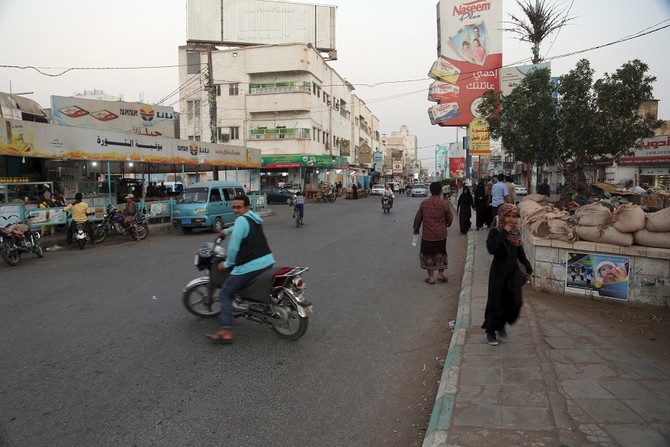
People driving in a market in the Yemeni flashpoint city of Hodeidah. (File/AFP)
Updated 28 December 2018
Follow

Yemen govt to pay civil servants in militia-held Hodeidah

  • For more than two years, the government has been unable to pay salaries and the riyal dropped sharply against the dollar, leaving Yemenis unable to afford food and water
  • Earlier this month, deputy central bank chief Shokeib Hobeishy said that Yemen’s central bank was expecting a $3 billion cash injection from Gulf allies

HODEIDAH: The United Nations on Friday welcomed a decision by Yemen’s government to pay the salaries of civil servants in the militia-held city of Hodeidah starting this month.

For more than two years, the government has been unable to pay salaries and the riyal dropped sharply against the dollar, leaving Yemenis unable to afford food and water.

“President (Abedrabbo Mansour) Hadi’s decision is an important step towards improving the economic situation, and alleviating the humanitarian suffering of the Yemeni people,” the office of the UN special envoy to Yemen Martin Griffiths tweeted.

“The (special envoy) hopes there will be more steps in this direction.”

On Thursday, Hadi instructed the government to “urgently work on paying the salaries of all civil servants in Hodeidah province starting from December”, Saba state news agency reported.

Earlier this month, deputy central bank chief Shokeib Hobeishy said that Yemen’s central bank was expecting a $3 billion cash injection from Gulf allies.

His statement came after a $2.2 billion infusion by Saudi Arabia to stem a slide in the Yemeni riyal.

More than one million civil servants lost their jobs in 2016, when Hadi moved the central bank from the militia-held capital Sanaa to Aden, controlled by the government.

A ceasefire -- agreed at peace talks in Sweden earlier this month -- went into effect in Hodeidah city and its surroundings on December 18 but has remained shaky with the warring sides accusing each other of violations.

An AFP correspondent said on Friday gunfire was heard overnight in the south of the Red Sea city, whose port serves as an entry point for the majority of imports and humanitarian aid to the war-torn country.

“We heard the sounds of jets in the early hours of the morning for a brief 15 minutes, but it has been complete calm since then,” the correspondent said, adding that the situation on the ground remains “tense”.

The conflict between the Iran-aligned Houthi militia and troops loyal to Hadi escalated in 2015, when he fled into Saudi exile and a Saudi-led military coalition intervened.

Since then, the war has killed some 10,000 people, according to the World Health Organization, although human rights groups say the real death toll could be five times as high.

The conflict has unleashed a major humanitarian crisis and pushed 14 million Yemenis to the brink of famine.



Syria Kurds chief says ‘all efforts’ being made to salvage deal with Damascus

Updated 25 December 2025
Follow

Syria Kurds chief says ‘all efforts’ being made to salvage deal with Damascus

  • Abdi said the Syrian Democratic Forces (SDF), the Kurds’ de facto army, remained committed to the deal
  • The two sides were working toward “mutual understanding” on military integration and counter-terrorism

DAMASCUS: Syrian Kurdish leader Mazloum Abdi said Thursday that “all efforts” were being made to prevent the collapse of talks on an agreement with Damascus to integrate his forces into the central government.
The remarks came days after Aleppo saw deadly clashes between the two sides before their respective leaders ordered a ceasefire.
In March, Abdi signed a deal with Syrian President Ahmed Al-Sharaa to merge the Kurds’ semi-autonomous administration into the government by year’s end, but differences have held up its implementation.
Abdi said the Syrian Democratic Forces (SDF), the Kurds’ de facto army, remained committed to the deal, adding in a statement that the two sides were working toward “mutual understanding” on military integration and counter-terrorism, and pledging further meetings with Damascus.
Downplaying the year-end deadline, he said the deal “did not specify a time limit for its ending or for the return to military solutions.”
He added that “all efforts are being made to prevent the collapse of this process” and that he considered failure unlikely.
Abdi also repeated the SDF’s demand for decentralization, which has been rejected by Syria’s Islamist authorities, who took power after ousting longtime ruler Bashar Assad last year.
Turkiye, an important ally of Syria’s new leaders, sees the presence of Kurdish forces on its border as a security threat.
In Damascus this week, Turkish Foreign Minister Hakan Fidan stressed the importance of the Kurds’ integration, having warned the week before that patience with the SDF “is running out.”
The SDF control large swathes of the country’s oil-rich north and northeast, and with the support of a US-led international coalition, were integral to the territorial defeat of the Daesh group in Syria in 2019.
Syria last month joined the anti-IS coalition and has announced operations against the jihadist group in recent days.