ISLAMABAD: With an aim to increase bilateral trade and facilitate the movement of passengers, Pakistan said on Wednesday that it is conducting a feasibility study to connect its northwestern city of Peshawar with Jalalabad in Afghanistan through a 145-kilometer railway track.
The study will look at selecting and designing the most suitable rail link between the two neighboring countries as a majority of the project area is located in the hilly terrain.
“The railway link between Pakistan and Afghanistan will help both the countries improve bilateral trade and facilitate the movement of thousands of passengers who cross the border daily,” Farrukh Habib, Parliamentary Secretary for Railways, told Arab News.
He said the project is in the initial stage and that his government is committed to complete it “as soon as possible.”
Providing details about the project, he said that the proposed design speed is 100 kilometers per hour for passenger trains and 80 kilometers for freight trains. “Afghanistan has already expressed its willingness for the project. It is a project of mutual interest,” he said.
In March 2010, former Afghan President Hamid Karzai assigned priority to the construction of the rail link during his visit to Islamabad. Later in July, Pakistan’s former Federal Railways Minister, Ghulam Ahmed Bilour, and Afghan Finance Minister, Hazrat Omar Zakhilwal signed a memorandum of understanding for the feasibility study of the project.
The proposed study could not be initiated due to several technical and financial issues, Habib said, adding that “we are taking it very seriously now.”
The study will help estimate the present and future freight and passenger railway transportation demand between Peshawar and Jalalabad, in addition to the construction, operations, and maintenance costs of the project.
The economic and financial viability of the project will also be determined through the study, besides the engineering and construction design of the railway track.
Economists and experts on international affairs term the project as one of strategic importance for both Pakistan and Afghanistan, especially in terms of trade and security.
“The bilateral trade between Pakistan and Afghanistan is currently around $2 billion which is negligible …. both the countries can easily increase it to $10 billion in a couple of years, provided the smuggling is curtailed and business is channeled through the official routes like the proposed rail link,” Dr. Athar Ahmed, a senior economist, told Arab News.
He said that Afghanistan is a landlocked country and “it needs connectivity with its neighboring countries to boost its trade and economy.”
“Pakistan can increase its exports of fruit, vegetables, machinery, textile goods and a lot more to Afghanistan through the railways,” he added.
Pakistan Tehreek-e-Insaf government, under the leadership of Prime Minister Imran Khan, has been struggling to enhance bilateral trade and business with its neighboring countries, but it has yet to allow an India-Afghanistan trade route through Pakistan.
US Ambassador to Afghanistan, John Bass claimed in an interview in September this year that Pakistan had expressed its willingness to allow trade between Afghanistan and India through its land route.
“Pakistani government expressed a willingness to start talking with its Afghan counterparts for parameters to enabling trade between India and Afghanistan through Pakistan,” the US ambassador had said at the time.
Pakistan’s Foreign Office, however, rejected the impression, saying: “Pakistan has not agreed to consider Afghanistan-India trade through our land.”
Professor Tahir Malik, an academic and an expert on international affairs, said that Pakistan, India, and Afghanistan should join hands for the betterment and prosperity of their people. “The proposed railway track from Peshawar to Jalalabad has strategic importance, and Pakistan can earn millions of dollars just by allowing India to use this track for trade with Afghanistan,” he told Arab News.


![]()
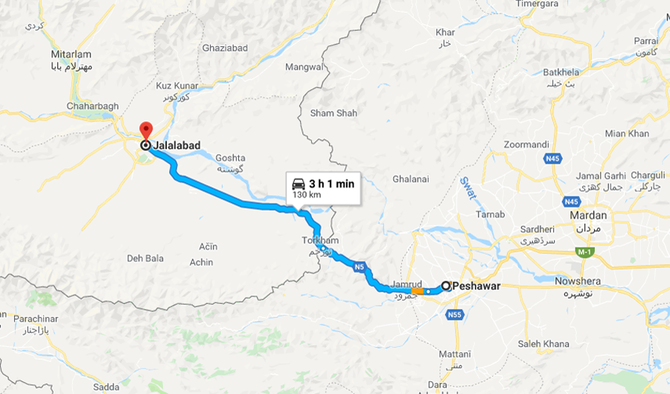
New railway track to connect Pakistan with Afghanistan
New railway track to connect Pakistan with Afghanistan
- Feasibility study to estimate freight and passenger demand between Peshawar and Jalalabad, among other things
- Experts say Islamabad can earn millions of dollars by allowing India to use the rail link for trade with Kabul
Latest updates


© 2026 SAUDI RESEARCH & PUBLISHING COMPANY, All Rights Reserved And subject to Terms of Use Agreement.