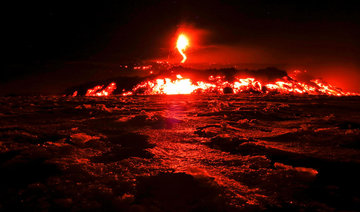
ROME: Italy's Catania airport resumed full operations a day after an ash cloud from Mount Etna's latest eruption forced it to shut down, while fiery red lava could be seen shooting from the volcano in eastern Sicily on Tuesday.
Ashes coated streets and sidewalks in the mountain towns of Zafferana Etnea and Santa Venerina. No evacuations of residents, many of whom work on farms or in tourism, were ordered.
At least 300 tremors rattled the slopes of the volcanic mountain during a three-hour span early Monday, including a magnitude 4.3 seismic shake, Italy's National Institute of Geophysics and Volcanology said.
Tremors continued Tuesday, but they were less powerful.
A new, 2-kilometer (1.25 mile) fissure opened up Monday on a stretch of uninhabited slope near Mount Etna's southeast crater.
On Monday, hikers were brought down from the volcano's higher elevations for their safety.
Etna has been particularly active since July.
Another volcano, Stromboli, on an inhabited Italian island of the same name and part of an archipelago north of Sicily, has shown increased activity of late, Italy's national Civil Protection agency said Monday.

Sicilian airport reopens amid Mount Etna's latest eruption
- Ashes coated streets and sidewalks in the mountain towns
British navy says it tracked Russian sub for three days in Channel
- The Russian ships had arrived from the North Sea and entered the Channel.
- “Expert aircrew were prepared to pivot to anti-submarine operations if Krasnodar had dived below the surface,” the statement said
LONDON: The British navy said Thursday it tracked a Russian submarine navigating through the Channel for three days, as it steps up efforts to police its seas against such threats.
A British naval supply ship with an on-board helicopter was deployed to track the stealthy Kilo-class submarine Krasnodar and the tug Altay, the Royal Navy said in a statement.
The Russian ships had arrived from the North Sea and entered the Channel.
“Expert aircrew were prepared to pivot to anti-submarine operations if Krasnodar had dived below the surface,” the statement said.
But it sailed on the surface throughout the operation, despite unfavorable weather conditions.
Near the island of Ouessant, off northwest France, the British said they handed over monitoring of the vessels to a NATO ally, without saying which one.
The British military carried out a similar shadowing operation in July, after spotting the Russian sub Novorossiysk in its territorial waters.
Defense minister John Healey announced on Monday the launch of a multi-million pound program to improve the Royal Navy’s capabilities in the face of Moscow’s “underwater threats.”
According to London, Russian submarine activity in British waters has increased by about a third over the past two years.
In early December, the UK and Norway signed a cooperation agreement to jointly operate a fleet of frigates to “hunt down” these submarines in the North Atlantic.