Iraqi Christians celebrate Christmas one year after Daesh defeat

1 / 4
A man dressed in a Santa Claus outfit touring a popular neighborhood on the outskirts of the Iraqi central city of Najaf, takes children on a ride in a tuktuk on December 25, 2018. (AFP)
2 / 4
Iraqis attend Christmas Mass in Mar Youssif Chaldean Church, in Baghdad, Iraq, Tuesday, Dec. 25, 2018. (AP)
3 / 4
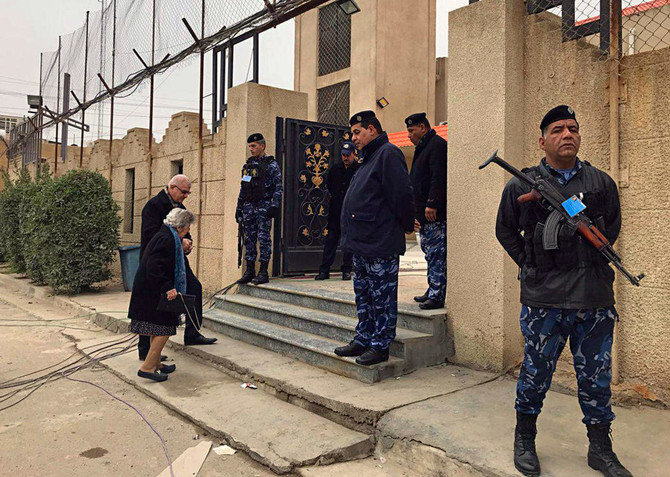
Security forces stand guard before Christmas Mass outside Mar Youssif Chaldean Church in Baghdad, Iraq, Tuesday, Dec. 25, 2018. (AP)
4 / 4
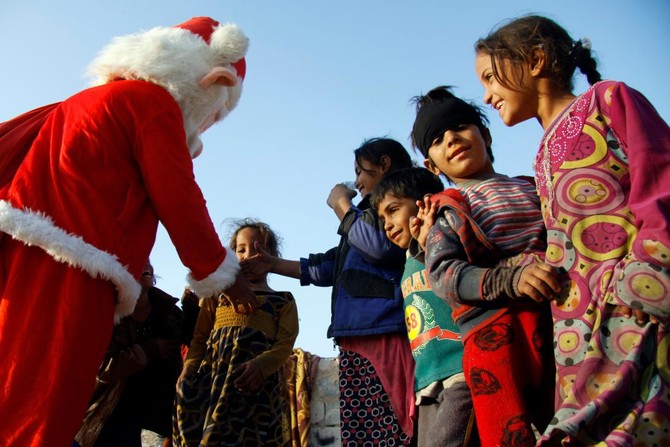
A man dressed in a Santa Claus outfit touring a popular neighbourhood on the outskirts of the Iraqi central city of Najaf, distributes small gifts to children on December 25, 2018. (AFP)
Updated 26 December 2018
Follow

Iraqi Christians celebrate Christmas one year after Daesh defeat

  • War and sectarian conflict shrank Iraq’s Christian population from 1.5 million to about 400,000 after the US-led invasion in 2003
  • Iraq is home to many different eastern rite churches, both Catholic and Orthodox

BAGHDAD: Iraqi Christians quietly celebrated Christmas on Tuesday amid improved security, more than a year after the country declared victory over Daesh militants who threatened to end their 2,000-year history in Iraq.
Christianity in Iraq dates back to the first century of the Christian era, when the apostles Thomas and Thaddeus are believed to have preached the Gospel on the fertile flood plains of the rivers Tigris and Euphrates.
Iraq is home to many different eastern rite churches, both Catholic and Orthodox, traditionally a sign of the country’s ethnic and religious diversity.
But war and sectarian conflict shrank Iraq’s Christian population from 1.5 million to about 400,000 after the US-led invasion in 2003. Following the onslaught of Daesh in 2014 and the brutal three-year war that followed their numbers have fallen further, though it is not known exactly by how much.
In Baghdad, Christians celebrated mass on Tuesday morning — declared a national holiday by government — in churches decorated for Christmas. Once fearful, they said they were now hopeful, since conditions had improved.
“Of course we can say the security situation is better than in previous years,” said Father Basilius, leader of the St. George Chaldean Church in Baghdad where more than a hundred congregants attended Christmas mass.
“We enjoy security and stability mainly in Baghdad. In addition, Daesh was beaten.”
Iraq declared victory over the militants more than a year ago, but the damage done to Christian enclaves on the Nineveh Plains has been extensive.
In Qaraqosh, a town also known as Hamdaniya which lies 15 km (10 miles) west of Mosul, the damage is still visible.
At the city’s Immaculate Church, which belongs to the Syrian Catholic denomination and has not yet been rebuilt since the militants set it on fire in 2014, Christians gathered for midnight mass on Monday, surrounded by blackened walls still tagged with Daesh graffiti.
Dozens of worshippers prayed and received communion, and then gathered around the traditional bonfire in the church’s courtyard.
Before the militant onslaught, Qaraqosh was the largest Christian settlement in Iraq, with a population of more than 50,000. But today only a few hundred families have returned.
Faced with a choice to convert, pay a tax or die, many Christians in the Nineveh Plains fled to nearby towns and cities and some eventually moved abroad.
Some have since returned, Father Butros said, adding: “We hope that all displaced families will return.”


Baghdad traders protest new customs tariffs

Iraqi traders protest against the imposition of customs duties on imported goods in Baghdad, Iraq, Sunday, Feb. 8, 2026. (AP)
Updated 57 min 51 sec ago
Follow

Baghdad traders protest new customs tariffs

  • The demonstrators gathered outside the General Customs Directorate on Sunday, chanting slogans against corruption and rejecting the new fees

BAGHDAD: Hundreds of traders and owners of customs clearance companies protested in central Baghdad on Sunday, demanding that Iraq’s government reverse recently imposed customs tariffs they say have sharply increased their costs and disrupted trade.
The new tariffs that took effect on Jan. 1 were imposed to reduce the country’s debt and reliance on oil revenues, as oil prices have fallen.
Iraq faces a debt of more than 90 trillion Iraqi dinars ($69 billion) — and a state budget that remains reliant on oil for about 90 percent of revenues, despite attempts to diversify.

We used to pay about 3 million dinars per container, but now in some cases they ask for up to 14 million.

Haider Al-Safi, Company owne

But traders say the new tariffs — in some cases as high as 30 percent — have placed an unfair burden on them. Opponents have filed a lawsuit aiming to reduce the decision, which Iraq’s Federal Supreme Court is set to rule on Wednesday.
The demonstrators gathered outside the General Customs Directorate on Sunday, chanting slogans against corruption and rejecting the new fees.
“We used to pay about 3 million dinars per container, but now in some cases they ask for up to 14 million,” said Haider Al-Safi, a transport and customs clearance company owner. 
“Even infant milk fees rose from about 495,000 dinars to nearly 3 million.”
He said that the new tariffs have caused a backlog of goods at the Umm Qasr port in southern Iraq and added that electric vehicles, previously exempt from customs duties, are now subject to a 15 percent fee.
“The main victim is the citizen with limited income, and government employee whose salary barely covers his daily living, those who have to pay rent, and have children with school expenses — they all will be affected by the market,” said Mohammed Samir, a wholesale trader from Baghdad.
Protesters also accused influential groups of facilitating the release of goods in exchange for lower unofficial payments, calling it widespread corruption. 
Many traders, they said, are now considering routing their imports through the Kurdistan region, where fees are lower.
The protests coincided with a nationwide strike by shop owners, who closed markets and stores in several parts of Baghdad to oppose the tariff increase. 
In major commercial districts, shops remained shut and hung up banners reading “Customs fees are killing citizens.”